

Like the gears of a well-built clock, every part of your business needs to connect for the whole system to keep time. A connected business model links your strategy to everyday behaviors through visible systems, clear accountability, and consistent feedback loops, so execution isn’t left to chance. When you understand how these elements interact, you’ll see why most strategies don’t fail at the planning stage—they fail where intention meets action, and what you can do about it.
Key Takeaways
- The Connected Business Model directly links strategy to daily work, making execution visible and owned rather than assumed.
- It hardwires accountability into operations through governance rhythms, reducing reliance on individual heroics for results.
- Cultural values are translated into observable behaviors like response speed, quality checks, and handoff standards demonstrated daily.
- Interaction design aligns systems and touchpoints so experiences feel intuitive through feedback loops, consistency, and behavioral clarity.
- Relationships serve as connective tissue across internal, ecosystem, and customer domains, enabling value flow and organizational alignment.
What Is a Connected Business Model?
A Connected Business Model isn’t a slide deck or a slogan—it’s the system that links strategy directly to the work people do every day, making execution visible and owned rather than assumed.
A Connected Business Model links strategy to daily work—making execution visible, owned, and never assumed.
It hardwires accountability into your operations so results don’t depend on heroics or individual effort alone. When paired with visual management tools, it turns strategy and culture into concrete signals, dashboards, and workflows that make performance expectations unmistakably clear in real time.
When you’re running without a Connected Business Model, you’ll notice great plans followed by inconsistent execution, and performance problems that surface only after the damage is done.
When it’s in place, you can see where execution breaks down early—before performance slips—because the model translates your cultural expectations into observable behaviors and connects them directly to strategic outcomes.
You’re not reacting to surprises; you’re closing gaps in advance.
Why Strategy Falls Apart Without Connected Execution
Most leaders don’t have a strategy problem—they have a connection problem, and the difference matters more than you’d think. When your strategy isn’t linked to daily work, the execution gap stays hidden until outcomes slip, and by then you’re reacting instead of adjusting.
You’ll notice performance issues showing up as late surprises because there’s no system translating strategic priorities into consistent behaviors and routines. Without that connective tissue, results depend on individual heroics rather than predictable processes. By embedding governance rhythms and regular progress tracking into daily operations, you create an early-warning system that surfaces misalignment before it erodes outcomes.
A connected execution model changes this by building accountability directly into how work gets tracked and delivered, so you can identify what’s breaking down before damage compounds. The insight arrives before the slip—not after—giving you time to course-correct.
How a Connected Business Model Aligns Culture and Daily Work
When culture stays disconnected from how people actually work, it becomes a poster on the wall instead of a force that shapes results. A Connected Business Model changes this by translating cultural values into observable, repeatable behaviors—things like response speed, quality checks, and handoff standards that you can actually see and measure during the workday. When culture, systems, and routines are aligned with operational realities, strategy and execution reinforce each other instead of pulling in opposite directions.
Instead of hoping your team embodies company values, you’re defining what those values look like in practice and connecting them directly to operational processes. This means culture isn’t something you talk about quarterly; it’s something your teams demonstrate daily.
When you tie expected behaviors to the work itself, accountability becomes built into the system rather than dependent on individual initiative or occasional management intervention.
What Happens When Pipelines Give Way to Interaction Fields?
Because traditional pipeline models assume customers move through a neat, linear sequence—from awareness to contemplate to purchase—they tend to treat demand as something the business generates and pushes forward through its own internal value chain.
When you shift to an interaction field, three things change immediately:
- Demand becomes a continuous swarm of cross-platform actions—scrolling, searching, sharing, co-creating—rather than a predictable funnel you control from end to end.
- Value is co-created by customers, partners, and institutions in an open ecosystem, so you’re orchestrating contributions instead of producing everything internally.
- Scaling depends on coordinating data and interactions across stakeholders, not on owning every touchpoint yourself.
This means your interface functions as the business itself, and execution visibility arrives earlier because you can identify the next needed closure before performance slips. In this environment, visual management boards become critical for surfacing real-time interaction patterns and coordinating rapid, cross-functional responses.
How Interaction Design Powers a Connected Business Model
Recognizing that the interface now functions as the business itself raises a pointed question: what discipline actually shapes how people, data, and systems behave at the moment of use?
That discipline is Interaction Design (IxD), and it choreographs every exchange where your brand promise is either fulfilled or broken.
IxD operates through five dimensions—words and visuals, space and time context, behavior paired with system reactions, feedback loops, and discoverability patterns—that together align daily behaviors with your connected strategy.
When you apply these dimensions well, interactions become invisible because they’re intuitive, shifting users from “how do I do this?” to “what outcome am I achieving?”
You’re not designing screens; you’re designing the participation and co-creation that drive strategic growth.
By treating key interaction touchpoints as living visual management systems, IxD gives teams real-time, at-a-glance feedback that links user behavior, system performance, and strategic objectives into a single, coherent experience.
Why the Best Connected Business Models Feel Invisible
Although you might assume the best connected business models impress users through visible sophistication, the opposite is true—they succeed precisely because people stop noticing them.
The best connected experiences don’t dazzle you—they disappear, letting you focus entirely on what you came to do.
Invisibility emerges when interaction design makes every touchpoint so intuitive that users focus on outcomes, not mechanics.
Three forces drive this invisibility:
- Timely feedback and intent anticipation—the system confirms your actions instantly and guesses your next move correctly, eliminating friction before you feel it.
- Consistent behavior across the ecosystem—familiar patterns reduce cognitive load whether you’re switching screens, devices, or service channels.
- Pre-wired accountability—connected systems surface what needs to close before performance slips, so fewer surprises hit you after the fact.
Disney’s MagicBand illustrates this well: connectivity eliminates repeat transactions while pre-programmed access delivers delight without visible fulfillment overhead.
In the background, this invisibility depends on robust integrated business planning and shared data foundations that keep every touchpoint aligned without demanding extra effort from users.
Five Dimensions That Shape Interactions in a Connected Business Model
That sense of invisibility doesn’t happen by chance—it’s the outcome of five interaction-design dimensions working together as a single cohesive system. These dimensions are words and imagery, physical items, space, and time, behavior, feedback, and consistency and findability pathways, and each one shapes how you engage with the model.
Words and imagery ensure you understand what’s possible and what to do next through clear labeling of states, actions, and outcomes.
Physical items, space, and time recognize that your device context, layout, and response latency change how an interaction feels—slow responses weaken trust regardless of how polished the interface looks.
Behavior translates the business model into dependable system reactions, mechanics, and action rules so you can complete tasks without unnecessary effort.
When these dimensions are designed in concert, they reinforce organizational alignment by ensuring that strategy, systems, and day-to-day interactions all pull in the same direction.
Why Relationships Are the Connective Tissue of a Connected Business Model
Because every dimension of interaction design ultimately depends on people choosing to participate, the relationships you build across your connected business model function as its connective tissue—they’re what hold the entire system together and allow value to flow between participants rather than being pushed through a single firm-controlled pipeline. When these relationships are intentionally nurtured, they drive organizational alignment that improves collaboration, speeds decision-making, and directly contributes to faster revenue growth.
You need to manage relationships across distinct yet overlapping domains:
- Internal alignment with your team and stakeholders ensures clearer ownership and fewer execution surprises, since trust reduces the friction that stalls daily follow-through.
- Ecosystem and partner relationships built on shared goals create mutual benefit and act as enduring currency that builds resilience during market shocks.
- Client and customer relationships where buyers actively co-create value generate faster feedback loops that fuel continuous innovation.
Without deliberate relationship nurturing, even strong technology becomes a hollow shell.
How a Connected Business Model Turns Learning Into a Competitive Edge
Relationships hold your connected business model together, but what keeps it moving forward is learning—specifically, the kind of structured, continuous learning that compounds over time and becomes harder for competitors to replicate.
Every connected interaction you create, whether through wearables, smartphones, or embedded sensors, generates data that feeds two learning loops.
Every connected interaction generates data that feeds two learning loops—one personal, one collective—compounding your advantage with each touchpoint.
At the individual level, each touchpoint improves how you personalize the experience for that specific customer.
At the population level, aggregated insights across similar customers refine your entire system’s intelligence.
This dual-loop structure means your model doesn’t just collect information—it converts patterns into operational changes before performance slips.
Competitors can’t simply buy the same technology and catch up, because your advantage lives in the depth of adoption and the closed-loop learning it’s already produced.
As companies like Tesla, Airbnb, and PayPal demonstrate, sustained advantage emerges when strategy and execution are tightly aligned so that every new data point can be rapidly translated into better products, services, and customer experiences.
How LinkedXL-OS Makes Connected Execution Visible
Learning loops only create lasting value when you can see exactly where execution connects to strategy and where it falls apart. LinkedXL-OS makes your Connected Business Model visible by mapping strategy intent directly to the daily work steps, owners, and interfaces responsible for delivering results.
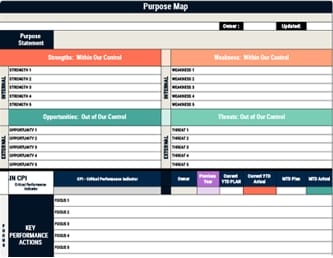
Rather than relying on after-the-fact reporting, LinkedXL-OS surfaces execution-failure signals at the point of breakdown, giving you earlier insight into what needs to close. It does this by linking your Critical Performance Indicators to the specific KPIs and daily KPAs that teams manage in real time.
Here’s what that visibility produces:
- Clearer ownership — you can observe who’s accountable for each work step instead of depending on heroics.
- Earlier gap detection — performance slips are identified before results degrade.
- Connected outcomes — consistent follow-through replaces fragmented execution.
Explore how this works in practice at [linkedxl.com](https://linkedxl.com).
Frequently Asked Questions
How Is Strategy Connected to Business Models and Tactics?
You connect strategy to your business model by aligning your value proposition, resources, processes, and profit formula so they directly serve your strategic goals, and you then translate those goals into specific tactics—like frictionless customer experiences or continuous data-driven adjustments—that reshape daily operations.
This linkage ensures you don’t just plan but systematically execute, closing the gap between intent and action through accountable, observable behaviors at every level.
What Is the Link Between Business Model and Business Strategy?
Your strategy defines *where* and *how* you compete, while your business model specifies the value proposition, resources, processes, and profit formula that make that competitive advantage repeatable.
The link between them is accountability—strategy sets the target outcomes you’re pursuing, and the business model hardwires execution so results aren’t random.
If your model can’t deliver your strategic vision, you’ll need to transform its components rather than simply optimize what already exists.
Conclusion
When strategy and daily work part ways, even the most promising plans quietly fade into irrelevance. You can prevent this gentle departure by connecting your systems, behaviors, and governance rhythms so that execution stays visible and owned rather than left to chance. A connected business model doesn’t let misalignment linger in the shadows—it surfaces gaps early, keeps accountability front and center, and turns your strategy into something your people live every day.