

Whether you’re struggling to connect boardroom goals to shop-floor actions, failing to sustain momentum past Q1, or watching strategic plans collect dust, Hoshin Kanri offers a disciplined fix. This Japanese strategy-deployment method doesn’t just set targets—it builds a structured cascade from breakthrough objectives down to daily work, using tools like catchball, the X-matrix, and weekly PDCA cycles. What makes it work isn’t complexity; it’s what most leaders skip.
Key Takeaways
- Hoshin Kanri connects an organization’s long-term breakthrough goals to daily frontline work through structured strategy deployment.
- Leaders define a True North vision, then distill three-to-five-year objectives into five or fewer measurable annual targets.
- Catchball ensures two-way dialogue between executives and teams, refining each goal until it is realistic, measurable, and owned.
- The X-matrix visually links breakthrough objectives, annual targets, improvement projects, and KPIs with one owner per objective.
- A weekly PDCA rhythm prevents strategic plans from going static by driving course corrections based on actual progress.
What Hoshin Kanri Is and How It Works
At its core, Hoshin Kanri is a Japanese management method—sometimes called policy deployment or strategy deployment—that connects an organization’s long-term breakthrough goals to the daily work happening on the front lines. You’re building a clear line of sight from executive vision down to every team’s priorities. The result is stronger organizational alignment, where a cohesive workforce is unified around strategic goals, driving faster revenue growth and higher profitability.
The process starts when leaders define a “true north” vision, then set three-to-five-year breakthrough objectives and annual targets. You don’t just hand these down—you use a two-way dialogue called catchball, where teams push back, refine assumptions, and take genuine ownership.
This back-and-forth ensures goals are both ambitious and feasible. The result is an aligned organization where everyone understands how their work drives strategic outcomes, not just operational tasks.
Why Most Strategy Deployment Fails
Even though most leaders believe they’ve deployed a strategy once they’ve shared a vision and set targets, the reality is that true strategy deployment fails far more often than it succeeds—and the root causes aren’t mysterious.
You’ll find deployment breaks down when there’s no genuine catchball process, so leadership assumes alignment while teams guess at priorities using outdated assumptions.
Execution stalls without an honest PDCA cadence because reviews become status updates instead of a working rhythm.
When PDCA becomes a status meeting instead of a working rhythm, execution quietly dies.
Your dashboards can show green while strategic results stay flat, creating false confidence through misleading metrics that count activity rather than breakthrough progress.
Perhaps most critically, you’re asking people to deliver new priorities without rewiring processes, ownership, or incentives—demanding different results inside an unchanged system.
Sustainable strategy deployment only takes hold when leaders integrate operational realities into planning, involving frontline experts early so that strategic goals, measures, and initiatives are grounded in how the work actually gets done.
Use Catchball to Align Hoshin Kanri Priorities
Because strategy deployment collapses when leaders assume alignment instead of building it, catchball exists as the structured dialogue process that bridges the gap between executive intent and frontline reality. Executives “throw” breakthrough objectives and annual targets to middle teams, who “catch” them by evaluating feasibility, identifying obstacles, and proposing supporting tactics. This back-and-forth continues until both sides reach genuine consensus on what’s achievable and how resources should flow. You’ll use catchball to refine objectives before execution begins, not after teams have already guessed at priorities. The process feeds directly into your X-matrix, linking breakthrough goals to annual objectives and improvement projects that teams believe they can deliver. This disciplined iteration transforms top-down directives into shared ownership across every level. By using catchball to clarify individual contributions and connect objectives to daily work, you reinforce alignment and accountability throughout the organization.
Map Your Hoshin Kanri X-Matrix Step by Step
Once catchball has produced genuine consensus on what’s achievable, you need a single document that locks those agreements into a visible, accountable structure—and that’s exactly what the Hoshin Kanri X-matrix does.
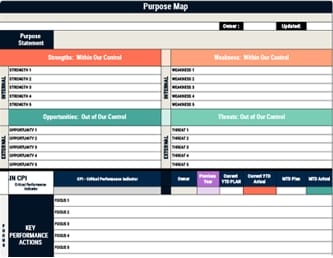
Start by placing your three-to-five-year breakthrough objectives in the south quadrant, then map each one to specific annual targets in the west quadrant.
In the north quadrant, list the improvement projects and tactics that’ll drive those annual targets, and in the east quadrant, assign the KPIs you’ll use to check progress.
Every metric should tie directly to an improvement priority, not generic activity.
By integrating X-matrix reviews into your visual management boards, you turn the document into a real-time performance dashboard that keeps strategy execution visible and actionable for the entire team.
Finally, use the correlation markers at each intersection to confirm linkage, and assign a single accountable owner per annual objective so escalation paths remain unambiguous when you review the matrix monthly.
Run Weekly PDCA to Keep Hoshin Kanri on Track
Too often, Hoshin Kanri objectives end up frozen in a slide deck or pinned to a wall where no one checks them—and that’s precisely why you need a real weekly PDCA rhythm that forces your team to plan, do, check, and act against the breakthrough and annual targets you locked into the X-matrix. During “Check,” validate whether your KPIs are actually moving targets, because dashboards can show green while results stay flat. When metrics reveal persistent stalling—often from leaders assuming vision translates perfectly or teams guessing priorities from outdated beliefs—trigger “Act” course corrections immediately. Execute fewer priorities at once; this discipline drives roughly 30% more improvement cycle completions annually. Treat each review as problem-solving, not status reporting: ask what worked, what didn’t, and whether you need a strategic reset. A disciplined weekly PDCA cadence also reinforces transparency and accountability through metrics, ensuring that progress is visible, debated, and acted on rather than assumed.
Pick Hoshin Kanri Metrics That Actually Matter
Your weekly PDCA rhythm only works if the metrics feeding it actually reflect strategic progress, so picking the right measures for your Hoshin Kanri deployment deserves the same rigor you’d give to setting the breakthrough goals themselves. Choose KPIs that directly indicate progress toward your X-matrix breakthrough goals rather than tracking activity volume that masks stalled outcomes. Balance key process indicators across input, process, and output dimensions so your dashboard can’t show green while strategic results stay flat. Define each metric to discourage gaming by selecting measures that reinforce genuine problem-solving behaviors. Run monthly data-driven checkpoints to course-correct when assumptions fail. When you design your Hoshin Kanri metric set by starting from Critical Performance Indicators and then cascading to KPIs and daily behaviors, you prevent measurement overload and ensure every action ties back to what truly defines success. You’ll know your metric set works when fewer, better-focused projects drive roughly 30% more improvement cycle completions annually.
Start Hoshin Kanri Without Overcomplicating It
Before you map every process, build elaborate dashboards, or draft a 40-page deployment plan, strip Hoshin Kanri back to its core purpose: aligning a small number of breakthrough goals from leadership through frontline teams so everyone pulls in the same direction. When you do this well, you’re effectively creating organizational alignment by linking strategy, structure, and daily work so teams stay focused on shared priorities.
Start with your True North vision, then identify three to five year breakthrough objectives and distill them into five or fewer annual targets.
Use catchball to pressure-test those targets through two-way dialogue between executives and frontline managers until each goal is realistic, measurable, and owned.
Assign one explicit owner per objective so accountability never gets diluted.
Track progress through monthly PDCA reviews that prioritize learning over presentations, and connect everything with a lightweight X-matrix rather than layering on additional tools you don’t need yet.
Frequently Asked Questions
What Is Hoshin Kanri Strategy Deployment?
Hoshin Kanri strategy deployment is a Japanese management method you use to align your long-term strategic vision with daily operations through structured two-way dialogue called “catchball,” where leaders and teams cascade breakthrough objectives into focused annual targets.
You’ll run PDCA-based review cycles—monthly and annually—using data-driven metrics to track progress, ensuring you’re concentrating resources on a few essential priorities rather than spreading effort across too many initiatives.
What Are the Four Phases of Hoshin Planning?
Imagine a plant manager who cut lead time 40% in three years by following these four phases.
First, you set True North by defining 3–5 year breakthrough objectives.
Next, you run catchball to cascade annual targets through two-way dialogue.
Then, you execute with PDCA cadence****, assigning clear ownership and weekly reviews.
Finally, you review and course-correct, using the right KPIs to close gaps before results stall.
What Are the Steps of Hoshin Kanri?
You’ll follow five core steps: first, you set breakthrough objectives** that translate your mission into 3–5 year goals cascaded into annual targets. Next, you run catchball** to align leadership proposals with team-level feasibility.
Then, you execute by deploying clear tactics tied to those objectives. After that, you review progress monthly through data-driven PDCA cycles.
Finally, you continue the cycle, maintaining strategy-to-project links using tools like the X-matrix.
What Are the Core Principles of Hoshin?
Think of Hoshin’s core principles as the “guardrails” that keep your strategy from drifting off course. You’ll align every level of the organization to a shared “true north” through catchball dialogue, limit your focus to five or fewer breakthrough objectives, assign clear ownership and data-driven KPIs to each goal, and embed PDCA cycles so you’re continuously checking results and adjusting your approach rather than simply hoping plans succeed.
Conclusion
The theory that strategy fails at execution, not at planning, holds up under scrutiny—and Hoshin Kanri exists precisely because of that reality. You now have a framework that connects your breakthrough objectives to daily work through catchball, the X-matrix, and weekly PDCA cycles. Don’t wait for perfect conditions; start with one objective, align your team, measure what matters, and let the discipline of the process sharpen your strategy over time.