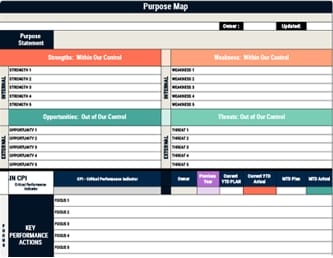


You can’t manage execution by counting tasks completed or hours logged—those numbers tell you people are busy, not that they’re making progress toward the right outcomes. The gap between activity and execution is where most strategies quietly fall apart, and it widens every week you’re watching the wrong metrics. What follows is a framework for identifying the specific signals that separate real momentum from well-organized motion.
Key Takeaways
- Track plan-to-result conversion by measuring milestone velocity and planned-versus-actual variance weekly, not just activities like tickets closed.
- Use the decision-speed filter: if a metric wouldn’t change a decision within two weeks, it’s vanity, not execution.
- Pair leading signals like pipeline coverage and cycle time with lagging outcomes such as revenue, retention, and NPS.
- Set Green/Yellow/Red thresholds on every execution metric and automate alerts so Red triggers immediate strategic review.
- Build a single source of truth syncing CRM and financial data so every metric traces back to common underlying records.
Why Most Teams Measure Activity Instead of Execution
Most teams default to measuring activity because it’s the easiest thing to count—tickets closed, meetings held, lines of code written, emails sent—but none of these prove that real outcomes like retention, revenue growth, NPS improvement, or margin uplift are actually happening.
You’re tracking motion, not progress.
The problem becomes visible when your activity metrics improve but your lagging outcomes don’t move.
Customer churn stays flat, NPS declines, and revenue misses forecast by more than 20%.
Churn holds steady, NPS drops, revenue misses by 20%—and your dashboard still says everything’s fine.
That gap tells you something critical: your team is busy, but it isn’t converting work into business value.
You’re implicitly testing the wrong hypothesis at scale, and the activity dashboard is giving you false confidence that everything’s working.
Instead of piling on more activity metrics, you need to anchor execution to a small set of Critical Performance Indicators that define success, then cascade supporting KPIs and daily actions from there.
What Execution Metrics Track That Activity Metrics Miss
Execution metrics close the gap between motion and progress by tracking whether your work actually converts into the outcomes you planned for. Instead of counting tickets closed or emails sent, you’re measuring plan-to-result conversion—starting at a milestone and checking if you’ve hit targets like active users by a specific date. This lets you detect drift when results land 20% off forecast rather than celebrating raw throughput. Delivery-focused KEIs like milestone velocity and cycle time verify your speed of execution toward business impact. When you layer in thresholds—Green, Yellow, Red—you’ll trigger tactical adjustments the moment performance drops rather than masking problems with busy work. You’re tracking what moves the business, not what’s easiest to count. By pairing execution metrics with visual management boards, you make progress and gaps immediately visible, reinforcing accountability and enabling faster strategic course corrections.
Vanity Metrics vs. Execution Metrics: A Quick Filter
Not every number that goes up means your team is winning—and that’s the trap most dashboards set for you. To separate vanity metrics from execution metrics, run each number through these filters:
- Decision speed: If the metric wouldn’t change a decision you’d make within one to two weeks, it’s vanity.
- Outcome linkage: If you can optimize the metric without improving customer value, retention, or revenue, it’s vanity.
- Leading signal: Execution metrics like milestone velocity or pipeline coverage give you early warning, not just a rearview mirror.
- Lagging validation: Back every leading metric with a lagging outcome—NPS, churn reduction, or margin uplift—so activity alone can’t fool you.
- Connect your execution metrics directly to strategic objectives so every number reinforces alignment from the C-suite roadmap down to frontline action plans.
Apply both filters together, and you’ll strip your dashboard down to numbers that actually drive results.
Daily Execution Signals That Predict Future Results
Between the weekly milestones you’ve set and the monthly outcomes you’re chasing, there’s a daily layer of execution signals that tells you—before it’s too late—whether you’re actually on track. Start by tracking lead-generation activity that directly predicts pipeline: calls made, follow-ups completed, and next-step meetings confirmed. Then monitor milestone velocity weekly—specifically the percentage of agreed tasks completed—so slowdowns surface before they derail monthly targets. If you’re in Phase 1, watch retention and NPS inputs daily because sub-25% eight-week retention signals a product-market fit problem that blocks everything downstream. Finally, treat cash conservation as an execution metric by reconciling daily spend against remaining runway, ensuring burn-rate drift never surprises you after the damage is done. To keep these execution signals visible and actionable, translate them into a simple daily visual management board using color-coded indicators so the team can spot deviations and intervene immediately.
Financial Metrics That Prove Your Execution Plan Works
While daily execution signals give you early warnings, financial metrics are the proof that your plan actually works—or the evidence that it doesn’t.
Focus on these four measures:
- Revenue growth vs. target—treat a greater than 20% miss as evidence your execution plan is failing, not just a bad month.
- Burn rate and runway—divide cash on hand by monthly spend (e.g., $150k ÷ $15k/month = ~10 months) and maintain at least six months of runway before scaling.
- CAC vs. LTV unit economics—aim for LTV at least 3× CAC to confirm your acquisition and retention strategy sustainably funds growth.
- Cash flow during the first ~18 months—this is your top survival metric, since lack of positive cash flow is a primary failure mode.
When these financial metrics are embedded in a documented Business Operating System, they become part of a repeatable cycle of setting targets, executing plans, and reviewing outcomes for continuous improvement.
Customer Metrics That Tie Execution to Real Outcomes
The customer metrics you track should directly reflect whether your execution plan is creating real value—not just generating activity.
Start by monitoring NPS, retention rate, and net revenue retention with explicit targets and scheduled review dates so you’re measuring outcomes rather than assumptions.
Tie your acquisition execution to unit economics by tracking CAC versus LTV, aiming for LTV at least three times CAC to confirm growth efforts produce durable value.
Use retention trends as phase-gated proof of product-market fit—don’t scale until retention stabilizes at your defined threshold.
Measure conversion and downstream behavior together, from lead to trial to active user to renewal.
Set Green/Yellow/Red alert thresholds so a Red signal triggers investigation and reallocation within roughly 14 days.
To keep these customer metrics driving the right behavior across teams, embed them into a simple organizational alignment framework so every department sees how its execution impacts the same shared outcomes.
Build an Execution Dashboard That Tracks Outcomes, Not Busywork
Because your dashboard shapes what your team pays attention to, you need to design it around outcome metrics—like percentage of initiatives delivered on time and on budget, margin uplift or churn reduction, and NPS or retention trends—rather than activity counts like tickets closed or hours logged. Layer in both lagging KPIs and leading KEIs with explicit Green/Yellow/Red thresholds so you can act before problems compound. Incorporate clear visual cues that follow the 1-3-10 second rule so teams can instantly see status, pinpoint issues, and understand required actions directly from the dashboard.
To make your dashboard operationally useful, follow these steps:
A dashboard that doesn’t drive action is just decoration—build yours to trigger decisions, not just display data.
- Sync CRM and accounting data into a single source of truth so every metric rolls up from the same underlying records.
- Track roadmap accuracy by measuring planned-versus-actual milestone variance weekly.
- Automate alerts when any metric hits Red.
- Conduct a 90-day reality-check audit against bank data.
Set Alerts So You Catch Execution Drift Early
Even the best-designed dashboard won’t protect your execution if nobody notices when a metric starts sliding, so you need to pair your outcome-focused tracking with automated alerts that flag problems while you still have time to correct them. Define Green, Yellow, and Red thresholds for every execution metric, where Red triggers an immediate strategic review rather than an ad-hoc reaction. Prioritize leading indicators like weekly milestone velocity and roadmap variance over lagging outcomes like revenue, so you detect drift before it compounds. Set alerts to fire within 14 days of a threshold breach, and add staleness logic that flags any metric stagnant for two consecutive quarters. Calibrate severity using business impact cutoffs—forecast gaps beyond 20% or retention dropping below 25% after eight weeks—to filter noise from genuine signals. To keep these alerts from becoming isolated signals, embed them in your broader organizational alignment practices so that threshold breaches trigger clear communication and coordinated responses across teams.
The Weekly Execution Review That Keeps Teams Honest
Strip away the guesswork from your weekly cadence by anchoring every review around milestone velocity—the percentage of planned tasks your team actually completed that week—and comparing it against the trailing four-to-eight-week trend so you can spot sustained dips before they snowball into missed deadlines. This weekly ritual should explicitly connect operational metrics back to strategic intent so you continuously test whether execution is truly aligned with your broader strategic objectives.
Structure every session around these four non-negotiable steps:
- Calculate plan-to-result conversion by matching completed milestones to next week’s forecasted outcomes, not just activity counts.
- Review KEIs like resource efficiency and cycle time to detect slippage before lagging KPIs shift.
- Update your single-source scoreboard with Green/Yellow/Red thresholds, documenting the specific action taken within 24–48 hours whenever any metric hits Red.
- Close with a data-backed reflection covering what moved the needle, what blocked delivery, and whether your roadmap assumptions remain valid.
Frequently Asked Questions
Are There Typical Metrics That You Would Track and if So, Which Metrics Would You Track and for What Purpose?
You’d track on-time and on-budget delivery to catch schedule or budget drift early, milestone velocity as a leading indicator of pace, and resource efficiency to measure how lean your execution is.
You’d also compare forecast vs. actual results every 90 days against real data to flag systemic misses, while aligning stage-appropriate metrics like retention and NPS early on, then shifting to unit economics like your CAC-to-LTV ratio later.
What General Metrics Do You Use to Determine if a Project Is Progressing on Track?
Think of your project as a ship crossing open water. You’ll track punctual delivery rate and financial compliance to confirm you’re holding course, monitor milestone momentum weekly to spot drift early, and measure turnaround time alongside resource productivity to ensure you’re moving faster without burning fuel recklessly.
You’ll also watch defect and rework rates as quality guardrails, then apply Green/Yellow/Red thresholds so problems trigger course corrections immediately.
Conclusion
You now have a framework that connects daily execution signals to the outcomes your strategy demands. Research from Harvard Business Review shows that companies lose roughly 40% of their strategy’s potential value due to execution breakdowns, which means the gap between your plan and your results is likely wider than you think. If you pair leading indicators with lagging KPIs, set Green/Yellow/Red thresholds, and run honest weekly reviews, you’ll close that gap before it costs you.