

When Toyota ties its plant-level defect rates directly to corporate profit targets, it’s using a Balanced Scorecard to bridge the gap between boardroom strategy and shop-floor execution. You can do the same by translating high-level goals into concrete metrics your operators actually influence every shift. The challenge isn’t picking KPIs—it’s picking the right ones and keeping them alive in daily routines, which is exactly where most operations teams stumble.
Key Takeaways
- The operations balanced scorecard aligns shop-floor actions to strategy through four perspectives: financial, customer, internal process, and learning and growth.
- Cause-and-effect links connect training and skills to process capability, then to delivery reliability, and ultimately to financial results.
- Each KPI needs a defined formula, data source, and owner to prevent inconsistent reporting and ensure accountability.
- Strategic objectives like lead-time reduction must translate into standardized work, preventive maintenance, and faster changeovers with verifiable KPIs.
- Real-time dashboards pulling live data from PLC/SCADA, MES, and quality systems replace stale spreadsheets with actionable operational signals.
What a Balanced Scorecard for Operations Looks Like
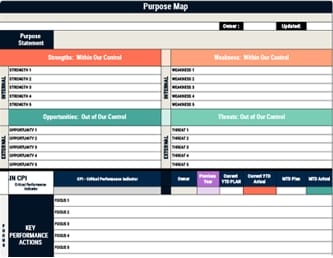
When you build a Balanced Scorecard specifically for operations, you’re still working with the same four perspectives Kaplan and Norton introduced—Financial, Customer/Stakeholder, Internal Process, and Learning & Growth—but the objectives and KPIs inside each one shift to reflect what actually happens on the production floor, in the warehouse, or across the supply chain. Instead of broad corporate targets, you’re tracking lead time reduction, first-pass yield, defect rates, and overall equipment effectiveness. Your financial metrics zero in on cost per unit, scrap, and rework rather than enterprise-level revenue goals. Customer measures focus on order fill rate and warranty costs, while Learning & Growth tracks training completion, preventive maintenance compliance, and employee engagement—ensuring your workforce can sustain every improvement you make. A strong operations scorecard also clarifies a few Critical Performance Indicators and links them to daily KPIs and behaviors so teams don’t drown in measurement overload.
The Four Perspectives on the Shop Floor
Now that you’ve seen the scorecard’s overall shape, let’s walk through each of the four perspectives as they actually play out on the shop floor—because the way you measure financial health in a plant is fundamentally different from how corporate finance tracks enterprise revenue, and the same gap exists across customer, process, and learning metrics.
The four perspectives link together through cause and effect. You invest in training and skill development, which strengthens process control and capability. That improved capability drives higher first-pass yield, lower defect rates, and better OEE. By making these connections explicit, you reinforce organizational alignment so that shop-floor behaviors, metrics, and decisions stay tightly linked to the company’s strategic goals.
Training builds capability, capability builds process control, and process control builds the results your plant lives on.
When your processes run reliably, you hit on-time delivery targets and reduce customer complaints. Those service outcomes ultimately flow into stronger gross margins and healthier cash flow.
Each perspective feeds the next, so your team sees exactly how their daily actions on the floor connect to strategic results.
How to Choose KPIs for Your Operations Scorecard
Map each operational strategic objective—whether it’s reducing cycle time, improving quality, or increasing throughput—to a single leading performance measure that your team can directly influence on the shop floor. Choose metrics that update frequently enough for real-time decision-making, and ensure each KPI has a defined formula, data source, and owner to prevent inconsistent reporting. Strengthen ownership and transparency by assigning each KPI to a clearly defined owner and making performance visible on visual management boards so teams can quickly spot gaps and take corrective action.
Balance your scorecard across four operational dimensions:
- Quality — Track first-pass yield or defect rate using ERP/WMS records to measure production accuracy.
- Delivery — Monitor on-time completion rates and time-to-ship reductions in days or weeks.
- Efficiency — Measure OEE (availability × performance × quality) and resource utilization for throughput visibility.
- Reliability — Capture equipment downtime and MTBF from machine sensors to assess asset dependability.
Map Shop-Floor Actions to Strategic Outcomes
Because every strategic objective needs a clear line of sight to the work your operators perform each day, your next step is to translate high-level goals—like reducing lead time or improving product quality—into specific, repeatable shop-floor actions such as standardized work routines, preventive maintenance schedules, and faster changeover procedures.
Every strategic objective must trace a clear line from the boardroom straight to the shop floor.
Assign at least one KPI to each action so you can verify it’s driving the intended objective.
Then build a strategy map that uses cause-and-effect logic to connect these internal process targets—quality, throughput, OEE—to customer outcomes like NPS and time-to-resolution, and ultimately to financial results such as operating profit margin and cash flow.
Cascade each target to specific teams and work cells with clear ownership, so daily shop-floor decisions stay aligned with strategic outcomes.
Integrate visual management tools such as dashboards, Kanban boards, and clear status indicators so operators receive real-time feedback on KPIs, enabling quicker responses to issues and stronger alignment between daily actions and strategic objectives.
Set Targets That Push Teams Without Breaking Them
How do you set targets that genuinely stretch your teams toward better performance without demoralizing them or setting them up to fail? You’ll need a disciplined approach that balances ambition with realism, grounded in actual shop-floor data rather than wishful thinking. This works best when targets and measures are embedded in a regular governance rhythm that connects shop-floor performance reviews to the broader strategic plan.
- Baseline first, then stretch. Derive your 6–12 month targets from 8–12 weeks of run-rate data, adding only the improvement you can tie to specific planned initiatives.
- Pair lagging with leading measures. Connect outcomes like OTD with drivers such as changeover duration and maintenance backlog so teams can act before results slip.
- Separate controllable from external factors. Use scenario-based buffers when supplier variability or market conditions would unfairly punish performance.
- Review on a fixed cadence. Adjust targets only when root-cause evidence supports the change.
Cascade Your Operations Scorecard Across Every Level
Once you’ve set targets that challenge without overwhelming, the next step is making sure those targets don’t live only on an executive dashboard where they can’t drive daily decisions.
You need to cascade each corporate objective into unit-level goals, then into team and individual KPIs that connect directly to those same targets.
Use strategy maps with clear cause-and-effect logic so every shop-floor initiative—whether it’s a training program, maintenance schedule, or process change—visibly supports your internal-process and customer outcomes.
Assign named owners at every level, from plant manager to shift lead, establishing accountability and feedback loops for each metric.
Keep objective wording and KPI definitions consistent across layers, and limit your metric set to prevent overload that dilutes focus and weakens execution.
Reinforce this cascade by translating scorecard metrics into visual management boards that use clear, color‑coded indicators and team-owned updates to make performance gaps visible and actionable on the shop floor.
Track Your Operations Balanced Scorecard With Live Data
Even the most carefully cascaded scorecard loses its power if your team reviews performance data that’s already weeks old, because stale numbers turn strategic targets into rearview-mirror observations rather than actionable signals.
You need a real-time operations dashboard that pulls KPIs—OEE, cycle time, scrap rate, first-pass yield—directly from your PLC/SCADA, MES, and quality systems into one centralized repository. In line with visual management’s 1-3-10 second rule, design your dashboard so status, problems, and required actions are immediately clear at a glance.
To make live tracking trustworthy and useful, build these four foundations:
- Centralize your data so operators, managers, and executives share a single source of truth without manual spreadsheet wrangling.
- Track leading and lagging indicators together—downtime causes and WIP levels alongside throughput and on-time delivery—to accelerate corrective action.
- Enforce governance rules including metric definitions, data validation, role-based access, and audit trails.
- Enable drill-down capability so leaders trace a rising KPI to the specific line, shift, or part family driving it.
Scorecard Mistakes That Derail Operations Performance
Despite the strategic clarity a balanced scorecard can bring to operations, the tool itself becomes a liability when teams fall into a handful of common design and execution traps that quietly erode its usefulness.
A balanced scorecard only works until poor design turns strategic clarity into operational noise.
You’ll want to avoid overloading each objective with too many KPIs—limit yourself to one or two leading and lagging measures per objective so priorities stay visible.
Don’t track activity metrics like audits completed when you should measure impact through first-pass yield or OEE.
If your learning and growth KPIs don’t demonstrably drive process improvements that cascade into customer and financial results, you’ve broken the cause-and-effect chain.
Never set targets without verified baselines and clean data, and always assign a named owner with real authority to every objective, or your scorecard won’t translate into shop-floor execution.
To keep the scorecard from becoming a paper exercise, engage operational experts early in its design so measures reflect real constraints, enable practical problem‑solving, and support continuous feedback between strategy and the shop floor.
Run Scorecard Reviews That Drive Continuous Improvement
Schedule your scorecard reviews on a fixed cadence—monthly for operational KPIs and quarterly for strategic objectives—so they become a non-negotiable rhythm rather than an afterthought that slips off the calendar when things get busy. Drawing on how companies like Tesla and PayPal used disciplined review cycles to keep strategy and execution tightly aligned, you can use this cadence to strengthen your own strategic organizational alignment across departments.
During each review, follow this structure:
- Compare actual versus target for every KPI so you immediately spot which processes are driving or blocking strategic outcomes.
- Apply trend and cause-and-effect analysis— for example, trace how training improvements lead to shorter cycle times, which then lift customer satisfaction.
- Separate activity from impact by tracking both initiative milestones and actual KPI movement.
- Confirm ownership by requiring each KPI’s accountable owner to report corrective actions and next steps.
Keep dashboards current to eliminate data drag and enable faster decisions.
Operations Balanced Scorecard Examples Worth Stealing
Because theory only clicks when you see it applied to real work, this section walks you through concrete KPI sets you can adapt to your own operation—organized by the four Balanced Scorecard perspectives so every metric connects shop-floor activity to a strategic result.
For process efficiency, track OEE (Availability × Performance × Quality), scrap rate in PPM, and labor utilization to reveal where real losses hide. Strong process metrics become even more powerful when they’re supported by ongoing organizational alignment practices that keep daily decisions tied to strategic goals.
For quality, monitor first-pass yield, DPMO, and rework hours per unit to confirm improvements are holding.
For customer linkage, measure OTIF percentage and complaint rate per 1,000 shipments so internal performance translates to downstream satisfaction.
For learning and growth, capture training hours per technician, mean time to competence in days, and process audit compliance to ensure capability building drives every other perspective’s results.
Frequently Asked Questions
What Is the Balanced Scorecard for Operations?
The Balanced Scorecard for Operations is a performance framework you use to translate your organization’s strategy into measurable, actionable targets on the shop floor.
It applies four perspectives—Financial, Customer/Stakeholder, Internal Process, and Organizational Capacity/Learning—so you’re tracking KPIs like cycle time, on-time delivery, first-pass yield, and training completion.
What Are the 4 Types of Balanced Scorecard?
Companies using all four perspectives report up to 30% better strategy execution. You’ll work with Financial, which tracks profit margins and cash flow; Customer/Stakeholder, which measures on-time delivery and satisfaction; Internal Process, which monitors cycle time, defect rates, and OEE; and Learning & Growth, which assesses employee training and engagement.
Together, these four types connect your shop-floor activities directly to strategic outcomes.
How Does a Balanced Scorecard Relate to Strategy?
A balanced scorecard relates to strategy by translating your organization’s vision into measurable objectives across its four perspectives, creating a clear cause-and-effect chain where improvements in organizational capacity drive better internal processes, which enhance customer outcomes and ultimately strengthen financial results.
You’ll tie each strategic objective to specific KPIs and targets, making strategy operational and ensuring that daily execution across every level directly supports your broader strategic goals.
Conclusion
It’s ironic that the very metrics meant to illuminate performance are the same ones that blind you when they’re poorly chosen or ignored. You’ve now got the framework to connect strategy directly to the shop floor, so the real question isn’t whether a Balanced Scorecard works—it’s whether you’ll actually commit to using it before your competitors do. Start building yours today, and let the data do the talking.