

If you’re an operations leader trying to decide between OKRs and Hoshin Kanri, you’re facing a choice that shapes how your team sets goals, tracks progress, and sustains alignment over time. Both frameworks drive results, but they work differently depending on your planning horizon, organizational complexity, and how quickly you need to adapt. Understanding where each method excels—and where it falls short—will help you avoid costly mismatches between your strategy and your execution system.
Key Takeaways
- OKRs convert strategy into quarterly, measurable outcomes ideal for fast tactical execution and transparent cross-functional accountability.
- Hoshin Kanri sustains multi-year strategic alignment using catchball consensus and monthly reviews anchored to five or fewer breakthrough objectives.
- Operations leaders needing rapid experimentation and stretch goals within short cycles gain a clear edge from OKRs.
- Hoshin Kanri outperforms OKRs in high-variability shop-floor environments requiring persistent direction and structured countermeasure responses.
- Combining both frameworks—Hoshin for direction, OKRs for quarterly execution—linked through an X-Matrix eliminates visibility gaps across deployment.
OKRs vs. Hoshin Kanri: What Each Framework Actually Does
Before you can decide which framework fits your operations, you need to understand what each one actually does at a structural level. Hoshin Kanri aligns your company’s strategic vision to annual priorities using a process called catchball, where objectives pass between leadership levels until there’s multi-level agreement, and then you track progress through KPIs on a monthly review rhythm. It’s built for direction-setting and deployment across a 3–5 year horizon. Both methods work best when they’re embedded in a broader system of alignment and accountability that links top-level strategy to frontline execution and is reinforced through regular governance rhythms.
OKRs, popularized by Google and rooted in Andy Grove’s work at Intel, translate strategy into quarterly objectives paired with time-bound, quantifiable key results. Where Hoshin emphasizes alignment and cross-departmental iteration of tactics, OKRs emphasize prioritization and measurable achievement within a shorter quarterly window.
The Core Trade-Off: Agility vs. Systematic Alignment
So how do you decide between a framework built for long-range strategic consistency and one designed for short-cycle execution speed?
Choosing between strategic consistency and execution speed defines how your organization balances long-term direction with short-cycle adaptability.
Hoshin Kanri gives you top-down direction combined with consensus through catchball, which reduces waste from inconsistent communication but can feel rigid and time-consuming.
OKRs give your teams bottom-up ownership to reprioritize quarterly based on new information, which drives faster learning through weekly check-ins but risks misalignment if you haven’t anchored those cycles to a longer-term direction.
You’re primarily choosing where to place your bet: systematic alignment that keeps everyone pulling toward three-to-five-year breakthrough objectives, or agility that lets you adapt tactics within weeks.
Neither choice eliminates the other’s strengths, which is why many operations leaders combine both.
Whichever you choose, you’ll need to ground it in integrated strategy and execution so that long-range objectives, stakeholder input, and operational realities stay tightly connected as you iterate.
When OKRs Give Operations Leaders a Clear Edge
OKRs pull ahead when your operations team needs quarterly, time-bound targets that translate directly into measurable action. Because each Key Result is specific and quantifiable, you’ll signal priorities clearly so everyone knows what defines success—and what counts as a distraction.
OKRs are your stronger choice when:
- You need faster tactical execution — converting annual themes into team-level, quantifiable outcomes without waiting for a full Hoshin deployment cycle.
- Your teams already follow predictable review cadences — weekly check-ins and quarterly cycles keep adaptation continuous rather than annual.
- You’re driving process improvement targets — stretch goals encourage experimentation around metrics like OEE within a single quarter.
- Transparency matters most — visible, measurable outcomes align cross-functional teams without lengthy catchball negotiations.
Compared with Hoshin, OKRs make it easier to distinguish between Critical Performance Indicators and supporting KPIs so you avoid measurement overload while still focusing teams on what truly defines success.
When Hoshin Kanri Outperforms OKRs on the Shop Floor
On the shop floor, Hoshin Kanri outperforms OKRs when your biggest challenge isn’t setting quarterly targets but sustaining strategic direction across years while keeping daily work aligned to a handful of breakthrough objectives.
Hoshin Kanri wins on the shop floor by turning long-term strategy into daily action through relentless focus.
If misalignment and poor cross-departmental communication are your dominant problems, Hoshin’s catchball process forces multiple levels of leadership into repeated back-and-forth dialogue before tactics and KPIs are locked.
You’ll concentrate on five or fewer critical initiatives, linking each directly to daily operations so focus doesn’t fragment.
Monthly Hoshin review cycles let you trigger countermeasures the moment targets slip, giving you faster operational course-corrections.
The X-Matrix maps objectives, owners, and measures in one visible document, establishing clear accountability that’s harder to achieve with OKRs alone in high-variability environments.
This kind of disciplined, top-to-bottom focus directly supports stronger organizational alignment by ensuring strategy, structure, and day‑to‑day execution stay in sync.
How X-Matrices and Catchball Make Hoshin Kanri Work
How precisely does Hoshin Kanri translate a multi-year vision into daily work without losing strategic coherence along the way? The answer lies in two core mechanisms: the X-Matrix and catchball.
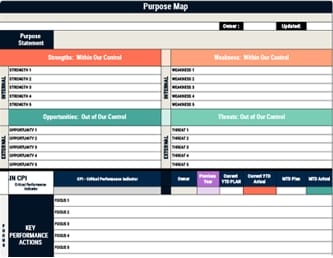
- The X-Matrix maps your 3–5 year breakthrough objectives to annual objectives, KPIs, and initiatives on a single page, so you can visually trace every tactic back to its strategic origin.
- Catchball ensures two-way dialogue where top management proposes direction, middle managers refine tactics, and frontline teams challenge feasibility before execution begins.
- Monthly reviews compare actual performance against X-Matrix KPIs, triggering countermeasures that keep the matrix current rather than decorative.
- Each cell in the matrix has a named owner, making accountability explicit and auditable across every level of your organization.
By pairing the X-Matrix with visual management boards and routine reporting, you create a closed-loop system where strategic goals, metrics, and daily actions remain aligned and transparent.
Match OKRs or Hoshin Kanri to Your Planning Cadence
Align your choice of framework to the rhythm your organization already uses for planning and review, because a mismatch between your strategic cadence and your goal-setting tool will either slow teams down or disconnect their daily work from long-term direction. When you match these methods to your existing planning rhythm, you strengthen organizational alignment by keeping strategy, structure, and day-to-day actions moving in the same direction.
If your organization plans on a longer horizon and leads with strategy, start with Hoshin Kanri’s 3–5 year breakthrough objectives, cascade them into annual themes using an X-Matrix, then convert those themes into quarterly OKRs with weekly or bi-weekly check-ins.
If your planning rhythm is tactical and fast-feedback, prioritize OKRs for quarterly clarity and agility, layering Hoshin only at the strategic level to keep short-cycle goals from drifting.
Run monthly Hoshin progress reviews alongside OKR check-ins so both layers stay connected.
Use OKRs and Hoshin Kanri Together Across Levels
Because Hoshin Kanri and OKRs operate on different time horizons and serve different functions, you can layer them across organizational levels without redundancy by assigning each framework a distinct role.
- Set direction with Hoshin Kanri by defining 3–5 year breakthrough objectives and annual themes, then run catchball to align departments through top-down intent and bottom-up feedback.
- Translate priorities into quarterly OKRs by using Hoshin’s annual goals as strategic inputs for selecting team-level objectives and measurable key results.
- Link everything through an X-Matrix that traces breakthrough objectives to annual goals, responsible owners, and supporting OKR metrics in one visible document.
- Separate review cadences so you’re running weekly or bi-weekly OKR check-ins for rapid adjustment while reserving monthly Hoshin reviews for strategic course corrections.
This layered use of Hoshin and OKRs helps prevent the kind of misalignment that causes up to 70% of strategic plans to fail in execution.
How to Phase in a Combined OKR–Hoshin Kanri System
Knowing where each framework fits is one thing, but rolling out a combined system all at once across every team invites confusion, resistance, and half-finished implementations.
Instead, you should implement in deliberate increments.
In phase one, pick one or two pilot teams tied to a single Hoshin breakthrough theme and run OKRs exclusively within those functions for at least two quarters.
This lets you test cadence alignment—monthly Hoshin reviews alongside bi-weekly OKR check-ins—without overwhelming the organization.
In phase two, you’ll expand OKRs company-wide once the pilot teams have established repeatable rhythms and proven the X-Matrix integration works.
Only in phase three should you consider linking individual goals to the system, and only if team-level OKRs aren’t driving sufficient accountability on their own.
Throughout each phase, use simple, high-visibility boards designed with the 1-3-10 second rule so leaders can instantly see status, spot misalignment, and decide where to intervene.
Frequently Asked Questions
What Is the Difference Between OKRS and Hoshin Kanri?
OKRs give you short-cycle, quarterly commitments where you set an inspirational objective and track progress through quantifiable key results at the team or individual level.
Hoshin Kanri, by contrast, aligns your entire organization around long-term breakthrough goals—typically spanning three to five years—using annual priorities and a catchball process that cascades direction across every level.
You’ll find OKRs emphasize measurable accountability, while Hoshin Kanri emphasizes strategic alignment and shared ownership.
What Is Hoshin Kanri Strategy Deployment?
Before companies had telegraph wires, aligning strategy across an organization was nearly impossible—Hoshin Kanri solves that problem.
You’ll use this Japanese deployment method to connect your long-term breakthrough objectives with annual goals and daily execution tactics.
Through the catchball process, you’ll refine top-down direction with two-way feedback across levels, while tools like the X-Matrix and Bowling Charts help you track ownership, measures, and progress systematically.
What Are Hoshin Kanri’s Common Pitfalls?
You’ll run into trouble when you overcomplicate the process with too many goals instead of focusing on five or fewer, when catchball becomes a one-way directive rather than genuine two-way alignment, or when you treat Hoshin as a static planning document instead of a living system.
Weak links between your X-Matrix KPIs and actual objectives also undermine reviews, making it harder to identify what needs correcting during monthly progress checks.
Which of the Following Are Strengths of Hoshin Kanri Compared to Other Strategy Execution Methods?
Where OKRs cycle quarterly, Hoshin Kanri stretches across years; where top-down directives stall, its catchball process builds alignment.
You’ll find its core strengths in how it connects long-term breakthrough objectives to daily work through tools like the X-Matrix, how it embeds accountability by mapping owners directly to KPIs, and how its structured monthly reviews let you detect deviations early and apply countermeasures before problems compound.
Conclusion
You don’t have to pick one framework and discard the other, because the evidence shows they solve different problems at different time horizons. Start by matching your planning cadence and strategic needs to the strengths each method offers, then layer them together using an X-Matrix to connect quarterly OKR cycles with multi-year Hoshin Kanri breakthroughs. When you align both systems deliberately, you’ll gain the agility of OKRs and the deep alignment that Hoshin Kanri provides.