

If you can’t clearly separate strategy from tactics, your cybersecurity initiatives will generate activity without actually reducing risk. Strategy sets the long-term direction tied to business outcomes, while tactics are the specific actions that execute it. When you confuse the two, you end up optimizing for checklists instead of measurable progress. Understanding where one ends and the other begins isn’t just an academic exercise—it’s the factor that determines whether your security investments land or quietly waste budget.
Key Takeaways
- Strategy sets long-term direction across the entire program; tactics execute concrete actions within weeks or months.
- Confusing tactics for strategy causes teams to measure activity volume instead of meaningful outcomes like risk reduction.
- Each tactic must explicitly link to a strategic objective with quantifiable KPIs to prove it reinforces direction.
- Strategy stays stable while tactics pivot based on operational shifts, preventing the “everything is a priority” trap.
- Regular reviews at different cadences—quarterly for strategy, biweekly for tactics—catch drift before misallocated work accumulates.
What Separates Strategy From Tactics in Cybersecurity
Strip away the jargon and the difference between strategy and tactics in cybersecurity comes down to level, scope, and time horizon.
Your strategy is the CISO’s long-term course of action, typically spanning one to three or more years, that directs resources toward supporting business objectives across the entire security program.
Your tactics are the concrete, shorter-horizon initiatives, measured in weeks or months, that your teams execute day to day within a specific line of business.
A practical way to separate them is to ask where the decision sits.
If it’s above any single line of business and sets direction for the whole program, that’s strategy.
If it’s a team-level procedure directly supporting an operational objective within one business unit, you’re looking at a tactic.
Keeping that distinction clear supports organizational alignment by ensuring team-level actions reinforce broader security and business goals.
How Strategic Clarity Makes Every Cyber Tactic Count
Define your strategic ends clearly—the specific outcomes your security program exists to achieve—and every tactic your teams execute gains a built-in test: does this action move us nearer to those outcomes, or is it just activity?
Research shows strategic clarity accounts for roughly 31% of the performance gap between high and low performers in growth and profitability, and the same principle applies to cybersecurity programs.
When you map each tactic—security campaigns, tooling investments, incident-response drills—to measurable KPIs like risk reduction targets or remediation speed, you can review progress on a cadence (strategy quarterly, tactics more frequently) and course-adjust before effort becomes waste.
Map every tactic to measurable KPIs and review on a cadence—course-adjust before effort becomes waste.
This linkage ensures you select the few high-impact actions that address your most important strategic gaps rather than spreading resources across disconnected initiatives.
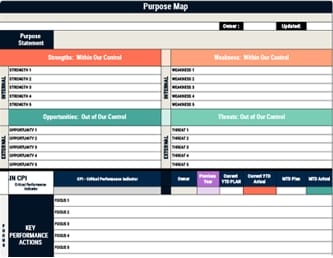
Using a CPI→KPI→KPA loop helps connect mission-critical outcomes to supporting metrics and the daily actions that actually drive execution.
Why Cyber Teams Confuse Tactics for Strategy: and the Cost
Because cyber teams operate under constant pressure to show progress, they frequently label a collection of projects and tool deployments as their “strategy”—when what they’ve actually produced is a tactical roadmap missing the strategic layer that gives it direction.
You end up measuring ticket volume and audit completions instead of breach-likelihood reduction or faster incident recovery, which means your KPIs reward activity rather than outcomes.
This confusion carries real financial weight.
When you can’t articulate a defensible “why” behind your investments, funding arrives late or targets the wrong problems entirely.
Quarterly execution cycles—the 13-week death march—reward concrete deliverables while crowding out the harder trade-offs that define genuine strategy, like deciding which risk domains you’ll deliberately deprioritize.
Without aligned OKRs, teams struggle to connect top-level risk priorities to daily execution and accountability.
Align Cyber Initiatives by Time, Scope, and Flexibility
The fix for this confusion starts with sorting every cyber initiative into its proper lane based on three dimensions: how far into the future it reaches, how broadly it spans the organization, and how much room it has to change course.
Strategy targets a one-to-three-year direction and covers your whole program across multiple business units, while tactics execute in weeks to months within a specific line of business or campaign.
Strategy sets the multi-year direction; tactics deliver results in weeks within a single campaign or business line.
You keep strategy’s ends stable—outcomes like reduced incident impact—but allow tactics to pivot when operational KPIs shift, such as changes in your attack surface or mean time to detect.
Strong organizational alignment helps teams connect these strategic outcomes to day-to-day execution, improving coordination across business units and reducing confusion over priorities.
This separation prevents the “everything is a priority” trap and gives each initiative a clear lane where it can actually deliver measurable results.
Track Whether Your Tactics Actually Move Strategy Forward
Once you’ve sorted initiatives into strategic and tactical lanes, you need a tracking system that proves your tactics actually reinforce the direction you’ve set rather than just generating activity.
Assign each tactic a start/end date, allocated budget, milestones, and a named owner, then require an explicit link to a strategic objective and measurable result.
Track progress with quantifiable KPIs—like NPS for customer-satisfaction goals—and set numeric targets broken into timeframes so you can tell whether the tactic is moving the needle.
Review tactical performance monthly or biweekly while keeping strategy-level reviews quarterly.
When dashboards show a tactic drifting from its linked objective, use status indicators to trigger course-correction before misalignment compounds into wasted resources and strategic drift.
Using color-coded indicators on visual management boards can make deviations from strategic objectives easier to spot and act on quickly.
Frequently Asked Questions
What Is the Distinction Between Strategy and Tactics?
Your strategy is the long-term plan—spanning one to three or more years—that sets your direction and defines the trade-offs you’ll make, while your tactics are the concrete, shorter-term actions you take over weeks to months to execute that plan.
Think of strategy as choosing *where* to compete and *why*, and tactics as deciding *how* you’ll carry out each specific step to get there.
What Are the 3 C’s of Strategy?
Like a three-legged stool that collapses without any single support, the 3 C’s of strategy are Customer, Company, and Competitors.
You identify which customers you’ll serve and what outcomes they value, then you assess your company’s unique strengths and resources that let you consistently deliver, and finally you position against competitors by making deliberate trade-offs.
When all three align, your initiatives connect directly to clear purpose rather than scattering across generic projects.
What Is the Difference Between a Tactic and an Initiative?
An initiative is the formal, scoped effort you’ve committed to—complete with ownership, milestones, and success criteria—while a tactic is the specific, ordered action you take inside that initiative to drive results.
Think of the initiative as your container for change and tactics as the practical moves that actually deliver it.
You won’t land any initiative unless your tactics are coherent, resourced, and measurable.
What Are the 5 C’s of Strategy?
The 5 C’s of strategy are Customer, Company, Competitors, Collaborators, and Climate. You’ll use these to anchor your strategy to a real need, leverage your actual capabilities, account for alternative approaches or adversaries, align with internal and external partners who must execute alongside you, and reflect the changing environment—regulation, technology shifts, and risk trends—so your strategic choices don’t become obsolete as conditions evolve.
Conclusion
Like a chess player who mistakes individual moves for a winning endgame, you’ll burn resources on activity that never compounds into real risk reduction if you conflate tactics with strategy. You now have the framework to separate the two, align them by time horizon and scope, and track whether daily work actually advances your program’s strategic ends. Apply the distinction consistently, and your initiatives will finally land where they matter.