

If you’re running operations and treating OKRs, KPIs, and Critical Performance Indicators as interchangeable terms, you’re likely measuring the wrong things at the wrong time—and missing signals that demand immediate action. Each serves a distinct purpose, operates on a different cadence, and triggers a different response when thresholds shift. Understanding where one ends and another begins isn’t semantic—it’s the difference between proactive execution and reactive firefighting.
Key Takeaways
- OKRs drive time-bound strategic change with three to five measurable Key Results tracked weekly and reset quarterly.
- KPIs monitor ongoing operational health against stable benchmarks through continuous measurement without inherent deadlines.
- Critical Performance Indicators are must-not-fail guardrails with tighter thresholds and faster escalation paths than standard KPIs.
- Persistently red KPIs should be elevated into OKR Key Results next cycle to commit focused cross-team corrective action.
- A metric answering “is the system working” stays a KPI; one targeting X-to-Y change by a date becomes a Key Result.
What OKRs Measure vs What KPIs Track
Here’s where it gets practical: churn rate can serve as a KPI when you’re simply monitoring it, but it becomes a key result the moment you attach a strategic target and deadline.
The metric doesn’t change—your intent does.
In contrast, Critical Performance Indicators represent the vital few outcomes that define organizational success, while KPIs track ongoing performance.
Where Critical Performance Indicators Fit In
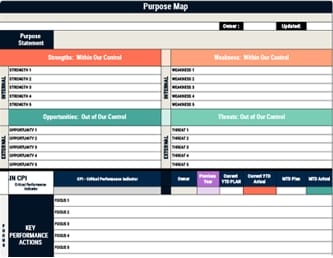
Within the broader universe of KPIs, a small subset earns a sharper designation—Critical Performance Indicators, or CPIs—because they represent the “must-not-fail” signals that operations leaders watch most closely. These indicators directly impact safety, reliability, compliance, or core service levels, which means they carry tighter thresholds, faster escalation paths, and higher review cadences than standard KPIs.
You should think of CPIs as real-time guardrails sitting beneath your KPI set. While you review most KPIs weekly or monthly to track trends, you’ll monitor CPIs daily or even intraday using green/amber/red thresholds that trigger immediate action.
When a CPI deviates, it doesn’t just signal a problem—it activates an operational response that rolls directly into the OKR Key Results depending on that stability. Teams often make these signals more actionable by displaying them on visual management boards with clear color-coded thresholds for rapid response.
OKR vs KPI vs Critical Indicator Examples
Because the distinctions between OKRs, KPIs, and Critical Performance Indicators become clearest through concrete scenarios, let’s walk through a single domain—customer support—and show how each framework applies to the same underlying data.
- OKR: You set the objective *”Resolve the support ticket crisis by end of Q2,”* measured by key results like reducing first response time to under five minutes, increasing CSAT to 90%, and processing 10,000 backlogged tickets by quarter-end.
- KPI: You track an ongoing target of completing 200 ticket responses per hour as a steady operational benchmark, which tells you about throughput but doesn’t guarantee customer satisfaction improves.
- Critical Performance Indicator: You monitor SLA breach rate as a must-not-fail signal that triggers immediate intervention when thresholds are crossed.
To keep these measures aligned and visible, many operations leaders use strategy maps and regular reporting routines to connect frontline metrics with broader organizational goals.
When to Use OKRs, KPIs, or Critical Indicators
Now that you’ve seen how OKRs, KPIs, and Critical Performance Indicators apply to the same data, the natural next question is which framework you should reach for in a given situation.
Use OKRs when you need time-bound, ambitious change and can define three to five measurable Key Results by quarter’s end.
Use KPIs when you’re monitoring ongoing process health against stable expectations, such as executive dashboard metrics like revenue or churn.
Use Critical Performance Indicators when certain metrics represent high-risk, must-not-fail signals requiring immediate attention.
If a metric mainly tells you “is the system working,” keep it as a KPI, but if it represents a strategic outcome—moving from X to Y by a specific date—promote it to a Key Result.
To keep these choices effective over time, support them with performance dashboards and regular reviews so teams can track progress, surface risks, and adapt execution as conditions change.
OKR vs KPI Decision Matrix
How do you decide whether a metric belongs in an OKR or stays as a KPI? Use this three-part decision rule:
- If the metric requires a deadline and drives change (e.g., “Decrease churn from 14% to 7% by quarter-end”), assign it as an OKR key result on a quarterly review cadence.
- If the metric tracks ongoing operational health (e.g., MRR trend or NPS), keep it as a KPI on continuous monitoring.
- If a KPI turns persistently red, elevate it into an OKR key result for the next cycle so you’re committing cross-team focus to closing that gap.
This matrix ensures you’re driving ambitious outcomes through OKRs while maintaining steady-state visibility through KPIs. Strong organizational alignment also helps teams connect these measurement choices to shared goals, clear roles, and better cross-functional execution.
How OKRs and KPIs Work as One System
Treat OKRs and KPIs not as competing frameworks but as two layers of a single performance system, where OKRs set the ambitious, time-bound outcomes you’re driving toward and KPIs supply the continuous health signals that tell you whether your operating environment can actually support those outcomes.
When this system is reinforced by organizational alignment, teams are more likely to connect daily execution to strategic goals and improve decision-making across the business.
You review KPIs weekly to detect risk early, then review OKRs quarterly to steer change.
When a KPI trends red, you diagnose the root cause and either adjust your existing OKRs to protect outcomes or create a new OKR that targets the specific gap with a fresh due-date and target.
This pairing keeps leadership conversations focused on improving outcomes rather than simply reporting activity, because direction without evidence is guesswork.
Common OKR vs KPI Mistakes to Avoid
Even the best-designed system breaks down when you confuse what belongs where, and most teams stumble over the same handful of errors when they first combine OKRs with KPIs.
Most teams fail not because the framework is wrong, but because they confuse what belongs where.
- You’re turning OKRs into task lists. OKRs must be outcome-focused (“I will ___ as measured by ___”), while tasks belong in initiatives underneath them—not inside the Objective itself.
- You’re misclassifying KPIs as OKRs. KPIs are ongoing health metrics that live on dashboards, whereas OKRs are time-bound, ambitious, and scoreable to drive specific change.
- You’re skipping review cadence. Without weekly or quarterly check-ins, red KPIs go undiagnosed and never escalate into refined OKRs, leaving you with stale strategy that doesn’t reflect operational reality.
Using frameworks like the McKinsey 7-S Model can also help operations leaders spot deeper structural misalignment between strategy, teams, and shared values before KPI or OKR problems compound.
How Often to Review OKRs, KPIs, and Critical Indicators
Consistently reviewing your OKRs, KPIs, and critical performance indicators at the right cadence is what separates teams that course-correct early from those that discover problems after the quarter’s already lost.
Check OKRs weekly to surface risks and quarterly to make reset decisions, since they’re time-bound and only stay alive through frequent check-ins.
Monitor KPIs on an ongoing basis—at least weekly—because they’re stable health indicators meant to reveal trends and trigger corrective action.
For critical performance indicators, you’ll need daily or near-real-time review loops, since any lag can cause service or quality failures.
In each review, pair direction questions (OKR progress versus due date) with performance signals (KPI movement versus target), and limit discussion to roughly three to five OKRs and a small KPI scorecard.
This cadence works best when teams have clear roles and responsibilities, because accountability and faster decision-making depend on everyone understanding who owns each metric and response.
Why Getting OKR vs KPI Right Changes Execution
Review cadence only matters if you’re measuring the right thing in the right frame—and that’s exactly where the distinction between OKRs and KPIs reshapes how your team actually executes. When you confuse their roles, you misdirect resources and slow action.
Consider these three scenarios:
- You manage a KPI like an OKR—”resolve 200 tickets per hour” optimizes output without fixing the system driving customer dissatisfaction.
- You frame an OKR as a KPI—a stretch objective like “resolve the support ticket crisis” loses its deadline-bound urgency and cross-team coordination power.
- You pair them correctly—a red KPI trend triggers a focused OKR with Key Results tied to response time and CSAT, enabling faster, fact-based decisions within your weekly and quarterly cycles.
Used well, visual indicators add real-time transparency that helps teams spot performance issues faster and coordinate corrective action.
Frequently Asked Questions
What Are the 5 Elements of OKR?
The five elements of an OKR are the Objective, Key Result(s), baseline, target, and timeframe.
You’ll set a qualitative Objective that states what you want to achieve, then define measurable Key Resultssthat prove progress.
Each Key Result needs a baseline (your starting value) and a target (your desired value), and you’ll bind everything to a specific timeframe so you can score results accurately.
What Are the 5 Key Performance Indicators in Operations?
Organizations that monitor these five indicators see up to 25% faster issue resolution.
You’ll want to oversee On-Time Delivery (OTD) to evaluate shipment reliability, Cycle Time/Lead Time to identify bottlenecks, and First Pass Yield to assess quality without rework.
You should also track Capacity Utilization/Throughput to confirm you’re satisfying demand efficiently, and Cost per Unit to link operational performance directly to profitability.
Conclusion
When you treat OKRs, KPIs, and critical performance indicators as distinct tools with clear roles, you stop drowning in metrics and start steering with purpose. KPIs keep your engine running, OKRs chart the destination, and CPIs are the guardrails that prevent you from going off the cliff. You’ll make faster decisions, escalate the right problems, and align your team around what actually matters for operational performance.