
If you’ve ever set ambitious goals only to lose track of them by mid-quarter, you’re not alone—and that’s exactly the problem OKRs are designed to solve. OKRs, or Objectives and Key Results, give you a structured way to define what you want to achieve and measure whether you’re actually getting there. But how do they stack up against KPAs, the broader performance areas your organization already monitors? The answer isn’t as simple as picking one over the other.
Key Takeaways
- OKRs are a goal-setting framework combining a qualitative Objective with quantitative Key Results scored on a 0–1 scale against a deadline.
- KPAs (Key Performance Areas) define broad responsibility zones, while OKRs set specific, time-bound outcomes within those areas.
- OKRs drive ambitious change; KPAs identify ongoing domains of accountability where consistent performance is expected.
- A CPI–KPI–KPA loop connects daily actions to strategic outcomes, and OKRs provide direction and purpose within that alignment.
- KPAs establish what matters long-term, while OKRs specify measurable targets to improve performance within each key area.
OKRs vs KPIs: Framework vs Metric
While OKRs and KPIs are often mentioned in the same breath, they serve fundamentally different roles—one is a goal-setting framework, and the other is a standalone metric.
OKRs drive where you’re going; KPIs tell you how the engine is running. Different roles, equally essential.
An OKR pairs a qualitative Objective (the “what”) with quantitative Key Results (the “how”), scored on a scale of 0–1 or 0–100 against a deadline.
A KPI, by contrast, is a single measurable indicator—like revenue or customer satisfaction score—that evaluates steady-state performance.
You can embed KPIs inside your Key Results as outcome measures, but you shouldn’t treat every Key Result as a KPI.
Keep your KPI tracking lean, around five to seven per plan, and limit OKRs to one to three objectives per period so your metrics stay meaningful and actionable.
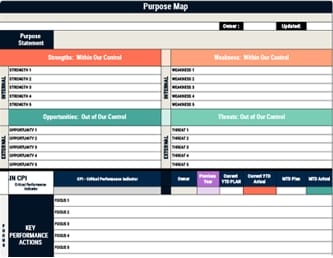
To ensure execution doesn’t stall, connect OKRs and KPIs through a CPI KPI KPA loop that ties strategic outcomes to daily actions.
OKR and KPI Examples Side by Side
The best way to see how OKRs and KPIs differ is to place them next to each other in real scenarios. Think of a racing team: your KPI tracks a best speed of 225 mph against a target range of 224–228 mph, while your OKR sets the objective to “Win the Indy 500 this year” with key results like raising top speed to 228 mph and cutting average pitstop time by 15%.
In marketing, a KPI might measure web conversion rate aiming for a 25% increase, but an OKR wraps that metric under a broader objective like “Increase sales revenue,” adding key results for average subscription value and sales cycle length.
You’re using KPIs as standalone gauges and OKRs as outcome-driven frameworks scored on a 0–1 scale within a set deadline. Effective use of both depends on aligning them with operational realities so that goals remain actionable and measurable in execution.
How OKRs Give Your KPIs Direction and Purpose
Seeing OKRs and KPIs side by side makes their differences clear, but the real power shows up when you layer them together so that OKRs give your KPIs direction and purpose. A strong alignment system like OKRs framework also reinforces strategic alignment by connecting daily metrics to long-term organizational goals.
A KPI like “customer satisfaction score” tells you how you’re performing, but an OKR wraps that metric in strategic context by answering *why* you need to move the number and *by when*.
Think of it as giving your KPIs soul—they’re no longer passive dashboard readings but active components of an operating plan with clear ownership.
Once you’ve hit an OKR’s target, those key results can graduate into ongoing KPIs for continuous monitoring, ensuring that every strategic win you’ve fought for becomes a sustained standard of performance.
When to Use OKRs, KPIs, or Both Together
Knowing which framework to reach for starts with a simple question: are you trying to change something or monitor something?
OKRs drive ambitious, time-bound outcomes—typically one to three objectives per quarter—while KPIs track steady-state performance against established targets like turnover rate or time-to-hire. To keep both approaches effective, organizations should support them with performance dashboards that enable continuous monitoring and quick adjustments.
You’ll get the best results when you match the tool to the situation:
- Use OKRs alone when you’re launching a new initiative and need to turn strategy into measurable execution within a quarter.
- Use KPIs alone when operations are stable and you simply need ongoing monthly reporting to confirm you’re hitting existing benchmarks.
- Use both together when you want OKRs to set direction and KPIs to serve as scorable key results—for example, “Increase retention from 75% to 80% by Q4.”
Setting Up OKRs and KPIs That Work Together
Once you’ve decided to pair OKRs with KPIs, the next step is structuring them so each framework reinforces the other rather than creating duplicate tracking.
Start by embedding one or two KPIs directly inside your Key Results as measurable proof-points, such as “Reduce average pitstop time by 15%,” so each KPI serves strategic progress rather than sitting in a separate dashboard. This alignment becomes clearer when teams visualize goals using a strategy map to connect metrics directly to strategic outcomes.
Embed KPIs directly into your Key Results so every metric drives strategic progress instead of collecting dust on a separate dashboard.
Don’t swap out KPIs every quarter if they represent ongoing performance—carry them forward across OKR cycles and only adjust targets when your baseline or strategy changes.
During quarterly planning, verify that each Key Result is either an outcome metric functioning as a KPI or a clearly labeled effort initiative, which prevents you from mislabeling routine measurements as OKR scores.
Common Mistakes When Combining Both
Even a well-structured pairing of OKRs and KPIs can fall apart if you repeat a handful of common mistakes that blur the line between the two frameworks.
- Treating OKRs and KPIs as interchangeable. KPIs are ongoing performance metrics, while OKRs are time-bound objectives tied to prioritized strategic efforts—swapping them creates confusion about what you’re actually measuring.
- Tagging every key result as a KPI. Keep your KPI set small, roughly one to two per objective, so you don’t drown in vanity metrics that obscure real progress.
- Replacing KPIs every quarter. When a KPI serves as an outcome-based key result, carry the metric forward and adjust targets instead of swapping it out each cycle.
Using tools like visual management boards can help teams clearly distinguish between ongoing KPIs and time-bound OKRs by making performance data visible and actionable in real time.
OKRs After KPIs: What Changes When Goals Are Met?
After you’ve hit an OKR’s target, the work doesn’t end—it shifts from pursuit to preservation. The outcome you achieved now graduates into a KPI-style metric that you’ll monitor continuously to confirm the improvement sticks.
For example, if your OKR drove average pitstop time down by 15%, that metric becomes a standing KPI you track every week.
You don’t reset this KPI each quarter—you carry it forward and only adjust the target when your strategy evolves.
Meanwhile, you’ll set a new, more ambitious OKR for the next cycle that pushes performance further or addresses a different priority.
This rhythm prevents you from treating success as a finish line and instead keeps your team sustaining gains while pursuing the next meaningful breakthrough.
This approach reinforces organizational alignment by ensuring sustained results continue to support broader strategic goals.
Frequently Asked Questions
What Is OKR Compared to KPI?
If you’re a sales manager tracking a KPI like “monthly close rate at 30%,” you’d create an OKR when that rate drops—say, “Improve sales effectiveness” measured by key results like raising close rate to 40% and cutting response time by 20%.
OKRs set ambitious, time-bound objectives with measurable key results driving change, while KPIs are ongoing metrics you’ll use to monitor steady performance against established targets.
What Are the 4 Pillars of KPI?
You’ll build every KPI around four pillars: Measure, which defines the exact metric and its formula; Target, which sets the specific result you’re aiming for within a timeframe; Owner/Data Source, which assigns accountability and identifies where the data comes from; and Reporting Frequency, which determines how often you’ll review progress—typically monthly or quarterly—so you can make timely course corrections.
What Are the 5 KPIS Examples?
Five fundamental KPIs you should track include employee turnover rate, which measures the percentage of staff leaving over a period, absenteeism rate, capturing missed scheduled work hours, time to hire, counting days from job posting to offer acceptance, training program success rate, reflecting the percentage of employees completing training, and employee engagement score, derived from surveys tracking satisfaction and motivation trends over time.
Are KPIS Outdated?
KPIs aren’t outdated, but they’ll lose their effectiveness if you use them in isolation or track too many at once. You should keep a small set—roughly one or two per objective—and tie each to a clear time frame and data source.
When you pair KPIs with OKRs, you’re giving them strategic context: the OKR provides the ambitious direction, while the KPI measures whether you’re actually getting there.
Conclusion
You don’t have to let your strategy quietly lose its way—by pairing OKRs with KPIs, you’re ensuring that your goals stay visible and your progress doesn’t slip through the cracks. When metrics lack direction, performance doesn’t decline overnight; it simply drifts into comfortable underperformance. You’ve now got the framework to prevent that gentle fade, so start aligning your objectives and key results with the indicators that keep your team accountable and moving forward.