

If you’ve ever struggled to connect your operational strategy to what your teams actually do each day, a Balanced Scorecard gives you the structured framework to bridge that gap. It pushes you beyond tracking financial results alone and forces you to measure what truly drives performance across customers, processes, and people. The real challenge, though, isn’t understanding the concept—it’s building one that works in practice.
Key Takeaways
- Balanced Scorecards translate strategy into measurable objectives across Financial, Customer, Internal Process, and Learning & Growth perspectives.
- Strategy maps use cause-and-effect arrows linking workforce capabilities to process improvements, customer satisfaction, and financial results.
- Limit scorecards to 15–20 KPIs with clear ownership, targets, and quarterly reviews to maintain focus and accountability.
- Cascade scorecards to team level so daily responsibilities connect directly to strategic objectives through a clear line of sight.
- Distinguish leading indicators from lagging indicators to verify that operational improvements drive customer and financial outcomes over time.
Why Operations Teams Need a Balanced Scorecard
When your operations team relies solely on financial metrics like revenue growth or ROI, you’re fundamentally driving by looking in the rearview mirror—reacting to outcomes that have already happened rather than shaping the ones ahead.
A Balanced Scorecard fixes this by translating your strategy into measurable objectives across four perspectives: Financial, Customer/Stakeholder, Internal Process, and Organization Capacity.
The Balanced Scorecard turns strategy into action across four perspectives—so every metric ties back to the mission.
You’ll pair leading indicators like cycle time, defect reduction, and training effectiveness with lagging financial results, giving you the full picture.
The scorecard’s cause-and-effect strategy map shows exactly how investing in workforce capabilities drives process excellence, which improves customer satisfaction, which ultimately delivers financial performance.
Without this framework, you can’t connect daily execution to long-term outcomes with any real precision.
It also enables teams to visualize alignment and quickly identify gaps using a strategy map, ensuring resources and actions stay tightly connected to strategic goals.
Connect Four Scorecard Perspectives to Daily Operations
Financial targets like daily cost control and operating-income goals guide spending and resource allocation.
Customer metrics such as order accuracy and response times keep your team focused on satisfaction and loyalty.
Internal Processes KPIs—cycle time, defect rates, and throughput efficiency—tell supervisors where workflows need immediate attention.
Learning & Growth indicators, including training completion rates and technology readiness, ensure your workforce develops the skills and tools that drive process improvements, which then elevate customer outcomes and ultimately deliver the financial results your strategy requires.
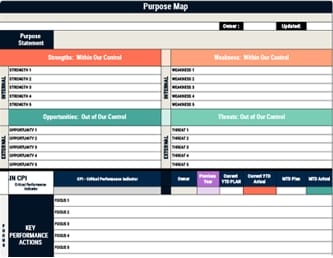
Embedding a CPI→KPI→KPA loop ensures these perspectives translate into daily, observable actions that teams can consistently execute and improve.
Build Scorecard Objectives and KPIs for Execution
Once you’ve connected each perspective to daily operations, the next step is translating that connection into strategic objectives and KPIs that your team can actually execute against.
Start each objective with a clear action verb, orient it toward long-term outcomes, and make it measurable across all four perspectives.
Every strategic objective should begin with an action verb, aim for lasting impact, and stay measurable across all four scorecard perspectives.
Select one to two KPIs per objective, keeping your total scorecard between 15 and 20 KPIs so reporting remains focused.
You’ll want a mix of leading indicators like cycle time and lagging indicators like operating income to support both real-time decisions and final result tracking.
Assign explicit ownership for every objective and KPI to specific individuals or teams, and set defined targets with quarterly reviews so underperformance triggers immediate, predefined action plan updates.
This structure reinforces alignment with your broader strategic plan while ensuring day-to-day execution stays connected to long-term goals.
Create a Strategy Map That Links Metrics to Outcomes
Although your objectives and KPIs now have clear ownership and targets, they won’t drive strategic execution until you’ve mapped the cause-and-effect relationships that connect them across all four balanced scorecard perspectives.
Start at the bottom with organizational capacity objectives like skills training effectiveness, draw explicit arrows upward to internal process improvements such as reduced cycle time, then connect those to customer outcomes like higher NPS scores, and finish with financial results including revenue growth and ROI.
This approach reinforces strategic alignment by ensuring every metric contributes to a unified organizational vision.
Label each KPI as either a leading or lagging indicator so you can distinguish short-term control levers from long-term results.
During quarterly reviews, verify whether leading indicator movement actually precedes customer and financial improvements, and revise broken linkages annually when evidence demands it.
Cascade Your Scorecard to Teams and Assign Ownership
After you’ve mapped the cause-and-effect relationships across all four perspectives, you need to cascade the enterprise-level scorecard down to individual teams and departments so every group maintains a direct “line of sight” from their daily responsibilities back to the organization’s strategic objectives.
Each team should define measurable KPIs—with specific targets and reporting schedules—that connect directly to the strategy map’s cause-and-effect logic.
Every KPI your team tracks should tie directly back to the strategy map—with clear targets and a defined reporting rhythm.
You’ll then assign a specific person or team as the accountable owner for every KPI and initiative, which strengthens execution and streamlines monitoring.
Departmental scorecards must roll up consistently into the corporate scorecard so you don’t end up with isolated metrics that ignore enterprise priorities.
Finally, establish a review cadence at each level, such as quarterly progress checks and annual strategic recalibrations, so owners can adjust action plans when performance falls short.
To ensure consistency across teams, align these efforts with proven frameworks like the 7-S Model to keep strategy, structure, and systems working in harmony.
Review and Adjust Your Scorecard Every Quarter
Having cascaded your scorecard to every team and assigned clear ownership for each KPI, you now need a disciplined rhythm for checking whether those metrics are actually moving in the right direction. Plan a quarterly review cycle that compares actual results against strategic objectives, and use those findings to determine your next actions.
Each quarter, you should:
- Evaluate performance gaps by checking if metrics like on-time delivery have fallen below target, which should trigger a process reevaluation
- Confirm you’re balancing leading and lagging indicators so measures like cycle time and defect reduction signal progress before financial outcomes appear
- Require named accountability for every metric so corrective action happens faster
- Leverage dashboards or balanced-scorecard software to automate data collection and ensure decisions rely on current performance data
Incorporating real-time data visualization into your dashboards can further strengthen these reviews by making performance deviations immediately visible and easier for teams to act on.
Frequently Asked Questions
How Does a Balanced Scorecard Differ From a Traditional KPI Dashboard?
A balanced scorecard differs from a traditional KPI dashboard because it connects your metrics across four strategic perspectives—financial, customer, internal processes, and learning and growth—rather than simply displaying isolated performance numbers.
While a KPI dashboard tracks individual metrics in real time, you’ll use a balanced scorecard to align those metrics with your organization’s broader strategy, showing cause-and-effect relationships between objectives and ensuring every measure drives meaningful, long-term outcomes.
What Software Tools Work Best for Managing Balanced Scorecards Operationally?
You might be surprised how many powerful options exist.
You’ll find that tools like ClearPoint Strategy, Spider Strategies, and BSC Designer are purpose-built for managing balanced scorecards, offering strategy mapping, cascading objectives, and real-time tracking.
If you’re already using broader platforms, Power BI, Tableau, or even Excel with structured templates can work effectively when you configure them to align metrics across all four scorecard perspectives operationally.
How Long Does a Typical Balanced Scorecard Implementation Take From Start to Finish?
You’ll typically need 12 to 16 weeks to implement a balanced scorecard from start to finish, though complex organizations may require up to six months.
The process involves defining strategic objectives, selecting KPIs, aligning departmental goals, and configuring your tracking systems.
You shouldn’t rush the stakeholder alignment phase, as it’s critical for long-term adoption, and you’ll want to build in time for testing and refinement before full deployment.
Can Balanced Scorecards Integrate With Existing ERP or Business Intelligence Systems?
Yes, balanced scorecards can integrate with existing ERP and business intelligence systems, which allows you to pull real-time data directly into your scorecard metrics without manual entry.
You’ll typically connect platforms like SAP, Oracle, or Power BI through APIs or built-in connectors, ensuring your KPIs automatically reflect current operational performance.
This integration streamlines reporting, reduces errors, and gives you a unified view of strategic progress across departments.
What Are the Most Common Mistakes Companies Make When First Adopting Scorecards?
Picture a dashboard cluttered with dozens of metrics, each competing for attention—that’s the first mistake you’ll want to avoid.
Companies often track too many KPIs, choose metrics that don’t align with strategic objectives, or fail to assign clear ownership for each measure.
You shouldn’t neglect regular review cycles either, because scorecards become stale quickly without consistent updates and accountability built into your operational rhythm.
Conclusion
When you align all four perspectives and cascade KPIs to every team, you’ll transform strategy from a static document into a daily operating rhythm. Organizations that implement balanced scorecards effectively see up to a 30% improvement in strategic goal attainment, which underscores the power of connecting metrics to outcomes. You’ve now got the framework, so start building your scorecard, assign ownership, and commit to quarterly reviews that keep execution on track.