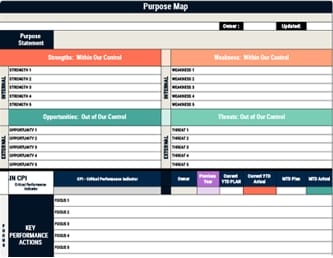


You need a scoreboard that makes performance unmistakable at a glance, so you’ll pick a few essential KPIs—like OEE, scrap, and throughput—and place them at eye level, color-coded for status, with daily updates and simple trend lines to show direction. Arrange space for issues, owners, and due dates, then anchor your huddles there to review gaps and assign actions. The real choice comes next: physical or digital, and how you’ll protect data integrity.
Key Takeaways
- Display concise Safety, Quality, Cost, Delivery, and People KPIs at eye level with clear labels and legible numbers.
- Use color coding (green/yellow/red) and trend graphs to highlight status and patterns over time.
- Anchor daily huddles at the scoreboard to review results, assign owners, and track actions visibly.
- Update metrics daily; use digital boards for real-time, accurate data and preserved history.
- Set triggers (e.g., OEE < 85%, FPY < 95%) to escalate issues within 24 hours.
Designing Scoreboards That Drive Accountability on the Shop Floor
Although scoreboards can take many forms, the ones that drive accountability on the shop floor always make SQCDP performance unmistakably visible, current, and actionable.
So start by defining a concise set of Safety, Quality, Cost, Delivery, and People KPIs that reflect your process’s daily reality and targets.
Place the scoreboard in a high-traffic location where teams naturally gather, then anchor daily huddles there to review results, discuss gaps, and assign owners for countermeasures.
Use clear labels and legible numbers, and add color-coded status indicators—green, yellow, red—to enable instant recognition of performance and priority.
Update the board daily to maintain relevance and reinforce discipline.
Consider digital scoreboards for real-time data feeds, historical trends, and easy access, but preserve a simple, intuitive layout.
Regularly involve the team in customization to keep the board relevant and engaging, using handwritten updates and feedback to strengthen ownership and action.
Choosing the Right KPIs: From OEE to Scrap and Throughput
Why start with KPIs like OEE, Scrap Rate, Throughput, First-Pass Yield, and Lead Time?
Because they form a balanced view of capacity, quality, and responsiveness, letting you see where losses occur and how to act.
Track OEE to blend availability, performance, and quality into one productivity signal, and set 85% as a practical benchmark to trigger problem-solving.
Track OEE to unite availability, performance, and quality—85% is a practical trigger for action.
Monitor Scrap Rate to expose waste, since lowering scrap cuts cost and supports sustainability.
Use Throughput to confirm whether assets convert time into output, indicating bottlenecks or smooth flow.
Measure First-Pass Yield, targeting 95% or higher, to validate process capability without rework.
Finally, watch Lead Time end to end, since shorter cycles boost customer satisfaction and reveal coordination and scheduling gaps.
To ensure these KPIs drive outcomes, link each one to a few Critical Performance Indicators and define daily Key Performance Actions that create a CPI→KPI→KPA execution loop.
Color Coding, Graphs, and Layout Patterns That Improve Clarity
When you design a visual management scoreboard, use color, graphs, and a consistent layout to make performance instantly clear and action-oriented.
Apply green for on-target, yellow for caution, and red for issues needing immediate attention, ensuring at-a-glance status during daily huddles.
Place the most critical KPIs at eye level so teams see throughput, quality, and safety first, then support them with trend graphs that reveal patterns and shifts over time.
Use standardized symbols and icons to reduce reading time and misinterpretation, and reserve space for next steps to drive accountability.
- Put primary KPIs at eye level; position drivers and root causes below.
- Use trend lines or run charts, not just snapshots.
- Standardize symbols, legends, and color meanings.
- Add a clear “actions and owners” panel.
Add the 1-3-10 rule as a design check: ensure status is readable in one second, the specific problem is identifiable in three seconds, and required actions and owners are clear within ten seconds.
Digital vs. Physical Boards: Trade-offs, Scalability, and Data Integrity
Even with the appeal of simple whiteboards, choosing between digital and physical scoreboards hinges on how fast you need data, how widely you must scale, and how tightly you manage data integrity.
If you need real-time visualization, remote visibility, and consistent accuracy, pick digital, since automated data feeds cut human error and guarantee everyone sees the same, current metrics from any device.
If you need something running today, a physical board starts faster, yet it risks handwritten mistakes, outdated numbers, and site-bound access.
Digital systems take longer to configure but pay off with scalable rollouts across shifts and plants, interactive features, and unified standards.
They also preserve time-stamped history for trend analysis, while physical boards lack built-in records, making long-term performance tracking difficult.
Additionally, aligning scoreboards with visual management tools like Kanban boards and Andon systems enhances transparency, enables quicker responses, and supports continuous improvement across teams.
Daily Huddles and Escalation Routines for Continuous Improvement
Although scoreboards can stand on their own, you get the most value when you anchor daily huddles to them and pair the discussion with clear escalation routines.
Use the board to review yesterday’s metrics, surface obstacles, and set one or two concrete actions with owners and deadlines, because this rhythm builds accountability and improves flow.
Meet at the same time daily, keep it brief, and use color-coded indicators to signal status, so you can prioritize gaps and act in real time.
Research shows regular huddles can lift performance by 15–20%, especially when issues escalate within 24 hours and progress is tracked visibly. Aligning these huddles with measurable performance indicators and clear roles strengthens accountability and sustains high-performance habits.
- Review targets vs. actuals, highlight variances.
- Identify root causes, assign owners.
- Escalate blockers using a 24-hour rule.
- Track resolutions on the board.
Frequently Asked Questions
How Do We Budget and Justify ROI for Scoreboards?
You budget by listing hardware, software, installation, network, content design, training, and maintenance, then estimating totals with a 10–15% contingency.
You justify ROI by quantifying gains: reduced downtime, faster changeovers, higher throughput, defect reduction, and labor saved by eliminating manual reporting.
Convert each improvement into annual dollar impact using baseline metrics, apply conservative assumptions, and compare against total cost over 1–3 years, including depreciation and avoided costs, to calculate payback and IRR.
What Change Management Steps Avoid Resistance From Operators?
Start by involving operators early; studies show change initiatives are 3.5x likelier to succeed with frontline engagement.
You map current pain points, co-design workflows, and pilot in one cell, gathering quick feedback to refine standards.
You provide concise training with hands-on practice, define clear roles, and align incentives to behaviors, not just outcomes.
You communicate purpose and benefits, share transparent metrics, appoint peer champions, and sustain adoption with daily huddles, visual cues, and responsive issue resolution.
How Do We Standardize Visuals Across Multiple Plants?
Standardize visuals by defining a global template library, then locking core elements—KPIs, color codes, symbols, fonts, and time horizons—while allowing a small local lane for site-specific metrics.
Build a style guide with do/don’t examples, create master files, and control versions through a central repository.
Train champions in each plant, audit against the standard, and use feedback loops to refine.
Integrate with MES/BI sources to automate data and guarantee consistency.
What Cybersecurity Measures Protect Connected Scoreboard Data?
Like a locked vault with alarmed corridors, you protect connected scoreboard data with network segmentation, strong encryption in transit and at rest, and role‑based access controls.
You enforce MFA, rotate strong passwords, and patch firmware promptly.
You deploy endpoint protection on gateways, use signed updates, and disable unused services.
You monitor with SIEM, set alerts, and review logs.
You back up configurations, test incident response, and limit vendor access via audited VPN.
How Do We Train Supervisors to Coach With Scoreboard Insights?
Start by teaching supervisors to interpret leading and lagging metrics, then practice translating gaps into specific, time-bound coaching actions.
You should run brief daily huddles, ask open-ended questions, and link behaviors to outcomes, while modeling fact-based feedback.
Use role-play with real scoreboard scenarios, standardize A3 or GROW coaching templates, and require follow-ups that document experiments and results.
Finally, track coaching quality with audits and refresher sessions, reinforcing consistency and accountability.
Conclusion
You’ll get results when you design scoreboards that make accountability visible, update them daily, and anchor huddles around clear KPIs like OEE, scrap, and throughput, with color cues and trend lines guiding quick decisions. Place critical metrics at eye level, standardize layouts, and set escalation rules so issues move fast, like telegrams in the Wild West. Choose digital for scale and integrity or physical for immediacy, and continually refine measures and visuals so teams act, learn, and improve.