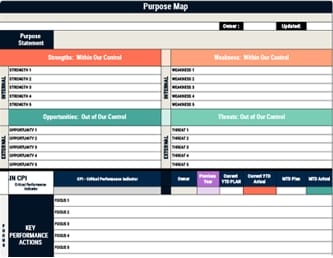

You need strategy templates that turn intent into action, so anchor them in a simple framework—Mission and Vision, Targets, Value Proposition, Go-to-Market, and Organization—then link a CPI→KPI→KPA loop to North Star metrics that guide daily work. Map where to play and how to win, assign owners, and set cadence, milestones, and dashboards for visual management. When templates convert slides into accountable initiatives, you get alignment, speed, and measurable impact—but only if you choose wisely.
Key Takeaways
- Use a CPI→KPI→KPA loop with North Star metrics to tie strategy to daily accountable actions.
- Build around a clear storyline: Mission & Vision, Targets, Value Proposition, Go-to-Market, Organization.
- Choose templates by use case: direction, GTM launch/growth, or execution alignment with OKRs and cadence charts.
- Demand visual scorecards and owner-tagged initiatives that convert slides into prioritized roadmaps with milestones.
- Prefer proven, customizable PPT/Excel templates trusted by ex-consultants, with sector-specific modules (B2B, B2C, SaaS, nonprofits).
The Best Business Strategy Templates (Quick Picks)
Although countless slide decks promise strategic clarity, start with quick picks that pair proven frameworks with practical execution, so you can build a plan fast and use it immediately.
Start with quick picks that pair proven frameworks with execution for a fast, immediately usable plan.
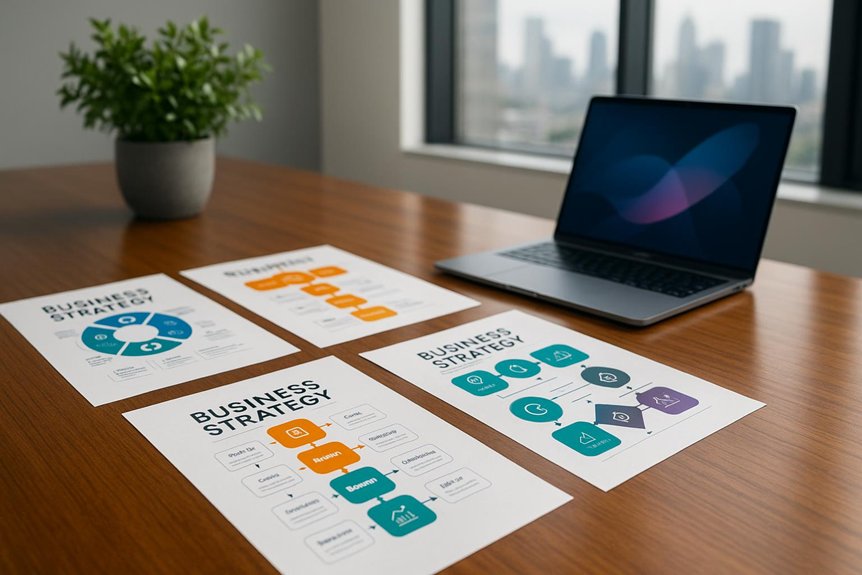
Choose a BusinessStrategy template that structures “where to play” and “how to win” into clear sections—Mission & Vision, Targets, Value Proposition, Go-to-Market, and Organization—so you can map choices to actions without rework.
Prioritize templates with storyline development and concise storytelling, because a reusable narrative keeps your visuals aligned with strategic objectives and stakeholder expectations.
Select fully customizable PowerPoint and Excel files, letting you adapt colors, fonts, layouts, and footnotes, while using tutorials and real-life examples to accelerate delivery.
Look for actionable steps, progress measures, and team-alignment techniques, validated by ex-McKinsey and BCG consultants and 4,500+ customers.
Strengthen your plan with tools that support organizational alignment, since aligned companies can grow revenue faster and improve profitability through clearer objectives, better collaboration, and enhanced decision-making.
How to Choose Business Strategy Templates by Use Case
Where should you start when selecting a strategy template by use case? Anchor on your goal: are you defining direction, building a go-to-market plan, or aligning execution. If you’re setting mission, vision, targets, and value proposition, choose a template with cohesive storyline slides and “where to play/how to win” frameworks, since these make Fortune 500–style narratives concise and reusable. For launch or growth use cases, prioritize go-to-market modules, metrics, and action plans that tie activities to outcomes.
To ensure cohesion and adaptability, consider templates that incorporate OKRs or similar alignment frameworks, enabling measurable objectives and regular performance reviews.
If you’re driving execution, pick templates with clear KPIs, cadence charts, and alignment techniques, so teams can track progress reliably. Confirm you can fully customize colors, fonts, layouts, and footnotes in PowerPoint and Excel, and lean on tutorials plus real examples. Finally, trust proven providers—ex-MBB teams, strong reviews, and thousands of customer deployments.
Business Strategy Templates That Actually Work
How do you know a business strategy template will actually move you from ideas to results? You look for tools that help you build a complete, cohesive plan, not just pretty slides. With ready-to-use frameworks for mission, targets, value proposition, and go-to-market plans, you can structure thinking, validate assumptions, and present clearly to executives.
- You translate strategy into action by defining measurable goals, initiatives, timelines, and owners, supported by storyline guidance that makes decisions obvious.
- You customize PowerPoint and Excel files—colors, fonts, layouts, footnotes—while following tutorials and real-life examples that show how to adapt slides without losing clarity.
- You trust proven expertise: ex-McKinsey and BCG consultants (Alexandra Kampmann, Kasper Vardrup, Mats Stigzelius) shaped these templates, used by 4,500+ customers, rated 4.8/5, with 95% recommending.
- They also help you ensure organizational alignment by connecting strategy, structure, and systems so teams execute the plan consistently and communicate clearly.
Customize Strategy Templates for Your Industry (B2B, B2C, SaaS, Nonprofit)
Precisely tailor your strategy template to your industry so the plan reflects real market dynamics, decision cycles, and success metrics rather than generic best practices. Start by mapping where-to-play, how-to-win, and your value proposition to sector realities, then define customer segments and competitive forces with enough detail to guide trade-offs. For B2B, align to long sales cycles, account-based motions, and pipeline health; for B2C, emphasize demand generation, basket size, and repeat purchase drivers. In SaaS, embed retention curves, cohort analysis, and unit economics like CAC, LTV, and payback. For nonprofits, translate goals into impact metrics, stakeholder alignment, and funding diversity. Set SMART goals and sector-relevant KPIs that resonate with typical decision-makers, and include concise case examples to illustrate credible execution. To keep teams aligned and responsive, incorporate visual management boards with color-coded, real-time KPIs so deviations are spotted quickly and discussed during routine performance check-ins.
From Slides to Action: Turn Strategy Templates Into Execution
Bridge the gap from polished slides to real outcomes by turning each section of your BusinessStrategy template into owned initiatives, accountable leaders, and time-bound milestones that tie directly to measurable KPIs. Start by converting storyline pages into a prioritized roadmap, assign owners for each initiative, and lock deadlines in the Excel tracker, which you can customize for your reporting cadence. Use the Fortune 500 examples to define scope, dependencies, and risks, then adapt colors, fonts, and footnotes so your leaders instantly recognize what’s critical and what’s next.
Turn slides into outcomes: owned initiatives, accountable leaders, time-bound milestones, and KPI-tied execution.
To sustain progress and visibility, establish governance rhythms with aligned OKRs and regular reviews that connect top-level strategy to day-to-day execution.
- Translate each framework into a charter: objectives, deliverables, owner, budget, and milestone dates.
- Build a weekly operating rhythm: stand-ups, status updates, and variance reviews.
- Create alignment artifacts: one-page briefs, RACI, and decision logs.
Leverage execution tips from ex-McKinsey and BCG consultants, validated by 4.8/5 reviews.
Prove Impact With KPIs and Strategy Scorecards
Evidence, not ambition, convinces stakeholders that strategy is working, so anchor your plan in KPIs and a strategy scorecard that translates objectives into measurable outcomes across financial, customer, internal process, and learning perspectives. Start by linking your vision to a small set of clear, quantifiable indicators that show movement, not just activity, then define baselines, targets, and time frames so progress is unambiguous. Assign owners for each KPI, specify data sources, and set review cadences to drive accountability and timely decisions. Use real-time dashboards to surface performance trends, enabling quick course corrections when indicators drift. Build cause-and-effect chains across the four perspectives, ensuring initiatives align with outcomes. Finally, keep definitions consistent across teams, update targets as context shifts, and share results openly to sustain momentum. Tie KPIs to operational realities and engage stakeholders early so measures remain actionable, trusted, and adaptable as conditions change.
Avoid These Strategy Template Mistakes
You’ve set KPIs and scorecards to track outcomes; now make sure your template choices don’t undermine that rigor by avoiding common pitfalls that derail clarity, alignment, and execution. Don’t let polished slides replace thinking; use the BusinessStrategy structure—Mission & Vision, Targets, Value Proposition, Go-to-Market, Organization—to force the hard choices, not hide them. Customize, but keep storylines tight and aligned with objectives, so metrics, tactics, and owners are unmistakable. To ensure execution, anchor your templates in a CPI→KPI→KPA loop, making CPIs the North Star metrics and translating them into daily KPAs that drive accountable action.
- Don’t over-customize PowerPoint and Excel: edit colors, fonts, and layouts to fit branding, yet preserve hierarchy, footnotes, and data integrity so stakeholders can follow the logic.
- Avoid slide dumping: build a reusable storyline, guided by the tutorials, that ties KPIs to actions, trade-offs, and timelines.
- Don’t copy Fortune 500 examples blindly: adapt them to your context, ensure assumptions match your market, and verify execution steps.
Download Formats and Where to Get Business Strategy Templates
Although formats vary across providers, you can download business strategy templates in PowerPoint and Excel, typically as ready-to-use slide decks and scorecards that you can customize without breaking structure. Look for files that map to proven frameworks like “where to play” and “how to win,” and ensure core sections are included: Mission & Vision, Targets, Value Proposition, Go-to-Market, and Organization, so you can slot in data without redesigning slides. Prioritize providers staffed by ex-consultants from McKinsey, BCG, and Bain, since their templates often embed actionable steps, progress measures, and team-alignment tools. To reduce risk, check credibility signals: a 4.8 average rating from 41 reviews, 95% recommendations, and adoption by 4,500+ customers. Download directly from vendor sites or reputable marketplaces offering instant access. For strategy execution, choose templates that support visual management principles so KPIs, progress, and actions are clear within 10 seconds.
Frequently Asked Questions
How Do We Run a Live Workshop Using These Templates?
You run a live workshop by defining goals, selecting templates, and setting a clear agenda with timed segments. Share materials beforehand, then open with a brief overview and a quick demo. Form small groups, assign roles, and guide them through each template step, using examples and checkpoints. Facilitate Q&A, capture decisions on a shared board, and keep momentum. Conclude with group readouts, synthesize insights, assign owners, and schedule follow-ups.
What Stakeholder Pre-Reads Should Accompany the Strategy Deck?
Include a one-page executive summary, a clear problem statement with context, market and competitor snapshots, customer insights, financial baseline and constraints, risk and assumption log, and definitions of key terms. Add a brief methodology note explaining how you built the deck, plus data sources and their dates. Provide a decision framework, draft KPIs, and a timeline. Share pre-mortem highlights, governance roles, and meeting objectives so stakeholders arrive prepared to challenge assumptions and decide next steps.
How Often Should We Refresh the Strategy Templates?
Refresh strategy templates quarterly to capture market shifts, technology changes, and lessons from execution, then perform a deeper annual overhaul to align with planning cycles and structural updates. You should also trigger ad‑hoc refreshes after major events, like M&A, regulatory changes, or a pivot. Maintain a change log, version controls, and review checklists, and gather cross‑functional feedback to retire stale sections, standardize definitions, and tighten decision criteria without bloating the templates.
How Do We Handle Sensitive or Confidential Data in Templates?
You handle sensitive data by stripping templates of real identifiers, using placeholders, and storing examples in a secure, access-controlled repository. Classify data (public, internal, confidential), then tailor fields to the lowest necessary sensitivity. Encrypt files at rest and in transit, enable version control with audit logs, and require least-privilege permissions. Provide redaction guidance in the template, add data retention rules, and schedule periodic reviews for compliance with legal, contractual, and privacy requirements.
What Facilitation Tips Improve Executive Alignment During Review Sessions?
Open with a one-sentence purpose and agenda; teams with clear goals are 2.8x more likely to align. Timebox each segment, surface decision rights upfront, and assign a facilitator to manage airtime and parking lots. Use a shared pre-read, a RACI for decisions, and a “two-way door” vs “one-way door” framing. Summarize agreements live, record owners and deadlines, and end with a decision log and explicit next steps.
Conclusion
Use these strategy templates to turn vision into motion, selecting by use case, customizing for your industry, and anchoring execution in a CPI→KPI→KPA loop with clear North Star metrics. Translate slides into accountable initiatives with owners, milestones, cadences, and dashboards, then validate impact through scorecards and objective KPIs. Avoid vague targets, bloated frameworks, and missing governance. When you align where to play and how to win, you’ll move from ideas to results at lightning speed, without sacrificing rigor.