
Most organizations that claim to manage performance are actually just documenting it after the fact. If you’re relying on annual reviews and subjective ratings, you’re not driving results—you’re reacting to them months too late. The connected business model flips this entirely by linking daily work to measurable outcomes in real time. The differences between these two approaches aren’t subtle, and understanding them will change how you think about your team’s output.
Key Takeaways
- Traditional performance management relies on annual reviews and subjective ratings; the connected model uses continuous check-ins and evidence-based measurement.
- Connected systems tie individual work directly to strategic business KPIs, while traditional systems evaluate behavioral competencies without measuring business impact.
- Annual reviews suffer from recency bias and delayed feedback; connected approaches enable real-time coaching and timely course corrections.
- Traditional evaluations create high-stakes stress through one-time meetings, whereas connected models foster ongoing, transparent, growth-focused conversations.
- Connected performance management replaces subjective rating scales with measurable OKRs integrated into everyday workflow tools like Jira or Slack.
Where Traditional Performance Management Falls Short
How effectively can a performance system serve employees when its feedback arrives months after the work is already done? You’re operating with outdated input that can’t guide real-time decisions.
Feedback that arrives months late can’t guide the decisions you’re making today.
The process depends heavily on your manager’s observation skills, making it vulnerable to recency bias and inconsistent standards.
Documentation alone demands 8–12 hours per employee per year, time that could go toward coaching.
Traditional competency ratings like “4 out of 5 for initiative” describe behavior rather than measuring actual business outcomes tied to strategic goals.
Perhaps most critically, these HR-centric, compliance-focused systems fragment performance from business execution, making it difficult for you to connect individual goals to the priorities your organization is actively pursuing.
With strategic alignment, teams can connect clear objectives and measurable KPIs to daily work, reducing the gap between performance management and business execution.
What the Connected Performance Model Actually Looks Like
What does it actually look like when performance management stops being a disconnected HR exercise and starts functioning as a live business system?
In the connected performance model, you’re tying individual work directly to business plans like OKRs, running frequent check-ins instead of waiting for annual review cycles, and evaluating people through measurable outcomes rather than backward-looking ratings.
Managers drive the process through regular coaching conversations while HR provides the structural framework and tooling that keep standards consistent.
You’re replacing vague competency assessments with evidence-based evaluation that connects contributions to strategic KPIs.
The shift moves your organization from fear-based, hidden ratings toward transparent, growth-oriented discussions where issues get addressed in near-real-time—while they can still influence current work.
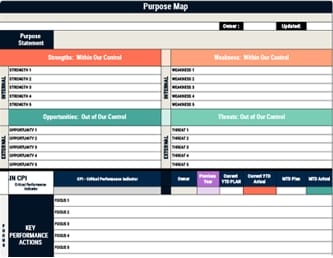
To make that visibility practical, teams often use real-time dashboards that surface KPI changes immediately so managers and employees can identify issues quickly and act before performance drifts further.
Connected vs. Traditional Performance Management: Key Differences
Because the differences between these two approaches shape every aspect of how your organization handles performance, it’s worth laying them out side by side so you can see where the connected model departs from the traditional one and why those departures matter for actual business results.
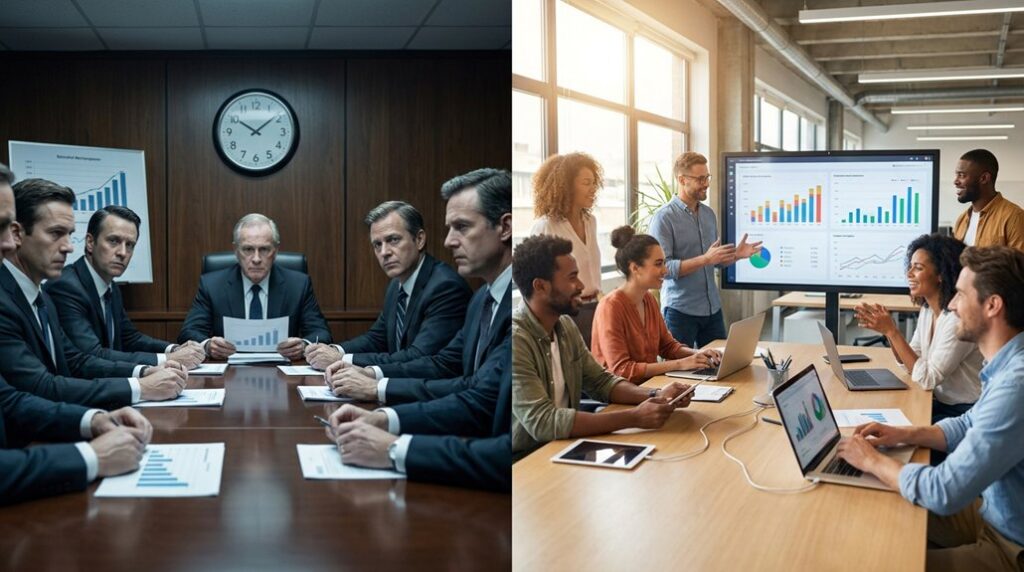
Traditional performance management relies on annual review cycles, subjective rating scales, and competency-based evaluations that often feel disconnected from daily work.
The connected model replaces these with continuous check-ins, evidence-based measurement tied to strategic KPIs, and an explicit link between plans, processes, and people.
Where traditional systems create stress through high-stakes, one-time meetings, the connected approach keeps conversations transparent, timely, and growth-focused.
You’re shifting from documenting behavior to measuring business impact, which reduces bias and gives employees clear visibility into how their contributions drive results.
This shift also strengthens strategic alignment by connecting everyday performance discussions to shared objectives, cross-functional coordination, and long-term business priorities.
Why the Connected Model Outperforms Annual Ratings
When annual ratings deliver feedback months after goals were set, they create a timing gap that makes meaningful improvement nearly impossible because the next work cycle has often already started and employees are focused on new priorities rather than correcting old ones.
The Connected Model addresses this by outperforming annual ratings in four key ways:
- Reduces recency bias by linking performance conversations to continuously tracked OKRs and progress check-ins rather than relying on a manager’s memory of recent months.
- Drives evidence-based decisions by tying your contributions to measurable business KPIs instead of subjective competency scales.
- Lowers stress by replacing high-stakes annual events with ongoing coaching loops that support earlier course correction.
- Adapts to shifting priorities through real-time dashboards that flex as your business pace changes.
Teams can make those shifting priorities easier to interpret by using color-coded indicators on visual management boards to spot deviations and act quickly.
How to Shift to Connected Performance Management
How exactly do you move from a system built around annual, backward-looking reviews to one that delivers agile, ongoing feedback without derailing your team’s day-to-day work? Start with a three-month assessment and preparation phase that includes a current-state analysis, a technology audit, and a manager capability check to establish your baseline.
Next, use a phased rollout: maintain Traditional PM for compliance and stability while you pilot Dynamic and Connected practices in a few data-rich departments before expanding organization-wide. This approach reduces adoption risk while immediately improving timeliness.
You’ll also want to align performance to business execution by tying each employee’s goals—such as OKRs—to integrated systems like Jira, Asana, Slack, or Teams, ensuring day-to-day work directly feeds performance insights. To keep the transition transparent and accountable, establish numeric KPIs early and review them regularly so teams can track progress and adjust execution in real time.
Frequently Asked Questions
What Are the 4 Pillars of PMS?
The four pillars of PMS are Plans, Processes, People, and Performance Evidence/Insights. You’ll use Plans to keep goals aligned with strategy, Processes to maintain continuous feedback loops, People to drive leader-led growth conversations, and Performance Evidence/Insights to ground evaluations in measurable indicators rather than subjective judgment.
Together, these pillars connect your strategy to daily work, ensuring performance expectations remain adaptive, objective, and growth-oriented.
What Are the 5 C’s of Performance Management?
The 5 C’s of performance management are Connected Plans, Processes, People, Coaching, and Criteria.
Research shows companies using connected performance models see up to 36% better business outcomes.
You’ll align goals to strategy through connected plans, replace annual reviews with ongoing check-ins through connected processes, empower managers to own conversations through connected people, deliver evidence-based feedback through coaching, and set clear expectations through defined criteria.
What Is the Difference Between Traditional Management Model and Modern Management Model?
Traditional management evaluates your past performance through annual reviews with standardized ratings, relying on manager judgment and manual documentation—which often introduces recency bias and delayed feedback.
Modern management, by contrast, gives you continuous, data-driven insights focused on future development, using real-time goal tracking and automated indicators so you can adjust your work while it still matters, aligning your outcomes directly with organizational strategy.
What Is the Difference Between Traditional and Modern Performance Management Systems?
Traditional performance management gives you periodic reviews based on subjective manager ratings and backward-looking documentation, which often creates recency bias and delayed feedback.
Modern performance management, by contrast, connects your work systems—like project tools and communication platforms—to automatically collect real-time, role-based indicators that AI synthesizes into predictive insights and coaching prompts, so you’re receiving continuous, evidence-based feedback that lets you adjust quickly as priorities shift.
Conclusion
Think of traditional performance management as a ship that only checks its compass once a year—you’ll drift far off course before anyone notices. When you adopt the connected model, you’re giving your crew real-time navigation, clear destinations through OKRs, and a captain who coaches through every storm. You don’t have to overhaul everything overnight, but you do need to start steering with intention, frequency, and measurable direction.