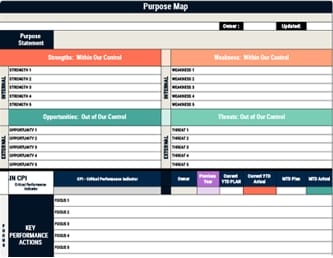


Strategy often feels aspirational while execution gets messy, yet you can connect them by translating high-level goals into SMART objectives, assigning clear owners, and cascading KPIs from top to bottom. You align cross-functional work through shared dashboards, cadence-based reviews, and visual management that flags risks early. You reduce bias with multi-source data, empower teams with bottom-up targets, and drive rapid course corrections—so the question becomes how to design the loops that keep this system honest and fast.
Key Takeaways
- Translate strategy into SMART goals, KPIs, and role-level outcomes, then cascade them to align daily work with enterprise priorities.
- Use unified dashboards and strategy maps to link objectives, KPIs, and initiatives, enabling real-time visibility and cross-functional coordination.
- Run continuous data-driven reviews to detect variances early, trigger rapid course corrections, and keep resources on the highest-impact work.
- Establish governance rhythms—monthly performance huddles and quarterly strategy reviews—with transparent scorecards, owners, targets, and trends.
- Integrate multi-source data and standardized feedback in 1:1s to reduce bias, sharpen decisions, celebrate wins, and refine plans continuously.
Why Strategic Alignment Drives Accountability and Engagement
How does strategic alignment turn abstract goals into daily accountability and real engagement? You make expectations concrete by linking tasks to broader objectives, so people see how their work advances strategic priorities and why standards matter. You reinforce this clarity with timely feedback, objective-based evaluations, and standardized processes that reduce bias, since consistent criteria and multi-source inputs keep performance judgments fair and actionable.
You align goals across marketing, sales, and product, ensuring measures reflect organizational aims and resources flow to the highest-priority outcomes, which increases ownership because teams can trace impact. You use clear strategy maps and unified dashboards to show contributions in real time, improving focus and cross-functional collaboration. You connect innovation roadmaps and metrics to strategy, promoting continuous learning and measurable long-term results. Aligned organizations can swiftly adapt to market changes and improve customer satisfaction, strengthening accountability and engagement across teams.
Translating Strategy Into Goals, KPIs, and Daily Work
Even before you set targets, translate your strategy into concrete goals by identifying the few departmental objectives that directly support enterprise priorities, then define clear KPIs so every function can track its contribution with shared standards. Convert those objectives into SMART goals that specify measurable results, time frames, and owners, then cascade them so every role is accountable for defined outcomes. Use a visual strategy map to show how goals connect to critical success factors, and pair it with a unified dashboard that displays KPIs by function and role.
Support fairness and accuracy by using standardized data definitions and multi‑source feedback, which reduce bias and clarify impact. Hold quarterly or monthly reviews to recalibrate goals, update metrics, and adjust daily tasks as priorities evolve.
Building Focus, Coordination, and Cross‑Functional Alignment
Why do some organizations move in lockstep while others spin in place? You build alignment by making every task serve strategy, so teams focus on what matters and drop work that doesn’t. Establish clear objectives, then use regular feedback cycles and objective-based evaluations to show how daily work advances priorities, correcting drift early. Strengthen fairness and accuracy with multi-source feedback and standardized processes, which reduces disputes and speeds cross-team handoffs. Connect individual contributions to broader goals with dashboards, strategy maps, and scorecards, enabling real-time alignment and course corrections. Use unified performance dashboards to give stakeholders shared visibility, so coordination decisions rely on the same facts. With this rhythm, you focus effort, synchronize dependencies, and keep execution tightly linked to strategic outcomes. To sustain momentum and adaptability, embed regular governance rhythms and performance dashboards that track OKRs, enabling timely course corrections and reinforcing accountability across teams.
Overcoming Visibility, Bias, and Fragmented Data Challenges
Strong alignment loses momentum when you can’t see consistent facts, so extend your coordination rhythm by fixing visibility gaps, bias, and fragmented data at the same time. Start by consolidating performance and business data into a unified dashboard that links KPIs to strategic goals, because a single source of truth lets you spot gaps quickly and adjust before issues spread. Use strategy maps and role-level dashboards to show how daily actions ladder to objectives, reducing confusion and rework.
Reduce bias with regular, standardized data collection from diverse sources, then pair it with multi‑source feedback to balance perspectives and strengthen fairness. Schedule recurring reviews that use the same measures and thresholds, so performance discussions stay objective, and decisions move faster with clear evidence rather than opinion. Add a daily management system with visual management and structured reviews to translate KPIs and CPIs into observable Key Performance Actions that drive continuous improvement.
Empowering Teams With Bottom‑Up Objective Setting
How do you turn strategy into action without losing ownership at the edge of the organization? You ask teams to set their own objectives that translate priorities into specific, measurable outcomes, then you hold them accountable for results. Start by sharing the strategic narrative and key metrics, clarify non‑negotiables, and invite teams to draft goals that mirror those priorities, using clear targets and time frames. Managers facilitate alignment sessions, challenge assumptions, and ensure each objective ladders to the overarching aims, reducing cross‑department misalignment by anchoring work in shared milestones. To reinforce cohesion and measurement, teams can connect their goals to OKRs as a structured framework that links ambitious objectives with clear key results and regular reviews. Require teams to articulate how their goals impact key performance indicators, and consolidate these into a transparent view so everyone sees contribution paths. Iterate objectives as insights emerge, refining scope, sequencing, and dependencies without losing ownership.
Continuous Feedback, Check‑Ins, and Data‑Driven Improvement
Although plans set the direction, you keep execution on track by running continuous feedback cycles anchored in data and structured check-ins that connect everyday work to strategic outcomes. Use flexible conversation frameworks to align priorities, reinforce accountability, and surface issues early, then convert insights into clear actions with owners and timelines. In recurring check-ins, review progress against strategy maps, goal-linked data points, and concise summaries that reveal how individual work advances team or company objectives, ensuring people see their impact and adjust quickly.
Celebrate measurable wins to sustain momentum, but also clarify expectations and recalibrate goals as strategic priorities evolve. Bring multi-source data and analytics to 1:1s to reduce bias, increase fairness, and sharpen decisions, while using trend signals to target coaching, remove blockers, and accelerate cross-functional coordination.
Integrate visual management tools like Kanban boards and metrics dashboards to create real-time transparency that speeds issue resolution and strengthens accountability across teams.
Technology Enablers: Dashboards, Transparency, and Real‑Time Insights
Why rely on guesswork when dashboards can centralize performance data, link goals to real-time metrics, and give you immediate visibility into progress across teams and departments? You use dashboards to translate strategy into action by surfacing strategy maps, KPI performance, and progress against critical success factors in one place, which clarifies ownership and drives accountability. By sharing transparent data with stakeholders, you reduce alignment gaps, accelerate consensus, and enable collaborative decisions grounded in facts rather than anecdotes. Real-time insights let you spot variances early, trigger rapid course corrections, and keep initiatives tied to strategic priorities and measurable outcomes. With continuous data refresh and multi-source inputs, you detect trends and bottlenecks sooner, guide targeted problem-solving, and reallocate resources to the work that matters most. Additionally, using color-coded indicators on dashboards enables quick, intuitive identification of performance deviations, ensuring issues are addressed promptly.
Measuring Impact and Sustaining Long‑Term Performance Momentum
Momentum comes from measurement you can trust, and you build it by treating impact as a managed, recurring cycle rather than a once‑a‑year report. You sustain performance by reviewing KPIs on a set rhythm, inviting open feedback across functions, and adjusting goals as priorities shift. Run gap analyses against strategy and budget, then update objectives and documentation when assumptions change, so your plan stays current.
- Hold monthly performance huddles and quarterly strategy reviews, using cross‑functional input to spot disconnects early and recalibrate.
- Maintain transparent scorecards that show targets, trends, and owners, reinforcing accountability and making progress visible to all stakeholders.
- Operate a continuous improvement loop that links data to decisions, refining actions, reallocating resources, and retiring low‑value work.
Treat this cadence as governance, not overhead, to maintain long‑term momentum. Aligned organizations can grow revenue faster and be more profitable, so regularly connecting KPIs to both vertical and horizontal alignment strengthens decision-making and boosts employee engagement.
Frequently Asked Questions
How Do We Budget and Allocate Funds for a Connected Business Model?
Start by funding high-impact, cross-functional initiatives, then allocate baseline budgets to core operations, data infrastructure, and integration tools. Use a portfolio approach: 60% to proven capabilities, 25% to scaling pilots, 15% to experiments. Tie every allocation to measurable outcomes, build a rolling quarterly forecast, and set guardrails for cost-to-value ratios. Centralize shared platforms, decentralize customer-facing budgets, and require stage gates, revisiting assumptions after each milestone to reallocate toward demonstrated value.
What Change Management Tactics Ease Adoption Across Skeptical Teams?
Like warming up a skeptical crowd, you start by co-creating a clear case for change, tying benefits to team pain points, and defining success metrics. You pilot with champions, publish quick wins, and scale iteratively. You equip managers with scripts, FAQs, and coaching, while offering role-based training and just-in-time job aids. You formalize feedback loops, adjust plans visibly, align incentives and performance goals, and maintain transparent timelines, risks, and decision logs.
How Do We Handle Governance, Risk, and Compliance Within This Framework?
You handle governance, risk, and compliance by defining clear policies, mapping them to objectives, and embedding controls directly into workflows. You create a risk register, assess impact and likelihood, assign owners, and set measurable thresholds. You automate control monitoring, use dashboards for real-time visibility, and escalate breaches with predefined playbooks. You align audits with key processes, maintain evidence trails, and run periodic reviews, so you continuously improve and prove compliance efficiently.
What Skills and Roles Are Needed to Operate and Sustain the Model?
You need strategic leaders, product owners, data analysts, process engineers, and risk/compliance specialists, plus finance partners who translate value. You should staff solution architects, integration engineers, and cybersecurity experts to build reliable platforms, while UX researchers and change managers drive adoption. You’ll rely on agile coaches and scrum masters for cadence, and PMO or portfolio managers for prioritization, with enablement roles—training, documentation, and support—sustaining performance, standards, and continuous improvement.
How Should We Phase Implementation Across Regions or Business Units?
Phase implementation in waves, starting with two pilot units that show strong leadership and data readiness, then expand to adjacent units with similar processes. Define standard templates, governance, and metrics upfront, and lock a common data model before scaling. Run parallel change, training, and incentives, and establish a central support squad. Use stage gates—adoption, data quality, and impact—to approve progression, and capture lessons learned to refine playbooks for the next wave.
Conclusion
You tie strategy, performance, and problem‑solving into one system, then keep it honest with clear owners, SMART goals, and cascading KPIs. Use dashboards and regular huddles to flag gaps early, align cross‑functional work, and correct course quickly. Treat data like a compass, verifying it from multiple sources to reduce bias. As teams set bottom‑up objectives, you maintain governance cadences, measure impact, and sustain momentum, steering the organization like a well‑trimmed sailboat that responds quickly to shifting winds.