

Consider a Fortune 500 company that spends six months building a strategy only to discover, one quarter later, that fewer than a third of its managers can name the top three priorities. That disconnect isn’t a communication failure—it’s an execution gap, and it shows up in predictable, diagnosable ways. If you can’t spot the symptoms early, you’ll keep mistaking activity for progress until the damage is already visible in your results.
Key Takeaways
- A quarter to nearly half of employees cannot articulate the company’s top strategic priorities, signaling a fundamental translation failure.
- Planning occurs episodically while execution runs continuously, causing daily drift between periodic review cycles.
- Goals define activities instead of measurable outcomes, diffusing accountability so no single owner drives results.
- Initiative momentum collapses weeks after kickoff as early enthusiasm fades and teams revert to old habits.
- Risks and cross-functional dependencies stay invisible until monthly or quarterly reviews, when slippage has already compounded.
What the Execution Gap Looks Like From the Top
When most executives encounter the execution gap, they don’t find it lurking in the quality of their strategy—they find it in the moment strategic ambition fails to show up in day-to-day operating reality, creating a persistent mismatch between what leadership intends and what managers actually deliver.
You’ll notice the first visible symptom when you realize 25–45% of your employees can’t articulate the company’s top priorities.
When a quarter of your people can’t name what matters most, your strategy exists only on paper.
Decisions across your organization may still appear sensible in isolation, yet they’re misaligned and expensive because people are optimizing against outdated or unclear objectives.
In a fast-moving environment, this isn’t a minor communication issue—it’s a structural failure that compounds daily, quietly eroding your competitive position while the strategy deck gathers dust.
This kind of breakdown is exactly what organizational alignment is designed to prevent by connecting strategy, structure, systems, and communication to daily execution.
Plans That Never Reach the Ground Floor
The gap between boardroom intent and front-line action starts well before anyone on the ground floor makes a bad decision—it starts in how plans travel downward through the organization.
When you translate strategy reviews into OKRs or initiatives, you’re assuming those constructs carry meaning all the way to the people doing the work, but research shows 25–45% of employees can’t articulate their company’s top priorities.
You’re running planning as an episodic event while execution remains continuous, which means strategic intent degrades as conditions shift faster than your management model adapts.
Without a system of record connecting strategy to actual tasks, initiatives get “agreed” in meetings but never become the weekly execution rhythm your teams need to deliver results consistently.
A disciplined performance dashboard can help leaders continuously monitor progress, reinforce accountability, and adapt execution as conditions change.
Priorities That Stay Aspirational and Never Turn Operational
Although leadership teams declare priorities with conviction during planning cycles, those priorities stay aspirational because the organization lacks the translation mechanisms that convert executive intent into owned, measurable work at the team level.
When 25–45% of your employees can’t clearly articulate what matters most, you’re witnessing the symptom firsthand.
The root cause is structural: planning is episodic while execution is continuous.
Your annual strategy decks and quarterly reviews create snapshots, but daily work drifts without objectives and key results tied to specific owners and leading indicators.
Strategy decks capture a moment; without owned OKRs and leading indicators, daily work drifts between snapshots.
You compound this by over-investing in backward-looking reporting—status recitations built on stale data—instead of weekly risk-focused conversations that adjust resource allocation in real time.
Priorities don’t become operational until someone owns de-risking them every week.
Using strategy maps can help leaders visually align strategic goals with team-level responsibilities so priorities are easier to translate into measurable execution.
Unclear Outcomes That Let Teams Interpret Strategy Differently
Beneath every misaligned team sits the same structural flaw: outcomes that were never defined precisely enough for two different departments to arrive at the same interpretation.
When you communicate objectives as activities instead of measurable key results, middle managers can’t explain how their work maps to enterprise success, and alignment fractures at exactly the layer responsible for translating strategy into daily decisions.
Because most organizations review strategy only annually while execution runs continuously, vague outcome definitions drift further apart each quarter.
Teams fill the gap with local assumptions, and your quarterly business reviews devolve into status recitations rather than risk-focused trade-offs.
You won’t discover the divergence until reconciliation becomes expensive, which means you need a shared system of record with measurable outcomes established from the start.
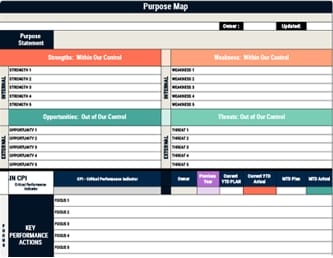
One way to prevent that drift is to define a small set of Critical Performance Indicators that establish the vital outcomes every function must interpret the same way.
Everyone Owns the Goal, So No One Actually Drives It
When a goal is phrased so that “everyone is responsible,” you’ve actually guaranteed that no single person can explain how their team’s work links to enterprise outcomes, because shared ownership without a named driver diffuses accountability to the point where it evaporates. This kind of ambiguity breaks organizational alignment, weakening the clear connection between team execution and strategic goals that drives stronger business performance.
- You’ll notice middle managers can’t articulate their team’s contribution to enterprise results, which signals absent ownership rather than poor communication.
- Decisions get made without committed capacity allocation, so teams treat priorities as shared intentions with no resource follow-through.
- Cross-functional coordination collapses into vertical status reporting instead of engineered lateral ownership.
- Dependencies slip for weeks because gaps surface too late without horizontal accountability.
- Weekly de-risking rituals lack named blockers and owners, so stalled work doesn’t get corrected in days.
Weak Accountability Rhythms That Let Risks Age in Silence
Organizations that rely on quarterly or monthly status recitations instead of a weekly, risk-focused cadence almost inevitably let dependencies slip for weeks before anyone surfaces the issue in time to adjust—turning what could’ve been an early correction into a late-stage failure.
When reviews happen monthly, risks compound silently—early corrections become late-stage failures before anyone sounds the alarm.
Without daily or weekly follow-through ownership, blockers aren’t flagged in red, owners aren’t assigned, and resolution actions aren’t tracked even when progress has stalled completely.
You’ll recognize this pattern when your teams can’t articulate top priorities—research shows 25–45% of employees fall into that category.
The root cause isn’t awareness; it’s the absence of a shared mechanism for escalation and de-risking.
Your reporting cycle has replaced active risk management, allowing problems to compound silently between reviews.
A simple visual management layer built around real-time data and clear ownership can surface stalled work early enough for teams to act before risks age into failures.
Momentum That Collapses Once the Kickoff Energy Fades
Every initiative looks unstoppable during the kickoff—slides are sharp, energy is high, and commitments feel genuine—but that momentum typically collapses within weeks because your planning model is episodic while execution is continuous.
- Your managers are overloaded and under-supported, so new priorities can’t survive the daily execution load
- You’re detecting risks and cross-functional dependencies too late—often at monthly or quarterly reviews after slippage has already compounded
- Your teams overestimate their own follow-through and revert to old habits once early enthusiasm fades
- You lack a weekly rhythm that forces progress visibility, so stalled work becomes invisible to leadership
- Your administrative-heavy schedules crowd out the operating support managers actually need to sustain momentum
Adding visual management boards with real-time, color-coded performance indicators creates a weekly execution rhythm that surfaces stalled work early and supports timely intervention.
Meetings That Report on Execution Without Improving It
Although your calendar may be packed with execution-related meetings, most of those sessions function as backward-looking status recitations rather than forward-looking problem-solving forums—and that distinction is the difference between meetings that actually drive results and meetings that merely document drift.
Meetings that document drift feel productive but deliver nothing—only forward-looking problem-solving actually drives results.
When teams report upward instead of coordinating laterally, you’re mistaking vertical reporting for execution management.
Senior reviews compound the problem by relying on stale data—by the time quarterly slides are presented, issues have already slipped for weeks.
The most damaging pattern is “everyone discusses, no one owns,” where meetings end without assigned outcomes or resolution owners, causing agreed plans to revert to business as usual within a week.
You need meetings that de-risk, not merely report.
The fix is to redesign these forums around clear ownership and continuous feedback so strategy and execution stay aligned as conditions change.
Frequently Asked Questions
What Are the 8 S’s?
Without mastering all eight, you’ll watch your strategy crumble spectacularly. The 8 S’s are Strategy, Structure, Systems, Shared Values, Style, Staff, Superordinate Goals, and reSources.
You should treat them as interdependent levers that must align for execution to succeed.
This model drops Skills from McKinsey’s original framework and adds reSources, so you’re focusing on how real capabilities and assets get allocated to close the strategy–execution gap.
What Is the Higgins 8S Framework?
The Higgins 8S Framework is a strategic execution tool you can use to diagnose why your strategy isn’t producing results, and it adapts McKinsey’s 7S model by removing “Skills” and adding “reSources” along with “Strategic Performance” as a measurable anchor.
You’ll align eight interdependent elements—Strategy, Structure, Systems, Style, Staff, Shared Values, reSources, and Strategic Performance—so that misalignment in one area doesn’t undermine the others during execution.
What Is the Execution Gap Model?
With research suggesting up to 90% of strategies aren’t executed successfully, the execution gap model explains how most strategy failures are actually mismatches between your strategic ambition and operating reality.
You’ll find it surfaces when declared priorities don’t match what your organization can fund and deliver, managers are overloaded without adequate support, lateral alignment is assumed rather than engineered, and risk detection gets delayed until quarterly reviews.
What Are the 5 Pillars of Effective Strategy Execution?
The five pillars you need for effective strategy execution are: (1) total clarity—translating strategy into measurable outcomes and KPIs, (2) prioritization of demand—allocating resources to strategy-critical objectives, (3) an operating cadence—using weekly de-risking rhythms and quarterly assessments, (4) real-time transparency and alignment—surfacing dependencies through cross-functional objectives, and (5) accountability and feedback loops—ensuring missed outcomes trigger coaching and corrective action.
Conclusion
It’s no coincidence that these eight symptoms tend to surface together, because they share the same root: a gap between what you decide and what you deliver. Once you recognize that unclear priorities, diffused accountability, and stale reporting aren’t isolated problems but connected signals, you can stop treating symptoms individually and start closing the execution gap at its source.