

If your strategy lives in spreadsheets, it’s already dying. You’ve built solid objectives at the board level, but somewhere between quarterly planning and daily operations, accountability fractures and KPIs go stale without anyone noticing. Strategy execution software exists to close that gap—connecting every initiative to the metric it should move and surfacing risks before they become surprises. What separates a platform that works from one that just looks good in a demo comes down to eight features most vendors can’t deliver.
Key Takeaways
- Demand enforced ownership on every objective, since 77% lack a named owner, directly undermining accountability and execution.
- Require live integrations with CRM, ERP, and BI tools that automatically refresh KPIs, eliminating manual reporting delays.
- Verify the platform surfaces risks early through structured daily, weekly, and quarterly review rhythms before quarter-end surprises.
- Confirm security credentials including current SOC 2 Type II certification, GDPR readiness, role-based access, and full audit trails.
- Test for stale-data visibility that flags outdated measures and identifies who is responsible for keeping scorecards current.
Why Execution Fails Without Strategy Execution Software
Although most organizations invest significant time crafting strategic plans, the majority of those plans fail not because the strategy itself is flawed but because execution breaks down once priorities need to translate into coordinated, accountable action across the enterprise—research indicates companies fail to meet roughly 20% of their strategic objectives due to poor implementation alone. When you rely on manual updates and spreadsheets, leadership sees problems too late to course-correct. Aggregated platform data reveals that 77% of objectives have no owner and 64.6% have never been formally assessed, which explains why only 13.6% of objectives are rated green. Importantly, objectives with clear ownership are 2.2× more likely to stay on track, proving that structured accountability isn’t optional—it’s the mechanism that determines whether strategy produces results. By contrast, strategy execution software enables governance rhythms and continuous monitoring so leaders can track progress, surface risks early, and adapt action plans before execution derails.
What Strategy Execution Software Actually Connects
How does strategy execution software differ from the dashboards and project trackers most teams already use? It creates a drill-down line from board-level objectives to the exact KPIs, initiatives, and data explanations beneath them, so you’re evaluating outcomes rather than task completion.
Strategy execution software connects board-level objectives to the KPIs and initiatives beneath them—so you measure outcomes, not tasks.
It enforces objective-to-owner accountability, which matters because aggregated data shows 77% of objectives initially lack an assigned owner.
It continuously refreshes KPI data through automated integrations with your CRM, ERP, and operational systems, eliminating stale-measure blind spots.
It connects milestones across departments so you can distinguish initiatives driving strategic progress from those simply finishing on schedule.
It links leading and lagging indicators, risks, and threshold trends to accountable workflows, letting you detect problems and adjust before quarterly results are fixed.
By integrating strategy execution software with visual management boards, operations leaders can turn high-level objectives into real-time, color-coded performance views that trigger faster, team-driven corrective action.
Eight Strategy Execution Software Features Worth Demanding
When you’re comparing strategy execution platforms, the feature list on a vendor’s website won’t tell you whether the tool actually enforces the disciplines that separate strategic progress from busy work, so you need a concrete checklist that tests real capability during every demo and pilot.
- Enforced ownership — the platform should make “no owner” impossible by raising an explicit exception until someone is assigned, since 77% of objectives typically lack an owner and owned objectives are 2.2x more likely to stay on track.
- Stale-data visibility — measures must clearly flag what hasn’t updated in the latest cycle and who’s responsible.
- Live, executive-ready rollups — every demo should produce a board-ready narrative connecting work to initiatives to objectives to KPIs.
- Initiative-to-outcome linkage — initiatives must tie directly to the specific KPIs they’re meant to move.
- Automated reporting and integrations — KPI status should refresh automatically from CRM, ERP, and operational systems.
A strong platform should also reinforce organizational alignment by clearly tying strategy, structure, and systems together so every team can see how their work contributes to shared goals.
How Strategy Execution Software Replaces Monthly KPI Surprises
Because most organizations still rely on manually compiled monthly reporting packs, leadership typically discovers that a KPI has drifted off target only after the damage has already compounded for weeks.
Strategy execution software eliminates this lag by automating KPI updates directly from your CRM, ERP, finance, and operations systems so you’re seeing current reality continuously.
Automated KPI updates from your core systems replace reporting lag with a continuous view of current reality.
Built-in threshold alerts notify owners when metrics trend toward problem zones, giving you an earlier detection window.
The platform also surfaces “stale-data” views that show what hasn’t been updated and who’s responsible, ensuring your scorecards reflect genuinely current performance.
Initiative-to-KPI linkage lets you trace which efforts are actually moving strategic metrics, while drill-down capabilities let you investigate movements immediately rather than waiting until the reporting cycle closes.
By aggregating performance measures into visual management boards, leaders gain a transparent, always-on view of strategic health that replaces sporadic reporting with continuous insight.
Link Every Initiative to the KPI It Should Move
Although most teams track whether an initiative is on time or on budget, those status markers tell you nothing about whether the work is actually moving the needle on a strategic metric.
You need every initiative mapped directly to the KPI it’s designed to influence, so reviews focus on impact rather than completion percentages.
Your platform should let you:
- Map each initiative to a specific KPI or key result so updates report actual impact
- Display the responsible owner and KPI linkage in one review board view, since owned objectives are 2.2× more likely to stay on track
- Flag “what’s stale” so initiative status reflects current KPI data, not last-cycle manual inputs
- Track leading and lagging indicators together to detect problems early
- Block initiatives from being marked “aligned” without an explicit KPI and accountable owner
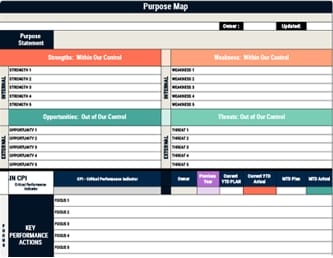
To avoid measurement overload and ensure execution, your platform should also support linking initiatives to a concise set of Critical Performance Indicators and the daily Key Performance Actions that drive them.
Five Demo Questions That Expose Platform Gaps
Before you sign a contract, the demo is your best opportunity to pressure-test whether a platform actually delivers on its promises or just looks good in a scripted walkthrough. Effective demos should also reveal how well the software supports continuous engagement with stakeholders so strategy and execution stay aligned as conditions change.
Ask the vendor to run these five tests using your actual demo data:
- Enforced ownership: Can every objective display a named owner, and can you assign or remove one on the spot?
- Stale-data accountability: Show a “what’s stale” view flagging measures not updated this cycle with the responsible party identified.
- Board-ready live reporting: Build an executive report in real time, not from screenshots.
- Strategy roll-up integrity: Demonstrate how projects roll up to objectives so you can trace which initiatives move strategic metrics.
- Execution risk and cadence: Walk through daily, weekly, and quarterly review rhythms where the system surfaces risks before the quarter ends.
Security, Compliance, and Integration Checks for Execution Platforms
Once you’ve confirmed the platform can handle the five demo scenarios above, shift your focus to what’s happening beneath the surface: security architecture, compliance certifications, and live integrations with your existing systems.
- Role-based access control should extend to the data-point level, with detailed audit trails covering every modification, report generation, and access event.
- Compliance certifications like SOC 2 Type II and GDPR readiness should be current, and you’ll want to confirm whether FedRAMP authorization is available if federal deployments are relevant.
- Data governance must be embedded in the platform’s architecture rather than added as an afterthought, with enterprise data residency options matching your geography.
- Integration testing should use production-grade connections to your CRM, ERP, and BI tools so KPIs refresh automatically.
- Staleness checks during demos should confirm automated refresh behavior and flag outdated measures.
A robust execution platform should also reinforce connected business models by unifying data across departments into a single source of truth, eliminating silos and enabling real-time, integrated planning.
Evaluate Adoption Risk Before You Buy
Even if a platform checks every box on your feature comparison spreadsheet, it can still fail spectacularly when the people who need to use it don’t actually use it—and the data confirms this is the norm rather than the exception.
ClearPoint’s own dataset reveals that 77% of objectives have no named owner, and 64.6% have never been formally assessed, which means most organizations buy strategy software and then quietly abandon the discipline it requires. Strengthening organizational alignment through clear ownership and accountability significantly improves the odds that your strategy execution platform will actually be adopted and used.
During your demo, enforce that every objective and measure must have a named owner, making “no owner” an impossible default rather than an easily ignored gap.
Request a live “stale-data” view showing which KPIs haven’t been updated this cycle and who’s responsible, because outdated metrics directly cause missed execution windows.
Frequently Asked Questions
What Are the Four P’s of Strategy Execution?
The four P’s of strategy execution are People, Plan, Process, and Performance—the operating essentials you need to turn strategic intent into measurable outcomes.
You assign named owners to every objective (People), link initiatives directly to the KPIs they’re meant to move (Plan), run a repeatable review cadence that catches drift early (Process), and maintain automated, current dashboards with threshold alerts so you’re managing performance in real time (Performance).
What Is the Role of Leadership in Strategy Execution?
Leadership is the glue that holds strategy execution together.
You need to assign a named owner to every objective, enforce a consistent review cadence so staleness doesn’t hide underperformance, and link KPIs in real time so you’re making decisions based on current data.
When you drive ownership behavior, your objectives are 2.2× more likely to stay on track, and demanding strategy-to-work visibility closes the gap between planning and execution.
Conclusion
Picture your strategy as a single thread running from the boardroom whiteboard down to every team’s daily dashboard, with no knots, no frayed ends, and no invisible gaps. When you demand enforced ownership, live KPI integrations, stale-data flags, and verified compliance, you’re weaving that thread into a fabric that actually holds weight. Use the evaluation criteria and demo questions above to stress-test every platform before you sign, so execution stays visible and accountable.