

Most execution failures don’t originate in bad strategy—they originate in the gap between agreement and action, where ownership dissolves and momentum quietly dies. You’ve likely experienced this: everyone leaves the meeting aligned, but within days, priorities drift, handoffs stall, and progress fragments across teams. The breakdown isn’t random, and it’s diagnosable if you know whether you’re facing a direction problem or a momentum problem—a distinction that changes everything about how you respond.
Key Takeaways
- Distinguish between direction failures (teams doing the wrong things) and momentum failures (teams doing the right things but stalling).
- Check whether each priority has one clear owner who can articulate its timeline, KPIs, and decision rights.
- Track stall points as measurable gaps between expected and actual progress, then diagnose root causes behind each gap.
- Audit cross-team handoff points weekly for missing owners, mismatched timelines, and misaligned success metrics between teams.
- Embed structured risk reviews into weekly cadences to catch priority drift before it quietly reshapes team execution.
Why Execution Breaks Down in Follow-Through, Not the Plan
Most execution problems don’t trace back to a flawed strategy or a poorly constructed plan—they trace back to what happens after the planning session ends.
You leave the room with clarity, alignment, and energy, but within weeks the momentum fades because ownership, timelines, and metrics aren’t revisited consistently.
The discipline of follow-through is where execution collapses, and it’s almost always because no one built the rhythm to sustain it.
Without weekly reviews that surface who’s stuck, what’s shifted, and what needs immediate adjustment, small stall points compound into major breakdowns.
You don’t need more planning—you need a reliable mechanism that keeps priorities visible, holds owners accountable, and forces honest conversation about progress before problems become irreversible.
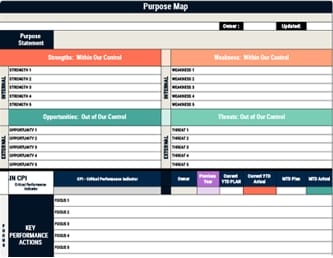
This is why establishing a simple weekly visual management routine—where KPIs are reviewed, gaps are surfaced, and owners update status in front of the team—turns strategy from a one-time event into an ongoing execution habit.
Two Types of Execution Failure: Direction vs. Momentum
When execution breaks down, the failure almost always falls into one of two categories—direction or momentum—and distinguishing between them changes how you respond.
- Direction failures mean the plan itself is mis-specified—stakeholder input was missing, priorities don’t match what actually matters, or teams interpret the vision differently from the start.
- Momentum failures mean the plan was initially correct, but alignment broke during unpacking because ongoing risk conversations weren’t maintained.
- If your teams are doing the wrong things, that’s a direction problem rooted in clarity, priority linkage, and shared understanding.
- If your teams are doing the right things but stalling, that’s a momentum problem driven by missing cadence, follow-through discipline, and cross-team rhythm.
In both cases, diagnosing whether you have a direction or momentum issue is easier if you’ve already built strong organizational alignment around strategy, structure, and communication.
Track Execution Ownership From Agreement to Action
Although a well-crafted strategy agreement sets the stage, execution won’t hold together unless you track ownership through every phase—from the moment a priority’s assigned to the point it becomes someone’s daily work.
Assign one clear owner per priority, then verify within the first week that they can articulate the timeline and KPI linkage in their own words.
From there, confirm each executing team translates the priority into day-to-day responsibilities, metrics, and decision rights—specifically, who decides what without needing approvals.
Use weekly reviews to catch ownership handoff failure: if tasks keep moving but the KPI isn’t shifting, you’ve got momentum without accountability.
Flag any deliverable with multiple claimants or no owner at all as a predictable stall point.
You can reinforce this ownership trail by pairing it with visual management tools that make priorities, KPIs, and decision rights visible in real time so gaps and bottlenecks surface quickly.
Trace How Risk Misunderstanding Shifts Your Priorities
Risk misunderstanding doesn’t announce itself—it quietly reshapes your team’s priorities before anyone notices the plan has drifted.
Risk misunderstanding doesn’t knock—it drifts in quietly, rearranging your priorities before the plan even hits the ground.
When your team holds an incomplete view of what actually matters, they’ll misidentify what’s critical and protect roles instead of resolving the real threat.
Watch for these four patterns that signal risk misunderstanding is driving priority drift:
- Risk alignment fades within hours after strategic planning because shifting conditions quickly overtake initial assessments.
- Teams re-prioritize using partial information when risk conversations aren’t embedded in your weekly cadence.
- A single gap in risk understanding cascades into cross-team friction and operational stalling as strategic risks shift to operational ones.
- Upstream misalignment in mission or values distorts leaders’ risk perception, producing downstream choices that don’t address the actual problem.
Embedding regular, structured risk assessments into your governance rhythms helps prevent this drift by keeping evolving threats visible, debated, and tied directly to execution decisions.
Spot Execution Drift Before Teams Slide Into Silos
Execution drift doesn’t start with a dramatic breakdown—it starts the moment your team stops revisiting the plan together and begins defaulting to individual task lists that feel productive but aren’t connected to shared outcomes.
Track your cadence: if weekly priorities aren’t being reviewed after the initial strategy session, you’re already sliding.
The clearest diagnostic is whether you can name cross-team owners for outcomes, not just activities.
When you can’t, work quietly redistributes into separate backlogs and a strategic vacuum forms.
Watch your information flow—if new risks emerge during execution but there’s no shared forum where teams solve problems together, misalignment accelerates fast.
You need tandem movement, not parallel isolation, because progress without connection just builds walls faster.
Sustained alignment requires intentional continuous communication and feedback loops so that teams can quickly surface issues and realign execution to shared outcomes.
Find Where Cross-Team Handoffs Stall Execution
Between every strategic decision and its operational result, there’s a handoff chain where ownership shifts from one team to another—and that’s exactly where execution stalls hide.
Map your strategy from executive risk discussions through team priorities, operational tasks, and deliverables, then flag every point where ownership changes without a named owner and shared success metric. You can make these handoffs visible and actionable by using visual management boards with clear, color‑coded indicators at each ownership shift so misaligned or stalled transitions are immediately obvious.
Run a weekly cadence review focused specifically on handoff points, and log the exact failure mode each time:
- The next step wasn’t clear enough to act on.
- The timeline was missing or mismatched between teams.
- The receiving team’s KPI didn’t align with the sending team’s intent.
- Both sides assumed the other had ownership.
This precision transforms vague “execution problems” into diagnosable, fixable breakdowns.
Use Weekly Rhythm to Catch Execution Stall Points Early
Most execution failures don’t announce themselves with a single dramatic missed deadline—they accumulate quietly across weeks of small slippages that no one flags until the cumulative damage forces costly rework.
You can prevent this by establishing a weekly review cadence that forces discussion of ownership, timelines, and metrics for each priority.
Start each week by re-confirming your three crystal-clear priorities, then tie daily actions to the same KPI set so priority drift doesn’t take hold when new information surfaces.
Track stall points as concrete gaps between expected and actual progress, and diagnose the root cause—whether it’s misalignment, capacity limits, or unclear decision timing.
Make wins visible weekly so progress feels real, and add proactive touchpoints to surface upcoming misalignment risk early. By explicitly linking your weekly reviews to a small set of Critical Performance Indicators, you ensure that every discussion of slippage or progress is tied back to the outcomes that actually define success.
Fix the Root Cause Behind Every Execution Breakdown
When you’ve identified where execution stalls, the next step is to trace each breakdown back to its actual root cause rather than treating the visible symptom, because the same surface-level failure—a missed deadline, a stalled initiative, a team working at cross-purposes—can stem from fundamentally different underlying problems that require different fixes. Map each breakdown to one of these root causes:
- Power and ownership misalignment, where approval bottlenecks or unclear decision rights prevent teams from acting freely.
- Insufficient capacity, including competence gaps, bandwidth constraints, or missing resources across functions.
- Risk understanding decay, where initial risk conversations weren’t revisited, creating priority confusion downstream.
- Missing execution infrastructure, meaning no named owners, timelines, KPIs, or review rhythms to maintain accountability.
To make these diagnoses stick, connect each root cause to your documented Business Operating System so roles, processes, and accountability are consistently visible and enforced.
Frequently Asked Questions
What Is an Example of Strategy Execution Failure?
You’ll see strategy execution fail when leadership agrees on priorities and KPIs but assigns vague ownership instead of designating one clear owner per initiative.
Without explicit accountability, teams revert to their day-job silos within months, each interpreting risks differently based on mismatched assumptions.
Cross-team alignment erodes, operational drift takes over, and the strategy that looked strong on paper quietly stalls because nobody’s driving it forward with consistent direction.
How to Identify Problems in an Organization?
Like peeling back the layers of an onion, you’ll uncover organizational problems by tracking execution symptoms—missed timelines, stalled deliverables, and priority drift—then testing whether misaligned assumptions, not weak follow-through, are the real cause.
You should map ownership of each strategic priority by name, run weekly KPI reviews to spot which metrics stall first, and validate whether work stoppages stem from capacity constraints rather than performance issues.
What Is the Execution Gap in Business?
An execution gap is the disconnect between your strategy on paper and the actual results you’re achieving, and it occurs when your plan doesn’t translate into effective action.
You’ll typically see it emerge when risk alignment becomes a one-time event, ownership isn’t clearly assigned, or your team simply lacks the capacity—whether that’s bandwidth, resources, or competence—to carry out what’s been outlined.
Does Strategy Execution Fail More Often, TK Poor Communication and Unclear Responsibilities Than Due to Flawed Strategy Formulation?
Think of strategy as a well-drawn map—it won’t help if your crew can’t agree on who’s steering and who’s calling directions.
Yes, execution fails more often because of poor communication and unclear responsibilities than flawed strategy formulation.
When you don’t assign a single named owner, maintain ongoing risk conversations, and enforce weekly accountability reviews, even your strongest plans stall as teams drift into siloed, disconnected work.
Conclusion
You’ve now got the tools to pinpoint exactly where execution falls apart, whether it’s a direction problem or a momentum problem, and you can stop barking up the wrong tree when results stall. Track ownership from agreement through action, maintain your weekly rhythm, and treat every breakdown as a diagnostic opportunity rather than a blame exercise. When you fix root causes instead of symptoms, your organization builds execution infrastructure that compounds over time.