

Most cross-functional failures don’t originate inside Operations, Quality, or Supply Chain—they originate in the gaps between them, where no single team owns the decision. You’re likely losing margin, speed, and yield at handoff points you can’t even see yet because each function tracks performance with its own data, its own timing, and its own definition of success. What follows is a practical framework for making those invisible losses visible—and fixable.
Key Takeaways
- Siloed scorecards optimize each function independently but hide losses at handoff points where operations, quality, and supply chain interact.
- Inventory stranding and rework spikes occur because decisions in one function propagate without real-time visibility into adjacent functions.
- Cross-functional risks cannot be owned by a single team; coordinated ownership through integrated information flows is required.
- A single real-time view connecting production status, material availability, and quality results enables verified execution across all three functions.
- Common data governance—standardized identifiers, quality status codes, and single-source-of-truth rules—ensures consistent interpretation across functions.
Why Operations, Quality, and Supply Chain Optimize in Silos
When operations, quality, and supply chain each report against their own scorecards, they naturally pull toward function-level targets that make perfect sense in isolation but create friction at every handoff point between them.
Operations chases throughput and long production runs, which generates excess inventory that supply chain didn’t plan for.
Supply chain optimizes sourcing on cost and lead time, but those decisions can collide with production sequences operations has already committed to.
Quality builds its own inspection and compliance reporting loops that rarely feed corrective actions back into procurement or scheduling fast enough to prevent repeat defects.
You end up with three functions performing well on paper while the boundary costs between them—stranded inventory, forced markdowns, schedule disruptions—go unaccounted for and quietly accumulate.
When these functions instead co-create shared metrics and engage in continuous engagement across planning and execution, they surface operational realities earlier and reduce the hidden boundary costs that traditional siloed scorecards overlook.
Where Silo Losses Hit: Inventory, Rework, and Delayed Response
Those boundary costs don’t stay abstract for long—they show up in three concrete areas that drain margin faster than most teams realize.
First, inventory stranding happens when operations runs long for throughput while supply chain plans distribution on a separate timeline, leaving stock that can’t move fast enough and forcing markdowns.
Second, rework spikes at function boundaries because quality issues detected in one area don’t reach the others before materials are already produced, sourced, or released.
Third, delayed response becomes predictable when each function chases its own targets—demand shifts spotted by one side never reach the other side’s planners in time.
You won’t find these losses in any single function’s dashboard; they only surface when you measure the combined cost across all three. Embedding shared visual management boards across operations, quality, and supply chain makes these cross-functional losses visible in real time so teams can adjust before inventory, rework, and response delays spiral.
Cross-Functional Risk No Single Team Can Own
Cross-functional risk doesn’t sit neatly inside any single team’s territory because it spans operations decisions like capacity and sequencing, quality outcomes like defect rates and qualification status, and supply chain constraints like lead times, allocation rules, and logistics route access—all at the same time.
When each team optimizes its own KPIs—throughput for operations, cost for sourcing, pass rates for quality—enterprise risk accumulates in the gaps between functions rather than surfacing in any one dashboard.
You can’t solve this by assigning a single owner; you solve it by building coordinated ownership through integrated information flows.
Coordinated ownership through shared information flow replaces the myth of a single risk owner.
When a supplier disruption or demand shift registers in one area, that signal must trigger a coordinated response across operations and quality before defects and delivery failures compound. Implementing shared governance rhythms and aligned performance tracking ensures these cross-functional signals are surfaced early and converted into coordinated action before risk escalates.
What Siloed Data Costs in Speed, Margin, and Yield
Because each function tracks performance against its own scorecard—throughput for operations, defect rates for quality, unit cost for procurement—the losses that accumulate at the boundaries between teams don’t fully register in any single report.
You end up with production runs sized for efficiency that generate excess inventory nobody can reallocate before it’s discounted or written off.
Quality findings like supplier lot defect trends stay trapped in inspection systems, so sourcing and planning don’t adjust in time to prevent repeated yield loss.
Procurement locks in favorable pricing without visibility into committed production sequences, triggering expedite fees or quality holds that erode the savings.
When demand shifts aren’t relayed reliably across functions, you respond late—and margin disappears in the gaps between decisions, not within any one team’s process.
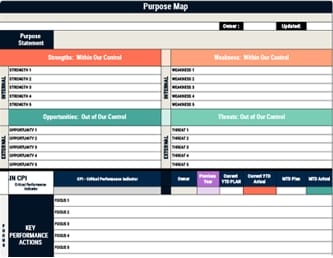
A unified view that connects CPIs, KPIs, and daily Key Performance Actions across operations, quality, and supply chain makes these boundary losses visible and actionable before they hit margin and yield.
What End-to-End Integration Looks Like Across All Three Functions
End-to-end integration means a single workflow connects production scheduling, quality gates, and inbound material availability so that a change in one function automatically propagates to the other two within the same decision cycle. You’re working from shared, real-time lot traceability data that tells Quality which supplier lot feeds which build batch, while Operations adjusts schedules without waiting on siloed reports.
This integration aligns KPIs across boundaries—connecting throughput, first-pass yield, and OTIF metrics—so you don’t optimize one function at the expense of enterprise margin. When these flows are documented and managed as part of a Business Operating System, they create a unified framework that makes cross-functional decision-making faster, more consistent, and easier to improve over time. When a supply risk or logistics constraint surfaces, your quality sampling plans and production execution respond together through cross-functional feedback loops.
A sourcing change triggers a coordinated Quality review and federated execution across your planning, ERP, and quality systems simultaneously.
Align Cross-Functional Incentives to One Decision Framework
When each function chases its own scorecard—Operations driving throughput, Quality minimizing scrap, Supply Chain hunting the lowest purchase price—you create a system where one team’s win is another team’s cost, and the enterprise absorbs the margin loss at every handoff.
You address this by tying all three functions to a single “cost-to-serve + service level” KPI, such as OTIF paired with lead time, so everyone evaluates tradeoffs against the same outcome.
Reinforce this alignment by using visual management tools—like shared metrics dashboards and process maps—to provide real-time, transparent views of cross-functional performance and tradeoffs.
Require that every cross-functional decision—whether it’s a supplier swap, an alternate material, or a production reschedule—passes through one coordinated change-request workflow showing quantified impact on throughput, defect risk, and delivery performance.
This governance rule ensures quality signs off on sourcing changes and planners account for downstream inventory consequences before anyone executes.
Build Real-Time Visibility Across Operations, Quality, and Supply Chain
Across every handoff between Operations, Quality, and Supply Chain, decisions stall or go wrong when teams rely on fragmented, outdated information—a planner checks yesterday’s inventory snapshot, a quality engineer reviews batch results sitting in an unlinked spreadsheet, and a buyer assumes material availability based on a purchase order that hasn’t been receipt-confirmed.
You need a single real-time view that connects shop-floor production status, material and lot availability, and quality results so planners can verify whether a build can actually execute with conforming parts and in-spec outputs. Extending this into shared visual management boards gives all three functions a common, color-coded view of performance deviations and priorities to drive faster, aligned decision-making.
Connect your work orders, MES production steps, ERP inventory, and LIMS/QMS nonconformance records into live dashboards tracking WIP status, on-time completion, supplier lot traceability, and defect rates.
Then establish data governance—common part and lot identifiers, standardized quality status codes, and single-source-of-truth rules—so every function interprets production and quality data identically.
How AI and Automation Close Silo Gaps in Practice
Real-time visibility gives you the foundation, but the data itself doesn’t close gaps between teams—you need AI and automation acting on that data to turn shared visibility into coordinated decisions.
When a quality nonconformance rate spikes, automation can trigger coordinated updates across sourcing lots, production schedules, and shipment plans simultaneously—not sequentially through email chains.
You’re closing the feedback loop by routing AI findings into decision workflows where the right owner approves changes and execution fans out across your existing systems.
To confirm this isn’t just reporting dressed up as progress, you should track boundary-impact KPIs like lead-time accuracy, scrap reduction, inventory stranding, and on-time delivery, ensuring automation measurably improves cross-functional reliability rather than generating dashboards nobody acts on.
As companies like Tesla and Spotify demonstrate, embedding AI-driven feedback into cross-functional workflows turns strategic alignment from a slideware concept into an operational reality that compounds over time.
Five Signs Your Integration Effort Is Working
Because dashboards and data pipelines can create an illusion of progress, you need concrete signals that your integration effort is actually changing how operations, quality, and supply chain work together—not just how they report. Look for these five signs:
Real integration changes how teams work together, not just how they report—look for these five signals.
- Production schedule changes automatically update quality inspection plans and supply commitments, with lead-time accuracy improving monthly.
- Quality findings like nonconformance rates and defect types influence sourcing decisions—supplier corrective-action SLAs, incoming lot acceptance rules—within the same review cycle.
- Cross-functional KPIs (on-time delivery, inventory turns, defect escape rate, rework cost) move together on shared dashboards.
- Boundary failures decline: fewer stockouts from long production runs, less excess inventory from delayed supply reactions.
- Coordinated responses to upstream constraints are recommended, approved, and executed through connected systems within a defined SLA.
When these signs are visible at a glance on shared boards and dashboards, you can apply the 1-3-10 second rule from visual management to verify that status, problems, and owners are immediately clear to everyone.
Frequently Asked Questions
What Are Common Silo Busting Strategies?
You’ll want to connect decision boundaries through a coordination layer that routes cross-functional recommendations to the right owner, standardize data flows into a single source of truth so quality signals reach supply planning in real time, adopt joint KPIs with shared ownership to prevent conflicting targets, extend risk visibility beyond Tier-1 suppliers by combining quality and sourcing data, and close the loop with dashboards that update all functions simultaneously when conditions change.
Conclusion
When you break down silos between operations, quality, and supply chain, you’re tackling a problem that costs manufacturers up to 30% of their operating budgets through hidden inefficiencies like excess inventory, rework, and delayed response times. You’ve now got a clear framework for aligning incentives, building real-time visibility, and leveraging AI to close the gaps, so start by mapping your costliest handoff failures and build your integration roadmap from there.