
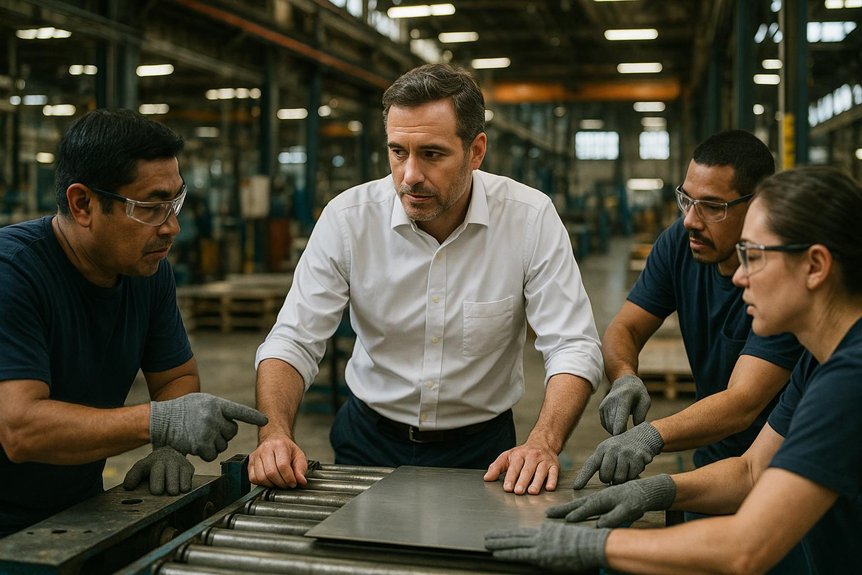
Picture yourself walking the production floor, clipboard in hand, while every operator within earshot goes quiet and stiffens up—that’s the moment you know your gemba walk has become an inspection, not a leadership tool. The difference between walks that change behavior and walks that breed resentment comes down to your intent, your questions, and what you do with what you find. What follows is a practical shift most leaders never make.
Key Takeaways
- Declare your walk mode—audit, learning, or problem-solving—so teams know your intent and respond with honesty instead of rehearsed behavior.
- Route each walk along the value stream through critical handoffs where delays, rework, and confusion actually surface.
- Ask process-focused, open-ended questions that uncover waste and variation without assigning personal blame to frontline workers.
- Remove barriers and clarify standards on the spot, then schedule a specific return visit to verify the fix held.
- Publicly recognize the specific repeatable behaviors that drove improvement, not just the outcome metrics that resulted.
Why Most Gemba Walks Feel Like Audits
When leaders approach the floor with a clipboard mentality—scanning for nonconformities, ticking boxes, and pointing out what’s wrong—they’ve already converted the Gemba walk into an inspection event, and everyone on the team knows it.
The walk shifts from learning to policing, and teams respond with rehearsed “show” behavior rather than honest dialogue about real conditions.
When the walk feels like policing, teams stop showing reality and start performing compliance.
The problem deepens when you mix purposes, sliding between audit mode and teaching mode without telling anyone which hat you’re wearing.
Add inconsistent follow-through—flagging issues but never returning to close the loop—and you’ve confirmed every suspicion: this visit is about catching mistakes, not understanding work.
Without a stated purpose beforehand, end-of-walk validation, and a scheduled return, your Gemba walk is just an audit with extra steps.
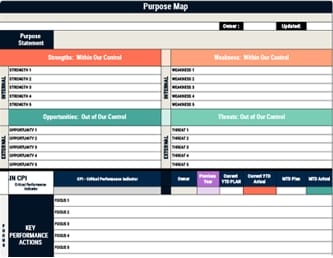
Integrating simple visual management tools into your walks can shift the tone from policing to shared problem-solving by making gaps, roles, and real-time conditions visible to everyone.
Three Gemba Walk Modes That Actually Drive Change
The fix isn’t to abandon Gemba walks—it’s to stop treating every walk like it serves the same purpose. You need three distinct modes in your rotation: Audit Mode, where you check compliance against standards and correct non-conformance on the spot; Learning Mode, where you ask open questions to surface friction, waste, and variation while building trust; and Problem-Solving Mode, where you identify what’s blocking flow and remove those barriers before you leave the floor. Each mode targets a different outcome—compliance, insight, or systemic improvement—and the critical skill is knowing when to switch between them based on what the situation actually demands, not defaulting to the same inspection behavior every time you show up. When used intentionally, each mode becomes a practical lever for strengthening alignment and accountability between top-level strategy and what actually happens at the Gemba.
Plan Your Gemba Walk Route Along the Value Stream
How you design your walking route determines whether you’ll catch real process breakdowns or just wander through familiar territory seeing what you’ve always seen. Map your path following the value stream from input to output—order intake through processing, handoff, and delivery—so you’re observing work in the sequence it actually flows. Include every critical handoff point where delays, errors, rework, or confusion typically surface, because those transitions expose root causes that isolated observations miss. Schedule your walk during normal operating conditions, not unusual shifts, so you’re seeing typical cycle times and flow interruptions. Assign timed observation beats at each stage and document the actual step sequence, including where work waits or repeats, so you can compare reality against your process map and convert gaps into specific improvements. Use your route to surface concrete, observable measures that can later feed into visual management boards and other strategy execution tools so improvement sticks beyond the walk.
Ask Questions That Uncover Waste, Not Blame
Shift your questioning from people to process the moment you step onto the floor, because the words you choose determine whether frontline workers open up about real problems or shut down to protect themselves.
Ask about the process, not the person — that shift in language is what unlocks honest conversation on the floor.
Ask open-ended questions tied to actual process steps—”Where does work wait longest?” or “What triggers rework here?”—instead of “Who caused this?”
Probe handoffs with specifics: “What’s the time between this step and the next?” and “What makes that handoff break?”
Follow a “what/why/what if” sequence: “What’s the standard here?” then “Why are deviations happening?” then “What would occur if this standard were followed for a week?”
Finally, connect findings to PDCA by asking, “How will we recognize improvement when it’s working?” A Gemba walk that emphasizes process optimization and learning-focused questions reinforces operational excellence and helps teams surface waste without eroding trust.
Solve Problems on the Gemba Walk, Not Back at Your Desk
Asking the right questions gets problems into the open, but those problems won’t stay visible for long if you walk away and try to solve them from behind a screen.
When you spot a flow interruption, a safety concern, or an unclear standard, remove that barrier right there on the floor.
Unblock the missing materials, clarify the ambiguous work instruction, or correct the quality condition while the context is fresh and the people involved can validate your understanding.
If you must document non-compliance, do it unobtrusively and handle obvious issues immediately, then complete your notes after you return to your desk.
This real-time approach builds credibility with the team and prevents observations from becoming another stale to-do list that no one trusts you’ll revisit.
Reinforce what you fix on the spot by capturing it visibly on a visual management board so the whole team can see the issue, the standard, and the follow-up at a glance.
Return to the Same People and Recognize Progress
Because solving a problem on the spot only matters if the fix actually sticks, you need to schedule a specific return date and time before you leave the area—and then go back to the same host area and the same employees so you can observe what changed under normal operating conditions.
Walk the same route, ask the same questions, and verify that the abnormal conditions you originally flagged are gone and updated standards are visibly in place.
Review each countermeasure against measurable outcomes—cycle time, defect rate, on-time delivery, safety incidents—and compare results to your original baseline.
When you see improvement, praise the specific behaviors that drove it, not just the output.
By consistently returning, measuring, and recognizing progress, your gemba walks become a practical engine for organizational alignment, connecting daily behaviors to strategic goals and sustained performance.
Then close the loop by sharing what still isn’t working and defining the next PDCA cycle focus.
Make Gemba Walks Part of Your Weekly Routine
A single return visit proves a fix held, but one-off follow-ups don’t build the muscle memory your organization needs to spot and solve problems continuously.
Embed Gemba Walks into your Leaders Standard Work by assigning leader pairs, protecting a recurring time block, and rotating through weekly themes like safety, quality, flow, and housekeeping so you observe every value-stream step under normal conditions.
Give teams advance notice of the purpose and route, and pair yourself with the process owner to reduce anxiety while increasing the authenticity of what you’ll actually see.
Keep the loop tight: recap observations within 24–72 hours, close actions before the next theme cycle, and publicly recognize the behaviors—not just outcomes—that drove improvement.
Frequently Asked Questions
What Is a Leadership Gemba Walk?
A leadership gemba walk is a structured visit where you go to the actual place work happens—the shop floor, the office, the clinic—so you can observe processes firsthand instead of relying on secondhand reports.
You’re there to ask questions, listen to frontline workers, and identify system-level issues like bottlenecks, unclear standards, or safety risks, not to judge individual performance but to drive continuous improvement.
What Are the Three Stages of Gemba Walks?
Like a three-act play, every gemba walk unfolds across preparation, observation, and follow-through.
In Stage 1, you’ll set a clear purpose and plan your route along the actual value stream.
During Stage 2, you’ll observe the process firsthand, ask open-ended questions, and capture structured evidence.
In Stage 3, you’ll validate findings with frontline workers and convert observations into specific improvement actions with owners and deadlines.
What Should a Leader Not Do During a Gemba Walk?
You shouldn’t treat a Gemba walk as an audit by hunting for non-compliance, asking gotcha questions, pointing blame at individuals, or delivering top-down instructions.
Don’t mix observation modes by jumping into problem-solving before you’ve validated what you’ve seen, and don’t skip the follow-up discipline—if you leave observations unassigned, never return to verify changes, or fail to communicate expectations back to the area, employees will disengage entirely.
Conclusion
Think of your shoes as the real tool—they carry you to the truth no dashboard can display. When you walk the gemba consistently, choose the right mode, ask process-focused questions, and close every loop, you’ll transform from a distant authority into a leader people trust enough to tell the truth. Don’t wait for the perfect moment; lace up and start this week.