

Most execution failures aren’t caused by bad strategy—they’re caused by too many priorities competing for the same attention, which is a problem both 4DX and the Connected Business Model were designed to solve, though each one targets a different root cause. If you’ve been running hard but still watching results flatline, understanding where these two frameworks diverge will show you which fix your team actually needs.
Key Takeaways
- Connected Business aligns plans across functions so nothing operates in isolation.
- 4DX narrows attention to one or two Wildly Important Goals and drives weekly accountability.
- 4DX distinguishes lead measures from lag measures and limits scoreboard metrics to no more than six.
- Connected Business coordinates cross-functional resources, data, and support around shared strategic outcomes.
- Both strengthen alignment when strategy maps visualize connections across goals, metrics, and responsibilities.
The Execution Gap That 4DX and Connected Business Both Solve
The gap exists because daily work—what 4DX authors call “the whirlwind”—consumes people’s time and energy, leaving strategic priorities starved of attention and accountability.
Research shows 87% of employees lack clarity on what to do, and only 81% are held to regular progress reviews.
Both 4DX and the Connected Business Model address this root cause by translating strategy into operating rhythms—4DX through weekly accountability cadences and Connected Business through connected planning and execution across teams—so your people’s daily actions align with what matters most.
A strong execution system also depends on cross-functional collaboration to address interdependencies and keep teams aligned around shared strategic objectives.
How 4DX Drives Focus Through Four Repeatable Disciplines
The 4DX framework gives teams a repeatable system for cutting through the whirlwind by organizing execution into four distinct disciplines that build on each other. First, you identify a single Wildly Important Goal written as “X to Y by when,” then dedicate roughly 20% of your team’s energy to it.
Second, you select high-leverage lead measures—predictive, influenceable activities rather than lagging outcomes. Third, you build a compelling scoreboard displaying up to six key measures that’s simple enough to glance at and immediately understand progress. To make that scoreboard more actionable, teams often use color-coded indicators so performance deviations can be spotted instantly and discussed quickly. Fourth, you lock in accountability through a weekly cadence where team members account for prior commitments, review the scoreboard, and plan the one or two actions they’ll take next to move lead measures forward.
What the Connected Business Model Actually Connects
Because strategy fails most often at the point where high-level goals lose connection to daily work, the Connected Business Model exists to bridge that exact gap by linking four critical layers: leaders’ intended outcomes, team-level commitments, the behavioral execution that happens week to week, and the measurable results that confirm progress.
You’re not just setting goals and hoping they cascade—you’re creating visible connection points between what leadership wants and what your teams actually do each day.
The model ties transparency to measurable progress through scoreboards and dashboards that track leading indicators, so you can course-correct before lag outcomes disappoint.
Regular check-ins maintain this connection, turning strategy from a static document into a sustained operating rhythm that reduces the whirlwind’s ability to overwhelm your priorities.
This kind of connection strengthens organizational alignment by integrating strategy, communication, and day-to-day execution around shared goals.
4DX vs. Connected Business: A Head-to-Head Comparison
Now that you understand what the Connected Business Model links together, it’s worth positioning it side by side with 4DX to see where these two approaches overlap, where they diverge, and which gaps each one fills that the other doesn’t.
Connected Business focuses on aligning plans across functions so nothing operates in isolation, while 4DX narrows your attention to one or two Wildly Important Goals and drives weekly accountability against them.
The Connected Business model coordinates; 4DX executes.
Where Connected Business ensures your departments aren’t planning in silos, 4DX ensures those plans actually generate results by distinguishing lead measures from lag measures and keeping a glanceable scoreboard that no more than six metrics populate.
One builds the network; the other ensures momentum through it.
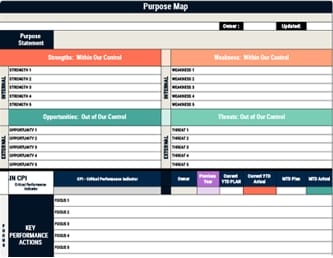
Both approaches become stronger when teams use strategy maps to visualize how goals, metrics, and responsibilities connect across the organization.
How 4DX and Connected Business Reinforce Each Other
When you layer 4DX on top of the Connected Business Model, each framework compensates for the other’s blind spots and creates a system that’s both strategically coherent and operationally relentless.
4DX strengthens execution by forcing teams to declare a single Wildly Important Goal with a clear finish line—framed as “X to Y by when”—and the Connected Business Model reinforces that same discipline by ensuring the goal doesn’t exist in a vacuum but ties directly to cross-functional plans that feed it resources, data, and support.
Together, 4DX’s lead measures give you predictive, influenceable indicators that connect strategy to actionable drivers, while the Connected Business Model’s transparent visibility keeps those measures honest across the entire value chain.
This combination works best when operational experts are engaged early, so strategic goals reflect real constraints, practical tradeoffs, and execution realities from the start.
The weekly cadence of accountability then becomes the learning loop both frameworks need to adapt execution in real time.
4DX or Connected Business: Match the Framework to the Problem
Knowing how the two frameworks reinforce each other is valuable, but the more practical question is which one to reach for first when a specific problem lands on your desk.
Start by naming the failure mode you’re experiencing.
If your team has a sound strategy but can’t translate it into measurable progress because competing priorities consume every hour, reach for 4DX—its single Wildly Important Goal, lead measures, scoreboard, and weekly cadence of accountability are built to solve execution drift.
If your problem is fragmented handoffs across departments and disconnected customer outcomes, choose Connected Business, which links people, processes, and governance end-to-end rather than optimizing one team’s goal in isolation.
In cases where the deeper issue is misalignment between strategy, structure, and culture, the McKinsey 7-S Model can help identify what must be realigned before either framework delivers full value.
One Execution Stack: Building Your Combined Playbook
Because both frameworks solve different halves of the same problem—4DX drives focused team execution while the Connected Business Model ensures that execution stays aligned across the entire organization—you’ll get the most effective outcomes by combining them into a single “execution stack” rather than running them side by side as separate initiatives.
Start by selecting one Wildly Important Goal in 4DX’s “X to Y by when” format, then map that outcome to your Connected Business priorities and measurable business drivers so every function understands how it contributes.
Choose lead measures that are both predictive and influenceable—controllable inputs like specific behaviors or activities—so you’re improving results rather than just reporting them.
Build a glanceable scoreboard of roughly six metrics, and run the weekly “account, review, plan” cadence to sustain radical accountability.
To make this combined playbook durable, document roles, responsibilities, and core processes inside a Business Operating System so execution remains transparent, repeatable, and aligned with company goals.
Frequently Asked Questions
What Are Four Disciplines of Execution?
The Four Disciplines of Execution (4DX) is a FranklinCovey framework you can use to close the gap between strategy and results.
You’ll focus on one Wildly Important Goal, act on lead measures you can directly influence, keep a compelling scoreboard your team checks at a glance, and create a weekly cadence of accountability where you commit to specific actions that drive your goal forward.
What Are the Common Pitfalls of 4DX?
Like spreading seeds across barren soil, you’ll waste effort if you don’t pick one Wildly Important Goal, choose lead measures that actually predict results, or maintain a simple scoreboard your team can read at a glance.
You’ll also fail if you skip the weekly accountability cadence, since without that structured rhythm, daily urgencies will consume your focus and leave your WIG unachieved.
What Are the 4 Disciplines of Execution Getting Strategy Done?
You execute strategy through four disciplines: first, you focus on one Wildly Important Goal written as “X to Y by when”; second, you identify lead measures that are predictive and influenceable; third, you keep a compelling scoreboard so everyone sees progress at a glance; and fourth, you maintain a weekly cadence of accountability where your team accounts for commitments, reviews the scoreboard, and plans next moves.
Conclusion
You’ll never close the execution gap by clinging to a single framework, because no one tool can handle every misfire your organization throws at you. Use 4DX when your team’s drowning in competing priorities and needs laser focus on one wildly important goal, and deploy the Connected Business Model when alignment between functions has completely collapsed. Layer them together, and you’ve built an execution stack that’s virtually impossible to outperform.