

You won’t notice the damage until it’s already compounding—misaligned mid-managers don’t break things loudly, they slow them quietly. Decisions take one extra approval, priorities shift by a few degrees each quarter, and your multi-year initiative drifts off course while every deliverable still hits its deadline. The real cost isn’t in what’s failing; it’s in what’s no longer accelerating, and by the time leadership sees it clearly, correction demands far more than a conversation.
Key Takeaways
- Misaligned mid-managers create compounding friction through slower decisions, excessive approvals, and eroded confidence that quietly drains multi-year initiative momentum.
- Director-level drift often hides beneath on-time deliverables and consistent hours while capital flows toward low-return paths undetected.
- Scaling businesses lose approximately 20% of potential annual revenue growth to wasted resources and missed opportunities from misalignment.
- Early warning signs surface in private conversations and second-guessing patterns long before formal channels acknowledge directional problems.
- Without checkpoints tied to 90-day focus and purpose, misalignment compounds until correction becomes costly and strategic intent is lost.
Why Mid-Manager Misalignment Quietly Kills Initiatives
When mid-manager misalignment takes hold, it doesn’t announce itself through dramatic project failures or obvious breakdowns—it shows up as a slow, compounding increase in friction that drains momentum from multi-year initiatives until they quietly stall out.
You’ll notice more second-guessing, longer delays in decision-making, and an increasing need to seek additional input before moving forward on things that should be straightforward.
The same meetings keep happening and the same hours get logged, but each responsibility costs more effort than it should because misaligned managers create drag across every touchpoint.
Over time, this erodes confidence and clarity at the leadership level—vision gets blurry, next steps feel uncertain, and your ability to make corrective pivots weakens precisely when you need it most.
This kind of drag often signals weak organizational alignment, especially when shared values and clear communication are no longer reinforcing strategy across teams.
How Steady Outputs Hide Strategic Drift From Leadership
What makes this kind of misalignment so difficult to catch is that the surface-level evidence actually works against you—steady outputs create the appearance of healthy execution even as the underlying work drifts further from where your strategy needs it to go.
Deliverables arrive on schedule, meeting cadences hold, and hours logged remain consistent, so your reporting layers reflect stability rather than erosion.
Meanwhile, value creation slows beneath those metrics because capital flows toward low-return paths that no longer serve updated strategic intent.
You’re consuming resources without the corresponding momentum, and the efficiency losses stay hidden inside operational rhythms that weren’t designed to surface directional mismatches.
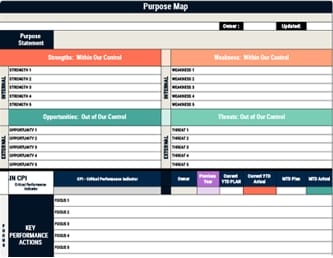
Teams are more likely to detect these hidden deviations earlier when visual management boards make performance gaps and directional drift visible through clear, color-coded indicators.
The Escalation Path From Private Criticism to Stalled Decisions
Because the drift described above doesn’t announce itself through broken deliverables, it first surfaces in a much quieter place—private conversations where directors and senior leaders begin criticizing execution choices they haven’t yet addressed through formal channels.
- You’ll notice leaders spending more time second-guessing decisions that previously felt straightforward, pulling in additional approvals and repeated reviews that slow momentum considerably.
- Trust in what’s known starts eroding, so directors revert to protecting their positions rather than owning course-correcting calls.
- Multi-year initiatives stall inside decision loops that compound misalignment the longer they persist.
- Private criticism replaces aligned enforcement, reducing decisive pivots and kill criteria.
- Operational drag hides beneath steady output metrics, meaning activity stays constant while velocity quietly disappears.
In these environments, the absence of real-time feedback often makes decision drift harder to detect until misalignment has already slowed execution.
Where Misalignment Costs You Revenue, Trust, and Time
Although the operational drag from misaligned mid-managers and directors doesn’t crash your dashboards overnight, it compounds in three distinct areas—revenue, trust, and time—each one feeding the others until the total cost far exceeds what any single metric would reveal.
In scaling businesses, this misalignment can quietly consume roughly 20% of potential annual revenue growth through wasted resources and missed opportunities that never surface in a single quarterly report.
On the trust front, you’ll notice leaders second-guessing decisions they’d previously have made confidently, seeking excessive input, and delaying approvals—turning strategic direction into reactive patchwork.
Meanwhile, your teams spend the same hours in the same meetings but ship less, draining energy and eroding employee commitment until turnover risks amplify every other loss you’re already absorbing.
Without a shared system like OKRs, leaders often miss the early signals of strategic drift until execution gaps are already affecting cross-functional performance.
What Causes Alignment to Break at the Director Level?
At the director level, alignment doesn’t shatter in a single dramatic moment—it erodes through a series of structural gaps that most leadership teams never address directly.
- OKRs without an operating rhythm — When you don’t define who decides, who reviews, and when to kill or pivot, directors optimize for the report instead of the outcome.
- Dashboards without decision rights — Directors receive data but can’t course-correct because they lack ownership to change direction when leading indicators show drift.
- Competing executive priorities — When your CTO, CFO, and CMO pull in different directions, directors spend more time managing noise than driving progress.
- Delayed correction — Misalignment compounds because compensation and momentum mask the problem until decision-making slows and trust erodes.
- Failed fit — Directors who don’t fully get, want, or can’t deliver on your vision create subtle non-alignment that quietly derails multi-year initiatives.
Without governance rhythms and regular progress tracking, these gaps persist unnoticed until strategic execution breaks down across teams.
Purpose and Values as Your Misalignment Detection System
When your execution metrics look healthy but decision-making keeps slowing down and small conflicts escalate into recurring drama, you’re likely dealing with a misalignment problem that won’t show up on any dashboard—and that’s exactly where your stated purpose, vision, and values become a detection system rather than wall art.
You test for misalignment by checking whether directors and mid-managers can clearly articulate your purpose, vision, and values and then connect their daily work back to them. If they can’t, drift is already underway.
Values function as a live behavioral test: when leaders repeatedly break agreements tied to what they’ve publicly committed to living, you’ve detected the gap early.
Run a “get it, want it, capable of doing it” assessment specifically for purpose-and-values ownership, because capability alone masks misalignment when someone executes well but doesn’t genuinely align.
This matters because weak alignment can quietly compound into major losses, with financial impact from misalignment averaging $109 million per $1 billion spent on projects.
Decision Checkpoints That Enforce Alignment Before Resets
Because misalignment compounds quietly across weeks and months, you need explicit decision checkpoints built into every multi-quarter initiative—checkpoints with defined owners, designated reviewers, and pre-agreed kill or pivot criteria that force the conversation before drift makes a reset feel like the only option left.
- Tie each checkpoint to leading indicators—behavioral and process signals—rather than lagging metrics, so you’re correcting course when fixes are still cheap.
- Require every checkpoint to restate alignment to your purpose, vision, values, and current 90-day focus, preventing directors from optimizing activity while outcomes wobble.
- Use a consistent cadence where weekly focus areas feed directly into checkpoint reviews.
- Measure the speed and quality of correction at each checkpoint as a health signal.
- If decisions require increasingly more digging to get unstuck, your operating rhythm is already failing.
A simple strategy map can make these checkpoints more effective by visually linking initiative decisions to strategic goals and exposing alignment gaps before they widen.
Frequently Asked Questions
What Are the 3 C’s of Change Leadership?
The 3 C’s of change leadership are Clarity, Cadence, and Course-correction.
You’ll need to translate your vision into a short list of priorities for the next 90 days so teams know exactly what they’re aligning to.
You’ll then establish a weekly execution rhythm with visible metrics and root-cause problem-solving to prevent drift.
Finally, you’ll define decision checkpoints with clear owners and kill/pivot criteria so you can correct direction quickly before misalignment compounds.
What Is Leadership Misalignment?
Leadership misalignment happens when your actions, priorities, and decision criteria stop matching your company’s stated purpose, vision, and values.
You’ll notice it shows up as slower judgment, more second-guessing, and longer decision cycles because what you’re “aligned to” becomes unclear.
The same meetings and responsibilities continue, but everything drains more energy than it should—eroding clarity, confidence, and trust across your team over time.
What Are the 4 P’s of Leadership?
The 4 P’s of leadership are Purpose, Priorities, People, and Process/Performance.
You’ll use Purpose to define why your organization exists, Priorities to narrow your focus to a few measurable goals within 90-day cycles, People to ensure your managers genuinely understand and want the mission while proving they can deliver, and Process/Performance to establish the operating cadence and leading indicators that turn your strategy into consistent execution.
What Are the Pitfalls of the Overall Cost Leadership Strategy?
Like rust eating through a hull, cost leadership quietly fails when you don’t translate margin targets into clear decision rights, weekly operating rhythms, and kill criteria.
You’ll find directors spending most of their time on people problems instead of driving execution, your teams working hard in different directions, and your data informing reports without actually reshaping how decisions get made—compounding wasted resources across every quarter.
Conclusion
You can’t afford to let misaligned mid-managers operate like invisible sinkholes swallowing your strategy whole, because by the time you notice the ground collapsing, years of momentum have already vanished beneath the surface. Start embedding purpose-driven checkpoints into every decision layer, enforce alignment before drift compounds into irreversible erosion, and treat early signals of friction as alarms rather than background noise you’ll address next quarter.