

You’ve probably seen the cascade on paper—strategy breaks into objectives, objectives break into team goals, and everything lines up in a tidy diagram. But if you ask a frontline team what they’re actually working toward and why, the answer often has nothing to do with that diagram. The gap between a structured cascade and one that genuinely drives behavior is where most execution quietly falls apart, and most leaders never notice until results stall.
Key Takeaways
- Real goal cascading translates strategic intent into locally owned, measurable outcomes through repeated loops of feedback across organizational levels.
- Goal cascading theater produces clean-looking goal trees but lacks cross-functional synchronization, progress tracking, and meaningful metrics.
- Goals can take three months to percolate down, leaving only eight or nine months for actual execution.
- Theater symptoms include renamed BAU work posing as strategy, missing feedback loops, and unverified cross-functional dependencies.
- Strategy reaches the shop floor only when structured conversations, quarterly alignment sessions, and connected goal networks replace rigid top-down cascades.
What Goal Cascading Actually Means
At its core, goal cascading is the process of translating leadership’s strategic intent into locally owned, measurable outcomes at each level of an organization, with repeated loops of intent, local context, and feedback so teams can adjust as they learn.
Goal cascading turns strategic intent into locally owned outcomes through repeated loops of context and feedback.
The purpose isn’t to create busywork or check a box—it’s to build coherence across a collective goal by reducing duplicate, competing, or missing efforts that naturally emerge when structure is applied across many individuals and functions.
In the best version, top leadership defines vision and strategic intent, each next level converts that intent into actionable plans suited to its context, and the pattern continues downward with regular cross-level feedback.
Strong organizational alignment can help companies achieve faster revenue growth and stronger profitability when teams are clearly connected to shared strategic goals.
You’re not just pushing goals down—you’re building a living system of aligned decision-making.
Why Goal Cascading Theater Looks Good on Paper
Because goal cascading theater follows a clean, linear chain—leadership vision flows to function leaders, which flows to teams, which flows to individuals—it produces diagrams and documents that look impressively coherent even when the underlying logic hasn’t been stress-tested.
Three features make it especially convincing in presentations and reports:
- Forced symmetry—a small number of top-level goals (often three) rolls out into a tidy tree structure that hides cross-functional complexity.
- Measurable-sounding language—each layer states ownership and success criteria, giving the appearance of rigor even when teams doing the work haven’t validated the translation assumptions.
- Promised rollup logic—activity-to-outcome connections appear linked through leading and lagging indicators, masking that many goals simply repackage business-as-usual work.
Without regular progress tracking and review mechanisms, these polished cascades can persist long after frontline reality has diverged from the original strategic assumptions.
Why Top-Down Cascades Fail Across Teams
The polished appearance of a cascaded goal tree starts to crack the moment you follow those goals sideways—across teams and functions rather than up and down the hierarchy.
Cascaded goals look elegant vertically—but follow them sideways across functions and the cracks appear immediately.
Each manager interprets leadership’s intent through their own operational lens, and when those interpretations meet at a cross-functional handoff, you’ll find duplicate efforts, conflicting priorities, or critical gaps where no one claimed ownership.
This happens because each group optimizes for its manager’s translation rather than shared end outcomes.
Without regular cross-functional synchronization to catch drift early, teams plan in parallel but never connect their work to the next function’s inputs.
The result is coordinated delivery on paper and fragmented execution in practice—alignment theater that satisfies reporting requirements while the actual shop floor stays misaligned.
Using strategic alignment frameworks can help teams reconnect departmental goals to a shared vision and reduce cross-functional drift.
The Last-Mile Problem With Goal Cascading
Even if your cascade survives the cross-functional drift described above, it still faces a brutal timing constraint: roughly three months can pass before leadership’s goals percolate down to the teams who’ll actually execute them.
That leaves only eight or nine months for actual work after goals are frozen, and during that delay, external shocks—recessions, pandemics, workforce shifts—can render those goals obsolete before they arrive.
When goals finally reach the shop floor, three things typically go wrong:
- They’ve degraded into “more of BAU” targets that feel unmotivating and disconnected from leadership’s original intent.
- They lack the feedback loops needed to correct misalignment during translation.
- They miss the cross-functional synchronization required to preserve meaning across layers.
A visible strategy map and shared metrics can shorten that lag by preserving intent, exposing gaps early, and aligning execution before goals lose relevance.
You don’t need a faster cascade—you need a fundamentally different mechanism.
What Real Goal Cascading Looks Like in Practice
At its core, real goal cascading isn’t a top-down broadcast—it’s a structured conversation that moves in both directions simultaneously. You start with three to five measurable top-level outcomes for the year, then translate each into functional and team-level outcomes with clear owners and success measures at every tier.
Rather than letting goals percolate downward over months until they’re obsolete, you build in feedback loops where each level negotiates translations with the next before finalizing commitments. You run cross-functional dependency checks at the seams—validating that a marketing conversion goal aligns with sales pipeline progression and product friction realities rather than assuming automatic roll-up.
Teams plan in parallel around a shared outcome model, synchronizing through quarterly alignment sessions that eliminate competing efforts and drift between individual action and organizational intent. This works best when strategy is grounded in operational realities, so teams can make realistic commitments and adapt quickly as constraints change.
Five Signs Your Goal Cascade Is Pure Theater
Behind every polished strategy deck, there’s usually a gap between what the cascade looks like on slides and what it actually produces in practice—and that gap is where theater lives. You can spot it when:
- Your cascade takes so long that goals expire before reaching frontline teams—if three months pass before employees see their targets, you’ve lost a quarter of execution time to bureaucracy alone.
- Cross-functional dependencies aren’t verified, so marketing’s activity metrics don’t connect to actual conversions, creating duplicate efforts and blind spots.
- Teams treat goals as renamed work rather than clarified outcomes, avoiding meaningful metrics because adding specificity feels like overload, which produces vague roadmaps that merely shoehorn existing initiatives under strategic labels.
Research suggests that nearly 70% of strategic plans fail because execution breaks down before strategy reaches coordinated action.
How Cross-Functional Context Strengthens a Goal Cascade
Across most organizations, the cascade breaks down not within a single team but between teams—specifically at the seams where one function’s output becomes another function’s input.
When marketing generates demand that product can’t support, or sales closes deals that service can’t deliver, you’re watching coherence gaps in action.
You fix this by setting goals in parallel across Sales, Marketing, Product, Service, and Finance while anchoring every function to the same master outcome.
Regular leader synchronization—annual and quarterly—keeps these linked goals from drifting as conditions change.
Using OKRs framework can reinforce transparency and accountability across these interdependent teams as goals evolve.
This network-style approach eliminates duplicate work, closes coverage gaps, and gives employees goals that connect to outcomes they actually value, which improves both execution quality and retention.
Turning a Cascade Into a Connected Goal Network
When you stop thinking of your goal cascade as a rigid tree and start treating it as a connected network, you replace the illusion of top-down control with something far more useful—a map that shows how work actually produces results.
A goal network reveals how work actually produces results—a cascade never will.
To build that network, you’ll need three structural shifts:
- Map every team goal to shared leading indicators and lagging outcomes so contributions link directly to mission results rather than dead-ending at the org chart.
- Overlay goals onto an org-agnostic driver model—demand, conversion, retention—so marketing, sales, product, and finance can see exactly where their inputs feed the same causal pathways.
- Cap goals at roughly four per person while grouping and rolling them up through the network, preserving connectivity without creating overload that paralyzes execution.
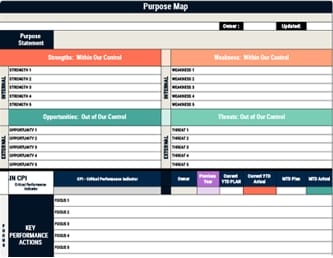
A strong way to keep this network grounded is to define a few Critical Performance Indicators first, then connect team-level KPIs and daily actions to those mission-critical outcomes.
Check-In Rhythms That Keep Cascaded Goals Alive
A connected goal network inevitably decays without a deliberate check-in rhythm that forces updates, surfaces blockers, and keeps every layer aligned to the original cascaded intent. You need a layered cadence: weekly operational checks where teams update leading indicators, monthly cross-functional dependency reviews where Sales, Marketing, Product, and Finance confirm their goals still connect, and quarterly recalibrations where you adjust priorities based on shifting conditions like market downturns or organizational pivots.
At each check-in, you should require back-and-forth feedback between managers and teams using short, documented conversations that review success criteria and leading indicators—not just lagging results. This prevents the cascade from degrading into recycled BAU targets that stop motivating anyone, and it closes the gap between what you expect and what people actually deliver. Clear roles and measurable performance indicators strengthen team accountability by making ownership visible at every level of the cascade.
Frequently Asked Questions
What Is an Example of a Cascading Goal?
You’d start with a company outcome—say, improving organizational performance by 10% in 12 months—then cascade it so HR targets a 15% lift in engagement, the team trains all managers in feedback skills by Q2, and each individual manager holds at least one structured check-in per quarter.
You’re replacing the old annual review with frequent, forward-looking conversations so every level connects its work directly to the strategy.
How Are Both the Strategy and Culture Cascaded Through an Organization?
You don’t cascade strategy and culture separately—they travel together when you translate leadership’s strategic intent layer by layer, repeating the translation at each level with a feedback loop rather than a one-way briefing.
Instead of letting departments cascade in isolation, you plan cross-functionally with regular synchronization so culture doesn’t drift and goals stay relevant by the time they reach the shop floor.
Conclusion
You don’t need a prettier cascade diagram—you need a living network where goals connect, flex, and hold people accountable from the boardroom to the shop floor. If your strategy can’t survive contact with a cross-functional dependency or a mid-quarter shift, it’s theater, not alignment. Stop cascading once and forgetting; start checking in, adjusting, and verifying that what’s tracked actually matters to the people doing the work.