
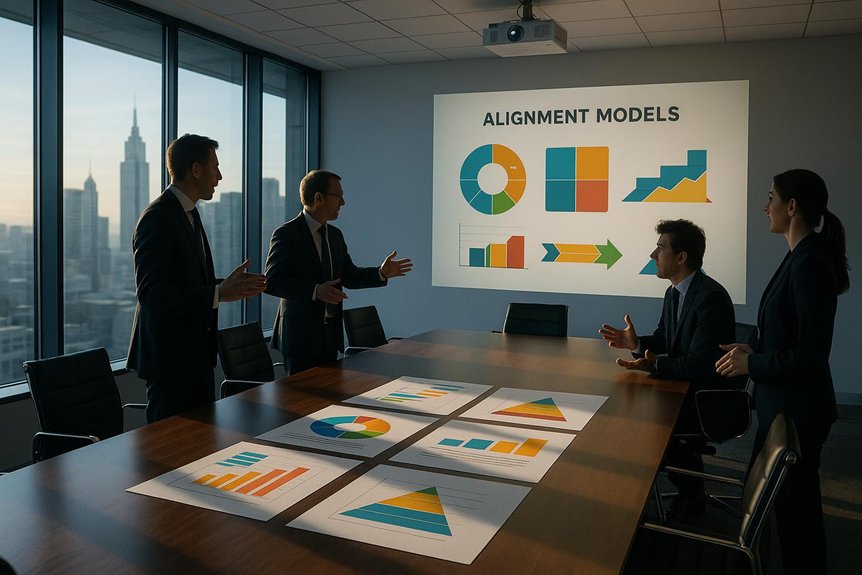
You probably don’t know how different alignment models quietly shape daily decisions, budgets, and meeting cadences, not just annual plans. You’ll see how OKRs, OGSM, and 4DX translate strategy into measurable behavior, why McKinsey’s 7-S keeps hard and soft elements in sync, and when RACI or incident command prevents confusion. You’ll also learn a 5-step checklist to choose the right model, plus metrics to track alignment—so you can spot gaps before they become misses.
Key Takeaways
- McKinsey 7-S aligns strategy, structure, and systems with shared values, skills, style, and staff for holistic, hard/soft realignment.
- OKRs translate strategy into measurable objectives and key results with frequent check-ins for rapid, cross-functional alignment.
- OGSM creates a one-page map linking objectives, goals, strategies, and measures to connect long-term vision to execution.
- 4DX drives focus on wildly important goals, lead measures, visible scoreboards, and a cadence of accountability.
- Use RACI and Incident Command to clarify ownership in steady state and crises, ensuring fast decisions and unmistakable execution.
Organizational Alignment: Definition, Types, and Impact
Alignment is the discipline of making every part of your organization—strategy, structure, people, processes, and metrics—pull in the same direction so daily work reliably advances company goals. You use it to turn strategy into a feedback-driven engine for growth, ensuring plans translate into actions and measurable outcomes. In practice, you balance two types: vertical alignment, which cascades clear goals top-down to stakeholders and clarifies accountability, and horizontal alignment, which flattens communication across teams to boost collaboration and autonomy. Strong alignment is reinforced by shared values and clear communication, which increase employee engagement and overall efficiency. When alignment is strong, you’ll see improved performance, stronger cross-team collaboration, higher employee engagement, and better customer satisfaction. Watch for warning signs: unclear role allocation, weak monitoring, unrecognized dependencies, and inconsistent goal-setting processes. These indicators reveal gaps where strategy, execution, and learning aren’t reinforcing each other.
Choose the Right Alignment Model: 5-Step Checklist
Where should you start when several alignment frameworks look useful yet pull you in different directions? Use this 5-step checklist to choose confidently.
First, define your primary objective—if you need rapid execution, you’ll favor focused, discipline-driven models; if you seek holistic culture change, you’ll lean toward comprehensive frameworks.
Start by clarifying your primary objective: rapid execution favors focused disciplines; culture change calls for comprehensive frameworks.
Second, set your planning horizon—short-term agility points to 4DX, while longer strategy arcs often suit OKRs or OGSM.
Third, gauge data maturity and measurement needs—OKRs require clear metrics, whereas 4DX emphasizes consistent cadence and four disciplines.
Fourth, match structure and culture—if hard and soft elements must realign, consider McKinsey 7-S; if goal tracking is central, use OKRs or OGSM.
Fifth, pilot with a cross-functional cohort, collect feedback, and iterate based on alignment outcomes.
Additionally, reinforce the change with continuous communication and feedback loops to keep teams informed, motivated, and aligned over time.
Strategy–Execution Alignment: How to Apply It Daily
How do you make strategy real in the flow of work rather than in slide decks and quarterly memos? Start by turning high-level goals into actionable plans with clear owners, defined timelines, and unambiguous success criteria, so accountability is visible and blockers surface early. Cascade objectives into measurable, time-bound key results for each team, then run regular reviews to adjust scope, staffing, or sequencing as data comes in. Map explicit dependencies between initiatives and required capabilities, identifying bottlenecks before they stall progress, and assign mitigation actions to responsible leaders. Keep priorities and progress transparent through simple dashboards and weekly touchpoints, aligning everyone to the same North Star. Finally, embed change management—train roles, update processes, and reinforce governance—so new designs stick and performance sustains. Establish governance rhythms with regular progress tracking to maintain performance visibility and ensure alignment from C-suite to frontline operations.
Compare Alignment Frameworks: OKRs, OGSM, and 4DX
Why compare OKRs, OGSM, and 4DX? You need to choose a framework that matches your rhythm, your planning horizon, and your team’s discipline. OKRs help you set clear, concise objectives with measurable key results, encouraging ambition, frequent check-ins, and rapid alignment across teams. OGSM gives you a one-page strategic map that links long-term objectives to goals, strategies, and measures, but it can feel rigid when short-term shifts demand quick pivots. 4DX drives disciplined execution by focusing on wildly important goals, lead measures, visible scoreboards, and a steady cadence of accountability.
Choose OKRs, OGSM, or 4DX to match your rhythm, horizon, and discipline.
- Feel clarity as strategy snaps into focus and teams pull in the same direction.
- Feel urgency as scoreboards reveal progress—or the lack of it.
- Feel confidence as disciplined routines convert plans into measurable outcomes.
To reinforce whichever framework you choose, establish numeric KPIs during planning and report outcomes regularly to foster transparency and accountability.
Use McKinsey 7-S to Align Hard and Soft Elements
Even as you fine-tune goals and scorecards, the McKinsey 7-S Model gives you a practical lens to align the hard mechanics of your organization with the soft forces that shape behavior. You’ll assess seven elements—Strategy, Structure, Systems (hard), and Shared Values, Skills, Style, Staff (soft)—and examine how they interact, since performance depends on balance, not one perfect lever.
Start by diagnosing gaps across all seven dimensions against your long-term vision, then prioritize adjustments that reinforce one another, such as refreshing strategy while updating systems and coaching leaders to model desired behaviors. Integrate real-time data into dashboards and visual boards to enable swift, 1–3–10 second comprehension of performance and action paths.
Use it to stress-test M&A integrations, ensuring cultural fit matches structural changes.
Recognize limitations: the model lacks step-by-step change guidance and may overlook external pressures, so complement it with execution and market scans.
Horizontal vs. Vertical Organizational Alignment
Where should you draw the line between top-down direction and peer-to-peer collaboration to keep execution crisp without stifling initiative?
Use vertical alignment to cascade strategy into clear goals, roles, and resource choices, so information flows to the right stakeholders and priorities stay coherent.
Rely on horizontal alignment to flatten communication, accelerate learning, and enable autonomy where teams must coordinate across functions. Don’t overuse either: pure vertical slows decisions, while unchecked horizontal invites power struggles and drift.
- You need clarity without rigidity, so set explicit decision rights and escalate only what truly needs executive calls.
- You want speed without chaos, so create cross-functional forums with clear charters.
- You expect focus with adaptability, so run OKRs and frequent reviews to recalibrate as markets shift.
Aligned organizations can grow revenue 58% faster and be 72% more profitable, underscoring the business impact of balanced vertical and horizontal alignment.
Clarify Roles Fast With RACI and Incident Command
You’ve balanced vertical and horizontal alignment; now make execution unmistakable by naming owners and escalation paths with RACI and Incident Command.
Use RACI—Responsible, Accountable, Consulted, Informed—to specify who does the work, who owns the outcome, who advises, and who gets updates, which prevents overlap and gaps.
Apply it to projects and recurring tasks, and you’ll accelerate onboarding because newcomers see a simple, repeatable map of decision rights and handoffs.
For fast-moving incidents, switch to Incident Command. Establish a unified command with predefined roles—Incident Commander, Public Information Officer, operations, planning, and logistics—so decisions flow quickly through a clear chain of command.
Combine both models: capture steady-state ownership with RACI, then trigger Incident Command during crises, reducing delays, miscommunication, and escalation confusion.
To sustain clarity and improvement over time, pair these role models with a daily management system that uses visual management and structured reviews to keep performance visible and accountable.
Measure Organizational Alignment: OAS, Surveys, and Leading Indicators
How do you know your organization is truly aligned beyond gut feel and anecdote? Start with the Organizational Alignment Survey (OAS), a rapid assessment that tests how well strategy, structure, and culture support execution, then add depth with targeted surveys. Begin broad to surface themes, and progressively narrow to specific alignment topics—goals, communication flows, role clarity, and interdependencies—so you can pinpoint concrete gaps and prioritize fixes. Implementing a Business Operating System (BOS) with clearly defined roles and documented processes creates transparency and accountability that make alignment measurable and repeatable. Use customer and employee surveys to capture frontline perspectives on whether objectives are clear, messages are consistent, and teams can depend on each other. Monitor leading indicators of misalignment and act early:
Diagnose alignment beyond gut feel: start broad with OAS, then target goals, communication, roles, and interdependencies.
- Unclear role allocation that slows decisions and creates rework
- Unrecognized dependencies that stall handoffs and timelines
- Poor task communication and inconsistent goal-setting processes
Review results regularly to steer strategy and track progress.
Frequently Asked Questions
How Do We Align Incentives and Compensation With Chosen Alignment Models?
Tie incentives to the specific outcomes your model prioritizes, then define measurable KPIs at company, team, and role levels. Calibrate weights so shared goals outweigh siloed metrics, and use a balanced scorecard to prevent gaming. Set thresholds, targets, and stretch tiers, linking them to salary, bonuses, equity, and recognition. Build line-of-sight dashboards, review quarterly, and adjust for external shifts. Enforce governance, audit payouts against results, and communicate criteria transparently.
What Governance Cadence Sustains Alignment Without Creating Meeting Overload?
Adopt a tiered cadence: a monthly executive review for strategy and trade-offs, biweekly cross-functional syncs for dependencies and risks, and weekly team standups for execution, while using dashboards and written updates to reduce live time. Timebox meetings, set clear decision owners, and standardize agendas. Bundle escalations into the nearest forum, avoid ad‑hoc check-ins, and run quarterly retrospectives to prune or adjust rituals, ensuring alignment persists without bloating calendars.
How Should Alignment Evolve During Mergers, Acquisitions, or Divestitures?
You should tighten alignment during diligence, expand it during integration, and recalibrate post-close. Define a single north star, map value drivers, and set non‑negotiables for culture and controls. Stand up a temporary Integration Management Office, merge OKRs, and align incentives and decision rights. Standardize critical processes while preserving edge capabilities, then retire temporary structures as run‑rate stabilizes. For divestitures, ring‑fence scope, create Transitional Service Agreements, and rebuild standalone governance and metrics.
Which Alignment Pitfalls Appear in Hybrid or Fully Remote Organizations?
You face misaligned goals, inconsistent communication, and weakened culture. You risk unclear decision rights, fragmented priorities, and siloed execution. To avoid drift, define crisp outcomes, document decision owners, and set shared metrics; to reduce confusion, standardize cadences, tools, and channels; to sustain trust, make leaders highly visible, enforce meeting hygiene, and foster cross-team rituals. Finally, codify norms for responsiveness, availability, and documentation, then audit alignment quarterly and correct promptly.
How Can AI Tools Support and Monitor Ongoing Organizational Alignment?
You can use AI to map goals to KPIs, flag misaligned projects, and surface gaps in ownership. Deploy NLP to summarize strategy updates, classify decisions, and track sentiment across surveys and chats. Set anomaly alerts on delivery, quality, and churn metrics, then auto-escalate risks. Apply LLMs to generate role-specific scorecards, meeting briefs, and OKR health checks. Maintain audit trails, define data governance, and calibrate models regularly to prevent bias and drift.
Conclusion
You’re ready to turn strategy into motion: pick a model that fits your rhythm, pilot it cross-functionally, and reinforce it with governance, RACI clarity, and daily management. Think of the 1908 Model T line—output jumped 700% when work, measures, and roles aligned—because precision beats effort. Start with one wildly important goal, define lead measures, and review weekly, then scale. You’ll build horizontal and vertical coherence, measure progress with OAS and surveys, and adjust before drift sets in.