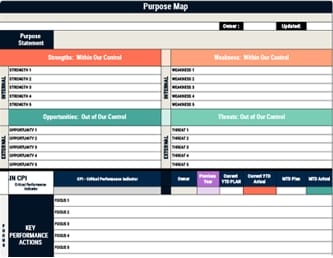


You use Critical Performance Indicators (CPIs) to focus your team on the few metrics that truly drive your goals, pairing leading signals like trial activations or outreach volume with lagging outcomes like revenue or margins, all with clear owners, data sources, and time frames. By choosing 5–7 measurable metrics tied to strategy and reviewed in regular forums, you create a system that guides action and course corrections, but selecting the right set isn’t as obvious as it seems.
Key Takeaways
- Critical Performance Indicators (CPIs) are the few metrics that most directly drive your highest-priority strategic goals.
- CPIs are measurable, time-bound, owned, and tied to clear targets and decision-making forums.
- Use both leading CPIs (predictive early signals) and lagging CPIs (results confirmation) for balanced control.
- Identify CPIs by starting from top objectives, selecting 5–7 metrics with reliable data, definitions, and action linkage.
- Examples: leading—trial activations, daily outreach; lagging—revenue growth, profit margin, on-time delivery rate.
What Are Critical Performance Indicators?
What exactly are Critical Performance Indicators (CPIs)? They’re the select metrics you track to capture the few activities and results that most directly drive your organization’s critical goals. Unlike broader KPIs, CPIs narrow your focus to the essential indicators with the highest influence on strategic outcomes, helping you monitor what truly moves the needle. You define them so they’re measurable and time-bound, tie them to high-priority objectives, and set clear targets to create accountability and visibility.
You’ll tailor CPIs to your context, but they commonly map to core aims such as revenue growth, customer retention, or operational resilience, reflecting where impact is concentrated. Because priorities evolve, you should review and update CPIs regularly, ensuring they stay aligned with changing business needs and current performance. In practice, CPIs work best when they’re integrated into a documented Business Operating System that clarifies roles, processes, and review cadences for continuous improvement.
Why CPIs Matter for Strategy and Execution
How do you guarantee strategy turns into results rather than reports? You define CPIs—the few metrics that most directly reflect your ability to execute—and link them tightly to strategic priorities, so every number you track answers whether critical initiatives are on track. CPIs matter because they turn abstract goals into measurable commitments, forcing clear ownership, time-bound targets, and decisive actions when performance drifts. Companies that excel at alignment, like Tesla and Spotify, focus on clear objectives and measurable KPIs to translate strategy into execution. You identify CPIs by mapping each strategic objective to specific, measurable outcomes, then selecting indicators that forecast success or signal risk early enough to intervene. Ensure data quality, define calculation rules, and confirm that each CPI is trackable and visible in decision-making forums. With a focused set, you reduce noise, align teams, and allocate resources toward what truly moves long-term goals.
Leading vs. Lagging CPIs
Why does the timing of a metric matter so much? Leading CPIs signal what’s likely to happen, so you can adjust before results lock in, while lagging CPIs confirm what already occurred, helping you validate progress and learn from outcomes. Use both: leading indicators, such as daily outreach, trial activations, or early customer engagement, provide early warnings and guide proactive moves; lagging indicators, like revenue, profit margins, and on-time delivery rates, verify whether those actions produced real results. Relying only on lagging CPIs delays corrective action, since problems appear after damage is done; leaning solely on leading CPIs risks chasing activity that never translates into impact. Define each CPI clearly, set baselines and targets, and ensure alignment with strategic goals for consistent measurement. To boost clarity and rapid action, design CPIs using the visual management 1-3-10 rule so teams can recognize status, pinpoint problems, and know next steps within seconds.
How to Identify Your Organization’s CPIs
Start by anchoring your CPIs to strategy, not convenience, because only metrics that reflect top priorities will steer real decisions. Begin by listing your top strategic objectives, then identify the few metrics that best predict progress and enable timely action. Limit your CPIs to 5–7, selecting measures tied to high-impact outcomes rather than routine activity, so leaders can allocate resources with confidence. For each candidate metric, confirm three things: a clear, time-bound target, a reliable data source with defined ownership, and a direct link to decisions you’re willing to make. Prioritize leading indicators where possible, yet validate them against essential outcomes. Document definitions and calculation methods to prevent drift. Review your CPIs quarterly, retire weak signals, and add stronger ones as strategy and context evolve. Add a simple CPI→KPI→KPA review cadence so CPIs guide supporting KPIs and daily Key Performance Actions in a continuous improvement loop.
Common CPI Examples by Function
With your shortlist anchored to strategy, it helps to see what strong CPIs look like within common business functions, because context clarifies what truly drives outcomes. In finance, net profit margin and operating cash flow reveal if growth is profitable and self-funded, so you can adjust pricing, spending, or capital plans quickly.
In operations, on-time delivery rate and defect rate expose reliability and quality, guiding capacity, scheduling, and process fixes before customers feel pain.
In marketing, customer acquisition cost relative to lifetime value tests whether demand generation creates durable value, informing channel mix and budget.
In customer service, first response time and resolution accuracy signal experience and trust, steering staffing, training, and escalation design. Assign owners, review monthly, and tie actions to executive priorities. Strong CPIs stay effective when they align with shared values and are supported by clear communication, ensuring consistent execution across teams.
Building and Reviewing a CPI Dashboard
Cut through the noise by designing a CPI dashboard that spotlights only the metrics that move the strategy. Select a tight set of 3–7 CPIs that directly reflect progress toward top objectives, and make each tile unambiguous: define the metric, target, owner, data source, and update frequency. Favor leading indicators that predict outcomes, while pairing them with essential lagging indicators to confirm results, then visualize both with real-time status, trend lines, and variance to target. Strengthen alignment by structuring CPIs to support both vertical and horizontal alignment, ensuring clear top-down objectives and cross-team collaboration that accelerate revenue growth and decision-making. Structure the layout by strategic pillar, not department, so alignment is obvious and accountability is clear. Set a review cadence—weekly for leading indicators, monthly or quarterly for lagging ones—and recalibrate when priorities shift. If a CPI no longer guides decisions, replace it, and reassign ownership immediately.
Frequently Asked Questions
How Do CPIS Differ From OKRS and KPIS in Practice?
Measure twice, cut once. You use CPIs to spotlight a few mission-critical levers that directly drive outcomes, triggering swift action when they slip.
You use KPIs to track broader operational performance across functions, offering trend visibility and benchmarking.
You use OKRs to set directional goals and measurable results, aligning teams and prioritization. In practice, CPIs escalate decisions now, KPIs monitor health over time, and OKRs guide strategy and focus.
What Governance Model Ensures CPI Ownership and Accountability?
Use a RACI-based governance model anchored in a CPI Council. You assign CPI Owners (Responsible) in each function, designate Executive Sponsors (Accountable) per CPI, involve Data Stewards and Process Leads (Consulted), and inform frontline managers and PMOs (Informed).
You set quarterly review cadences, define decision rights for recalibration, require documented data lineage and thresholds, and integrate CPIs into performance reviews, incentives, and risk registers, ensuring traceable ownership, timely actions, and cross-functional alignment.
How Should Incentives Be Tied to CPIS Without Encouraging Gaming?
Start with gentle carrots, not sticks: tie a portion of pay to CPIs, but balance them with complementary metrics to deter tunnel vision. You define clear formulas, set thresholds and ranges, and use rolling averages to mute short-term hacks. Add outcome and quality gates, plus peer and customer feedback, so shortcuts don’t pay. Include team-level bonuses to foster collaboration, cap upside to curb risk-taking, and run audits with clawbacks for detected gaming.
How Do You Localize CPIS for Global Teams and Markets?
You localize CPIs by defining a global “north star” metric, then translating it into region-specific drivers that reflect market maturity, regulations, and customer behavior. You baseline each market with local data, set ranges not absolutes, and weight inputs differently by region. You align definitions and data sources, document calculation rules, and audit regularly. You add qualitative guardrails, segment by channel, and roll up results to a normalized global dashboard.
What Tools Integrate CPIS With Financial Planning and Forecasting?
Right out of the gate, you can tie CPIs to planning tools so everything sings from the same sheet. Use enterprise suites like Oracle Cloud EPM, SAP Analytics Cloud, and Anaplan, which integrate driver-based models, rolling forecasts, and variance analysis. Connect operational data via Snowflake or Databricks, then route CPIs through Power BI or Tableau for visualization. Automate pipelines with Power Automate or Workato, and govern definitions in Collibra or Alation to maintain consistency.
Conclusion
You’ll make progress faster when your CPIs act like a compass, not a map; think of Shackleton checking bearings every hour, adjusting course before ice closed in. Pick 5–7 metrics tied to top goals, define them precisely, confirm reliable data sources, assign owners, and review them in standing forums. Balance leading indicators that signal momentum with lagging ones that confirm outcomes, then iterate. When a metric stops driving decisions, replace it, and keep your dashboard lean, current, and accountable.