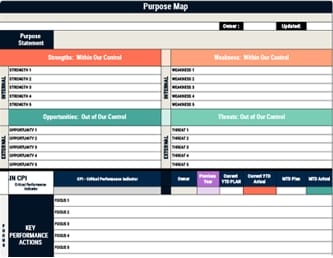


You use Critical Performance Indicators (CPIs) to track the few metrics that truly drive your strategy, linking daily actions to top goals, and enabling quick, data-backed decisions. CPIs are specific, real-time measures with clear owners, targets, and data sources, such as on-time delivery, net profit margin, pipeline coverage, and customer satisfaction. You should pick 5–7 that are actionable and aligned to your structure and systems, then review them regularly to stay relevant—here’s how to choose wisely.
Key Takeaways
- CPIs are the few metrics that directly reflect and protect an organization’s core strategic success and competitive advantage.
- They translate top-level goals into measurable, time-bound outcomes with clear targets, owners, and data sources.
- Select 5–7 high-leverage indicators that are actionable, precisely measurable, and tied to mission-critical objectives.
- Examples: on-time delivery, first-pass yield, net profit margin, cash conversion cycle, pipeline coverage, win rate, qualified leads, CPA, NPS, gross revenue retention.
- Review CPIs at least quarterly to validate relevance, ensure data quality, update targets, and realign after strategy shifts.
What Are Critical Performance Indicators?
So, what’re Critical Performance Indicators (CPIs)? They’re the select few metrics you choose to reflect the most important drivers of your organization’s success, tightly aligned to strategic objectives and mission-critical goals. You use CPIs to monitor high-impact outcomes in real time, so you can act quickly when performance shifts and keep attention on what truly moves the needle. Unlike broader KPIs, CPIs zero in on the essential measures that protect competitive advantage and long-term viability. Each CPI should be measurable and time-bound, tied directly to core strategies, and supported by clear targets and accountable owners who can adjust plans when results lag. Common CPIs include customer retention rate, revenue per user, or production cycle time—metrics that most strongly influence overall performance. As part of a structured execution loop, CPIs should cascade into supporting KPIs and daily Key Performance Actions, creating accountability and a feedback cycle that drives continuous improvement.
Why CPIs Matter for Strategy and Execution
Having defined CPIs as the few metrics that best capture your organization’s most important drivers, it’s time to show why they matter for strategy and execution: they concentrate attention on what directly advances core objectives, turning broad ambitions into measurable, time-bound commitments that guide day-to-day decisions.
When you elevate CPIs above a sea of KPIs, you clarify what truly moves the strategy, so leaders and teams allocate resources, design initiatives, and escalate issues in ways that maximize impact.
Because CPIs are high-level and cross-functional, they reveal interdependencies, reduce siloed optimization, and keep long-term outcomes visible amid short-term noise.
They also reinforce organizational alignment by focusing efforts on shared strategic objectives, improving collaboration and decision-making that drive faster revenue growth and profitability.
How to Identify the Right CPIs for Your Organization
Where should you begin when narrowing a sea of metrics into the few that truly matter? Start by translating top-level strategic goals into measurable outcomes, then select a small set—typically 5–7—of high‑leverage indicators that most directly drive long‑term success. Choose metrics that are actionable and clearly measurable, ensuring each one links to critical outcomes like growth, profitability, or customer value, and define precise owners, data sources, and targets so teams know how to act. To ensure coherence and execution, align your CPIs with the organization’s 7-S Model so strategy, structure, and systems reinforce the same goals. Balance leading indicators that predict future performance, such as pipeline velocity or product adoption, with a few lagging indicators that confirm results, like net profit or retention. Apply an MPRA approach—Measure, Perform, Review, Adapt—to test, compare, and prune indicators, keeping only those that meaningfully influence strategic progress.
Common CPI Examples Across Functions
Blueprints for action help you translate strategy into daily focus, and common CPI examples by function make that translation concrete. In operations, track on-time delivery rate and first-pass yield, since they directly affect cost, reliability, and customer trust. In finance, use net profit margin and cash conversion cycle, because they reflect value creation and capital efficiency. In sales, prioritize pipeline coverage and win rate, tying targets to revenue goals. In marketing, focus on qualified lead volume and cost per acquisition, aligning spend with growth. For customer success, monitor customer satisfaction or NPS and gross revenue retention, linking service quality to expansion. Add a CPI for communication health by tracking regular frontline engagement and feedback response rates, since improving open communication and trust measurably accelerates cultural transformation.
- You feel clarity when a single number guides your day.
- You gain confidence as noise falls away.
- You sense momentum as results compound.
Best Practices for Reviewing and Refining CPIs
How often should you revisit your CPIs to ensure they still reflect what matters most? Review them quarterly at minimum, and immediately after major strategy shifts, so your metrics stay aligned with core objectives and high‑impact goals. Validate each CPI against current priorities, confirm it’s measurable and trackable over a defined period, and verify data quality by checking sources, calculation logic, and timeliness. Update targets when market conditions, budgets, or capacity change, and retire blunted indicators that no longer drive action.
Balance leading and lagging signals to improve foresight and accountability, keeping a manageable set to prevent dashboard clutter and decision fatigue. Document ownership, definitions, and reporting cadence, then standardize visualization to ensure consistent interpretation. Finally, pilot refinements before full rollout, and forecast implications to anticipate trade‑offs. To strengthen execution discipline, align CPI reviews with governance rhythms and use performance dashboards to track progress and accountability across teams.
Frequently Asked Questions
How Do CPIS Differ From KPIS and OKRS in Practice?
CPIs differ because you track them as the few metrics that directly determine operational survival or system integrity, while KPIs measure broader performance areas, and OKRs define ambitious goals and the results you’ll achieve.
You use CPIs to signal immediate risks or thresholds, you use KPIs to manage ongoing effectiveness, and you use OKRs to steer change, align teams, and prioritize initiatives, linking outputs to measurable outcomes and strategic intent.
What Tools Can Automate CPI Tracking and Visualization?
Like a dashboard guiding a night drive, you can automate CPI tracking with tools such as Power BI, Tableau, and Looker for robust visualization and alerts, while Google Data Studio suits lighter needs. You’ll centralize data using ETL platforms like Fivetran, Stitch, or Zapier, then model metrics in dbt. For operational monitoring, use Grafana and Prometheus; for product analytics, consider Amplitude or Mixpanel. Enable scheduled refreshes, anomaly detection, and Slack or email notifications.
How Should Startups Prioritize CPIS With Limited Data?
Prioritize CPIs by linking them directly to your immediate business goal, then choose a small set you can measure reliably. Start with leading indicators tied to your growth engine—activation, conversion, retention, or unit economics—so you can act quickly despite sparse data. Use directional targets, short review cycles, and consistent definitions, and document assumptions. Validate with lightweight experiments, compare trends over absolutes, and drop any CPI that doesn’t influence decisions within two weeks.
How Do CPIS Adapt During Mergers or Restructuring?
They adapt by resetting baselines, aligning metrics to the new operating model, and reweighting targets to reflect merged goals and synergies. You map legacy CPIs to consolidated value drivers, retire duplicates, and add integration metrics like customer retention, cost-to-serve, and time-to-synergy. You phase changes: stabilize day one metrics, then shift to transformation KPIs. You recalibrate thresholds using combined data, update dashboards and accountability owners, and schedule frequent reviews to prevent drift.
How Can We Communicate CPIS Effectively to Frontline Employees?
Start with a brief, relevant example: on a factory floor, you display “First-Pass Yield” on a daily board, show yesterday’s number, today’s target, and the two actions that move it. You communicate CPIs effectively when you translate them into job-level behaviors, use plain language, set visible daily targets, and update results in short huddles. Tie each CPI to incentives and safety, teach the calculation once, and give quick feedback through dashboards and supervisor coaching.
Conclusion
You’re ready to turn strategy into motion by selecting a few CPIs that act like a compass in fog, guiding daily decisions toward measurable results. Translate goals into outcomes, choose 5–7 actionable metrics with owners, data sources, and targets, and align them with your structure and systems so execution stays coherent. Review them on a cadence, adjust for relevance and quality, and close the loop with visible accountability, enabling faster course corrections and sustained performance.