
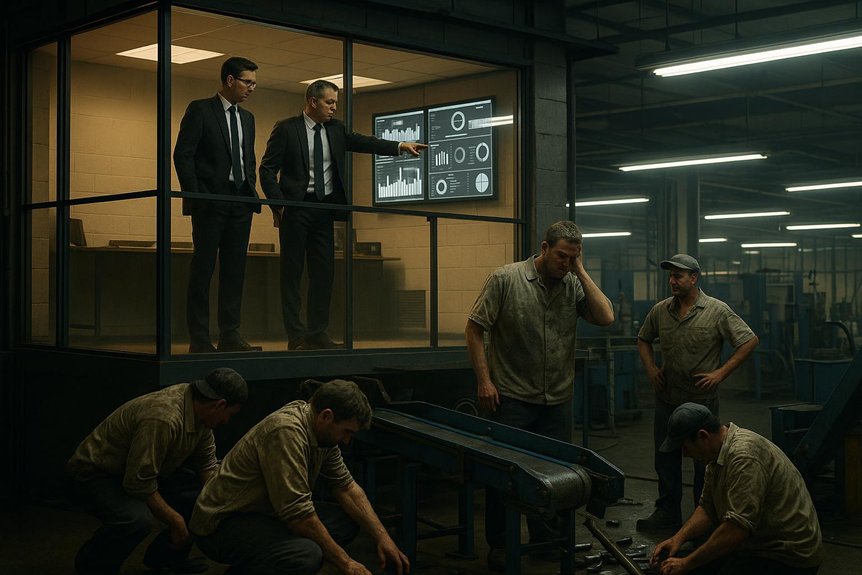
Research suggests that roughly 60 to 90 percent of strategies fail not because they’re poorly conceived, but because they break down during execution. You’ve likely seen this firsthand—a well-crafted plan that loses momentum the moment it leaves the boardroom and hits the shop floor. The gap between intent and outcome widens quietly, driven by misalignments most leaders don’t catch until the damage is already compounding.
Key Takeaways
- Up to 90% of well-formulated strategies fail during execution, turning strategic investments into recurring rework and missed outcomes.
- Drift begins immediately after strategy decks close because backward-looking reporting delays issue detection by days or weeks.
- Nearly 45% of employees cannot articulate top priorities, causing misconnected decisions between the boardroom and shop floor.
- Closing the gap requires redesigning the operating model with a continuous cadence, not just louder communication of strategy.
- Weekly cross-functional de-risking rituals tracking leading indicators prevent silent execution drift before it compounds into failure.
What the Execution Gap Actually Costs You
When a strategy looks flawless on paper but still fails to deliver results, the cost isn’t just a missed target—it’s a compounding financial drain that most organizations drastically underestimate.
Research shows that 67% to 90% of well-formulated strategies fail during execution, turning your strategic investments into recurring rework, missed outcomes, and delayed value realization.
Most strategies don’t fail in the boardroom—they bleed out slowly during execution, compounding costs with every missed milestone.
When your progress reports diverge from what’s actually happening on the ground, you’re making decisions that feel reasonable but are fundamentally disconnected from reality—and that expensive drift persists across quarters.
The fallout shows up as stalled deadlines, employee burnout, and rising turnover, all of which quietly inflate your operating costs.
You don’t just lose momentum; you lose the people carrying it.
Without clear alignment and accountability mechanisms connecting top-level strategies to frontline operations, that execution gap widens over time and compounds both operational and human costs.
Why Strategy Dies Between Boardroom and Shop Floor
Although most leaders assume their strategy failed because it was flawed, 70% of business transformation initiatives actually collapse in the space between executive vision and operational reality—the gap where high-level ambition meets day-to-day work.
You declare priorities in a quarterly planning cycle, but execution runs continuously, so drift begins the moment that strategy deck closes.
Here’s what compounds the problem: your reporting structure looks backward instead of forward, letting dependency slips and priority conflicts persist for weeks before they surface on a dashboard.
Meanwhile, up to 45% of your employees can’t even articulate your top priorities, which means they’re making reasonable decisions that don’t connect to your actual strategy.
The result isn’t sabotage—it’s well-intentioned misexecution at scale.
This is why building a culture of accountability with clear ownership, regular check-ins, and transparent metrics is essential to close the space where strategy so often dies.
Three Misalignments That Widen the Execution Gap
That well-intentioned misexecution doesn’t stem from a single point of failure—it compounds across three distinct misalignments that feed off each other and widen the execution gap faster than most leadership teams realize.
Strategic-to-operations misalignment hits first: your strategy deck gets produced annually, but operations run continuously, so the plan never translates into day-to-day work.
Operational-to-behavior misalignment widens the gap next, because reported progress replaces ground-truth risk detection—meetings turn backward-facing, and issues that should surface in days take weeks to appear.
Behavioral-to-leadership misalignment seals the damage when leaders avoid decisive authority, over-rely on hallway conversations, or oscillate between micromanaging and under-supporting managers, which leads teams to make reasonable but disconnected choices that stall momentum across the organization. In many cases, these three gaps are symptoms of weak organizational alignment, where strategy, structure, and systems drift apart and leave teams to improvise their own version of success.
Design an Operating Model That Closes the Execution Gap
Because those three misalignments compound silently, you can’t fix the execution gap by simply communicating strategy louder or more often—you need to redesign the operating model itself so that strategy flows into daily work through a consistent, repeatable cadence. That cadence follows four phases: Plan, Align & Activate, Execute, and Assess & Adapt. Each phase connects strategic objectives to actual work capacity, reported progress, and ground truth—creating a system of record that eliminates the drift between leadership’s intent and what teams truly execute. By reinforcing this cadence with continuous communication and feedback loops, you sustain organizational alignment and keep teams focused on shared strategic objectives. When you institutionalize this rhythm weekly rather than quarterly, you shift from backward-looking reporting to forward-looking risk detection, catching dependency failures and blocker escalations before they metastasize into the costly breakdowns that sink 67% of well-crafted strategies.
Create Cross-Functional Cadence That Sustains Alignment
Every execution framework eventually faces the same stress test: the moment cross-functional teams walk out of a strategy session and return to their departmental rhythms, alignment begins to decay unless you’ve built a deliberate cadence that forces coordination back into the weekly workflow.
You need a weekly “de-risking” ritual where cross-functional owners review leading indicators, flag what’s shifted from “on track” to “at risk,” and assign lateral owners for blockers requiring follow-through.
Without this, siloed teams make reasonable but disconnected decisions that waste 25–45% of capacity because employees can’t articulate priorities.
Maintain a shared, real-time system of record visible across functions, and limit simultaneous strategic priorities to roughly five—execution effectiveness drops approximately 30% beyond that threshold.
Sustaining this cadence depends on continuous engagement and feedback loops that keep strategy grounded in operational reality and allow rapid adjustment as circumstances change.
Catch Execution Drift Before It Becomes Failure
Even the most disciplined cross-functional cadence can’t protect you if you don’t know what you’re watching for between those weekly touchpoints—and the single biggest threat hiding in plain sight is execution drift.
Drift starts when team execution quietly shifts into individuals running their day jobs with separate metrics, causing priorities to diverge from the strategy during normal operations. Using visual management boards to make leading indicators, blockers, and ownership visible in real time keeps teams aligned to the strategy and prevents silent drift on the shop floor.
HBR reports 70% of business transformation initiatives fail because strategy ambition doesn’t match operating reality, and drifting teams are the common mechanism.
You stop drift by tracking leading indicators weekly, flagging blockers immediately, and assigning resolution owners on the spot—because waiting for monthly or quarterly reviews guarantees risk detection arrive too late.
Force cross-team ownership and guarantee everyone shares common language on “who is doing what on what.”
Leadership Habits That Prevent the Execution Gap From Reopening
Once you’ve built the cadence to catch execution drift, the harder question becomes whether your leadership habits are strong enough to keep the gap from quietly reopening during the daily grind of operations. You need to enforce time discipline by limiting reactive hallway conversations and micromanagement, because planning happens in episodes while execution runs continuously. Replace backward-looking strategy decks with a system of record that ties enterprise objectives to current work and exposes capacity against stated priorities. Require every middle manager to articulate exactly how their team’s work drives enterprise outcomes, since alignment breaks down when that translation is missing. As companies like Tesla and PayPal demonstrate, sustaining advantage depends on tight strategic organizational alignment that keeps day‑to‑day decisions tethered to clearly defined enterprise priorities. Finally, maintain an ongoing risk conversation cadence where you regularly recalibrate what’s changed in likelihood, impact, and understanding rather than treating risk as a one-off planning exercise.
Frequently Asked Questions
Why Does Strategy Often Fail During Execution?
Your strategy fails during execution because planning happens in isolated events while actual work runs continuously, so priorities drift before anyone notices.
You’ll find that risk discussions get minimal attention upfront and aren’t revisited as conditions change.
When your managers are overloaded with reporting instead of receiving real operating support, meetings become backward-looking status updates rather than forward-looking problem-solving sessions, and misaligned work quietly consumes your team’s capacity.
Why Does Strategy Execution Fail?
Your strategy execution fails because you’re treating planning as a one-time event while execution runs continuously, which lets drift accumulate unchecked.
When you run more than five priorities at once, your team’s effectiveness drops roughly 30% because managers can’t allocate capacity clearly.
You compound this by replacing real-time risk conversations with backward-looking status reports, so misalignment between strategy, operations, and daily behavior goes undetected until it’s too late.
Conclusion
You’ve seen how strategy stumbles when planning and performance part ways, so your next step is to purposefully pair real-time alignment with disciplined cadence across every function. By spotting slippage swiftly, sustaining structured check-ins, and shaping leadership habits that reinforce accountability, you’ll prevent the persistent pattern of drift that derails even the strongest strategies. Start small, stay consistent, and you’ll steadily seal the execution gap before it silently spreads.