

By coincidence, the plans you approve often fail where execution begins, so you need to translate intent into aligned actions, owners, and metrics. Start by clarifying outcomes, mapping initiatives to value streams, and assigning accountable leaders. Use OKRs, real-time dashboards, and a Sense–Decide–Do–Revise loop to adapt quickly, while aligning budgets and governance to outcomes. When you embed disciplined reviews and empower frontline teams, risks surface earlier, momentum holds, and the next move becomes obvious—if you know what to check next.
Key Takeaways
- Translate strategy into plain-language objectives with ranked priorities, clear decision rights, and accountable KPI owners.
- Build an operating model linking goals to budgets, roles, processes, and capacity, funded by value streams.
- Run an adaptive Sense-Decide-Do-Revise cycle with scenario triggers and pre-commit moves.
- Use a small, balanced metric set with leading/lagging indicators and transparent dashboards.
- Establish regular review cadences to surface risks, course-correct quickly, and sustain momentum.
Key Takeaways
How do you turn a well-written strategy into measurable results without losing speed or focus along the way? Start by aligning direction, because clear objectives and ranked priorities let you translate intent into operational reality, connect roles to outcomes, and anchor metrics to what matters.
Use an adaptive planning cycle—Sense, Decide, Do, Revise—to convert signals into timely decisions and adjustments, so plans don’t stall while conditions change.
Give leaders and middle managers explicit decision rights, timely information, and practical dashboards, since empowered ownership accelerates execution and keeps momentum.
Establish continuous feedback loops with regular reviews and accountable KPI owners, which normalizes learning, exposes slippage early, and drives fast course corrections.
Finally, watch for missed milestones and conflicting priorities, and treat them as prompts to realign.
To reinforce execution quality, conduct an organizational alignment survey to assess how well strategy, roles, and communication are synchronized, using the 7-S Model as a diagnostic lens to spot gaps and improve cohesion.
Defining the Strategy–Execution Gap
Even with a solid plan in hand, the strategy–execution gap shows up as the measurable distance between what you intend to achieve and what actually happens, and you can spot it in missed milestones, stagnant roadmaps, shifting priorities, and burnout from conflicting demands.
You define this gap by comparing your stated goals to the outcomes you deliver, then quantifying the variance in timelines, scope, budget, and impact.
In fast-moving markets, top-down planning often embeds outdated assumptions, so execution drifts while reality changes.
To counter this, you adopt adaptive, iterative planning: sense what’s happening, decide on the next best move, do the work, then revise with real-time feedback.
You then translate clarified direction into aligned operating models, roles, and metrics, supported by continuous, transparent communication across teams.
Use structured frameworks like OKRs to set measurable objectives and create feedback loops that keep teams aligned and responsive.
Root Causes Behind Missed Outcomes
Why do well-crafted strategies still miss the mark when you start executing? You often anchor plans in top-down assumptions that don’t hold in dynamic markets, so execution races ahead on a shaky foundation, amplifying errors rather than learning.
Execution sprints on shaky assumptions, scaling errors faster than learning in volatile markets
A core issue is lack of iteration; instead of cycling through real-time feedback, you double down on failing bets, mistaking speed for progress.
You also face misalignment between strategy and operating models: decision rights are unclear, funding doesn’t follow priorities, and incentives reward local wins over enterprise outcomes.
Cultural friction compounds the gap when leaders don’t set crisp direction, model trade-offs, or enforce accountability.
Finally, you neglect the full adaptation loop—Sense, Decide, Do, Revise—so plans don’t evolve as conditions shift, and outcomes stall.
Embedding visual management boards with real-time, color-coded indicators creates shared visibility on KPIs, turning feedback into timely decisions and structured team actions.
Building an Adaptive Planning Cycle
Missed outcomes often come from static plans, so you need a planning cycle that senses reality and adjusts fast instead of defending assumptions. Build a Sense-Decide-Do-Revise loop: sense signals through data, customers, and frontline reports, decide using clear criteria and constraints, do with tight execution windows, then revise based on results before momentum locks in. Add scenario planning to rehearse multiple futures, define explicit triggers, and pre-commit moves so you’re not improvising under pressure. Schedule frequent progress reviews to surface missed milestones, reset priorities, and prevent sunk-cost bias. Strengthen leadership discipline by allocating time to clarify aims, priorities, and the why, giving teams decision guardrails. Finally, convert feedback into metrics and short-cycle course corrections that keep plans responsive. Add regular governance rhythms with aligned OKRs to connect strategic goals to day-to-day execution and provide performance visibility.
Aligning Operating Models to Strategy
How do you ensure strategy doesn’t stall at the slide deck and instead shows up in daily work, funding choices, and decision speed? Start by mapping strategic initiatives to roles, budgets, and core workflows, so structure and capabilities explicitly drive priorities rather than legacy routines. Link each initiative to a value stream, making sure funded work traces to customer and economic outcomes, not siloed activities. Assign decision rights to specific roles, clarify interdependencies across teams, and document escalation paths, which reduces ambiguity and accelerates choices. Fund priorities by value instead of functions, moving resources toward the highest-impact streams. Run quarterly performance reviews to test fit-for-purpose structures, and adjust org design, handoffs, and capacity models as strategy evolves, keeping execution aligned and responsive. Strengthen both vertical and horizontal alignment to create a cohesive environment that boosts engagement and profitability through improved collaboration and decision-making.
Creating Clarity: Direction, Metrics, and Accountability
Sometimes strategy drifts because people can’t see what to do next, so you need to translate direction into plain-language outcomes, name an accountable owner for each, and define what “good” looks like with concrete targets and timeframes. Turn broad goals into specific results a team can deliver, then clarify roles and decision rights so owners know what they control and when they escalate. Build a small, balanced set of metrics that separates operational activity from strategic results, using leading and lagging indicators to track progress precisely. Establish review cadences—weekly for actions, monthly for outcomes—and use transparent dashboards to close data gaps and surface risks early. Create feedback loops that revisit direction, normalize quick course corrections, and document learnings to maintain alignment and momentum. Apply the visual management 1-3-10 rule so status, problems, and actions are instantly clear during reviews, enabling faster decisions and accountability.
Empowering Leaders and Middle Managers to Drive Change
Why does execution stall after a good plan? You haven’t equipped leaders and middle managers with what they need to act decisively. Give leaders clear decision rights, timely information, and practical support so they can remove bottlenecks and move work forward. Engage middle managers early in planning, because they translate strategic goals into local actions, accelerate day‑to‑day decisions, and build commitment on the front lines. Incorporate clear roles and measurable performance indicators to reinforce accountability and align execution with organizational objectives. Strengthen change capacity with focused training and coaching, then reinforce it through peer forums where managers compare approaches and share fixes, while senior leaders repeat consistent messages that set expectations. Use simple, visible dashboards and define nonnegotiable outcomes and guardrails to maintain alignment. Assign KPIs to named owners, run regular performance reviews, and communicate progress, risks, and course corrections transparently across teams.
Measuring Progress and Sustaining Momentum
With leaders and middle managers equipped to act, you now need a disciplined way to see whether the strategy is actually working, not just busy. Start by defining a small, balanced set of metrics that separate operational activity from strategic results, then align those KPIs to the few outcomes that matter most. Build accountability with clear owners, decision rights, and cadences, so progress is reviewed regularly and action follows quickly. Make performance visible with transparent dashboards and recurring reviews, closing data access gaps and enabling course corrections before drift becomes damage. Use continuous feedback loops and periodic assessments to test assumptions, refine priorities, and sustain momentum by allocating more time to direction setting. Incorporate visual management tools like Kanban boards and metrics dashboards to enhance transparency, enable real-time feedback, and accelerate course corrections.
1) Outcome-focused dashboards tied to priority KPIs
2) Scheduled review cadences with named owners
3) Feedback loops informing rapid adjustments
Five Pillars of Strategy Execution
Although strategies often look crisp on paper, execution only works when you build it on five integrated pillars that translate intent into disciplined action. First, align every level around a plain-language strategy, so teams understand priorities and can make consistent choices.
Strategy looks crisp on paper; execution requires alignment, clarity, and consistent choices across every level.
Second, define roles, decision rights, and metrics, assigning owners who are accountable for outcomes and timelines.
Third, build an operating model that links clarified direction to budgets, processes, and capacity, ensuring resources match strategic aims.
Fourth, install continuous feedback loops with regular reviews, data checks, and clear course corrections to sustain momentum.
Fifth, foster a culture of strategic inquiry, using adaptive, iterative planning and transparent dashboards, so you learn in real time, expose risks early, and tighten execution discipline.
To strengthen these pillars, unify data and planning across departments through a connected business model, enabling real-time insights, faster decisions, and collaborative execution at scale.
Tools for Winning
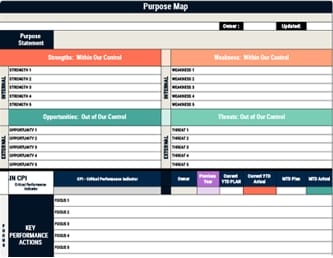
Even if your strategy is clear, you win only when you use practical tools that translate intent into funded, trackable work. Start with a Purpose Map, a one-year strategic plan that links objectives to initiatives, assigns owners, and sequences deliverables so budgets and timelines reflect real priorities. Pair it with the Mirror Exercise Work Instructions to compare how you think the organization performs with how people actually see it, then adjust messages, metrics, and incentives to close perception gaps. Anchor execution with an 8-step system that locks in cadence, governance, and risk management, while free downloads and subscriptions keep guidance current. To ensure execution drives results, connect your CPIs to KPIs to daily KPAs, creating a visible feedback loop that makes performance coachable and accountable.
1) Purpose Map: align objectives, initiatives, and funding.
2) Mirror Exercise: surface perception gaps and actions.
3) Eight-step framework: drive disciplined, repeatable implementation.
Frequently Asked Questions
How Do We Budget for Rapid Experiments Without Destabilizing Finances?
Set a fixed experimentation fund, say 5–10% of discretionary spend, and ring-fence it so core operations stay protected. Define tight stage gates, small test budgets, and time-boxed cycles, then stop or scale based on pre-set metrics. Use a rolling portfolio, balancing low-risk optimizations with a few bold bets. Tie experiments to quarterly objectives, require lightweight business cases, track burn and ROI weekly, and reallocate underperforming funds without expanding total spend.
What Governance Model Supports Adaptive Execution Without Slowing Decisions?
Use a dual‑operating governance model. You set strategic guardrails and outcome metrics centrally, then delegate decision rights to cross‑functional pods with clear budgets, risk thresholds, and escalation paths. Establish lightweight stage gates, weekly OKR reviews, and a single accountable owner per initiative. Standardize playbooks and data definitions, automate reporting, and run a cadence of brief decision forums. You audit compliance quarterly, adjust guardrails as evidence changes, and retire bottlenecks quickly.
How Should Incentives Evolve to Reward Long-Term Strategic Behaviors?
Channel Odysseus: reward the journey, not just the splashy arrival. You should shift incentives toward multi-year value creation, tying bonuses to leading indicators—customer retention, cycle-time reductions, capability building, and risk-adjusted growth. Use vesting schedules, clawbacks, and rolling scorecards to discourage short-term spikes. Weight team outcomes over solo wins, require evidence of knowledge transfer, and recognize prudent experimentation. Publish transparent metrics, review annually, and recalibrate thresholds as market conditions, strategy, and maturity evolve.
How Do We Sunset Legacy Initiatives That Dilute Strategic Focus?
You sunset legacy initiatives by defining objective exit criteria, auditing value versus strategic fit, and ranking candidates by impact, risk, and dependencies.
Announce a time-bound wind-down plan, shift budgets and talent to priority bets, and migrate customers with clear alternatives.
Set governance that requires periodic continuation cases, archive knowledge, and decommission tech responsibly.
Track outcomes post-sunset, adjust KPIs and incentives to prevent relapse, and communicate progress transparently to maintain alignment.
What Cadence Keeps Cross-Functional Learning Loops Alive Post-Launch?
Adopt a weekly pulse for quick wins and risks, a biweekly cross-functional review to align insights and backlog, and a monthly deep-dive to validate hypotheses against metrics and customer feedback.
You standardize inputs with a shared template, rotate ownership to prevent silos, and document decisions in a living playbook.
You trigger ad‑hoc huddles for anomalies, close the loop with experiment briefs, and adjust cadences if signal quality drops.
Conclusion
You bridge planning and results by turning strategy into clear roles, OKRs, and feedback loops, then running a steady Sense-Decide-Do-Revise cadence. Tie initiatives to value streams, fund outcomes, and track leading and lagging indicators on real-time dashboards. For example, a regional bank launches digital onboarding: a VP owns the value stream, squads commit to quarterly OKRs, weekly risk reviews unblock dependencies, and budget gates shift with evidence, producing a 40% faster signup and measurable revenue lift within two quarters.