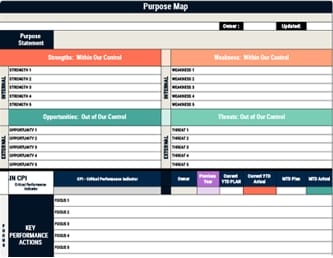


You bridge planning and results by aligning your operating model to strategic intent, translating priorities into funded work with clear owners, and running a tight Sense–Decide–Do–Revise cycle. Use transparent dashboards, explicit decision rights, and daily management to expose tradeoffs early, while middle managers convert objectives into tasks and handoffs. Rapid feedback loops surface risks and learning, so you correct course quickly and protect value streams—now, see how to set the cadence and governance that make it stick.
Key Takeaways
- Map strategy to operations by linking initiatives to value streams, owners, budgets, workflows, and explicit decision rights.
- Run an adaptive Sense–Decide–Do–Revise cycle with time-bound checkpoints and rapid feedback loops.
- Establish clear KPI ownership, thresholds, and follow-up obligations within a documented operating system.
- Use transparent, real-time dashboards for leadership and middle management to surface risks and trigger timely course corrections.
- Maintain a regular review cadence to update priorities, rebalance resources, and convert learning into action.
Defining the Strategy–Execution Gap
Why does a solid plan so often fail to deliver the results you expect? You’re likely experiencing the strategy–execution gap, the measurable distance between your desired outcomes and what actually happens, which signals misalignment, weak execution, or poor communication. You see it when milestones slip, strategies stagnate year over year, priorities change so often that teams lose focus, and burnout rises under competing demands. The gap widens when you rely on top-down planning in fast-moving markets, don’t iterate as conditions shift, and let plans outpace real operating constraints. To define it properly, look for where intent disconnects from action and impact, then map owners, decisions, and feedback loops. You close the gap by aligning strategy with operations, setting clear accountabilities, and institutionalizing continuous learning. Strengthening organizational alignment—through clear communication, shared values, and aligned goals—helps close this gap by improving engagement, agility, and accountability.
Root Causes Behind Missed Outcomes
How do solid strategies unravel between planning sessions and quarter-end reviews? They slip when top-down plans rest on shaky assumptions, skip feedback, and drift from day-to-day work. You move fast, but you don’t iterate, so teams execute failing plans efficiently instead of cycling through Sense–Decide–Do–Revise. Without clear accountability and aligned resources, operations can’t translate goals into milestones, and you stall. Establish governance rhythms and regular progress tracking with aligned OKRs to connect top-level strategies with everyday operations and maintain performance visibility.
- False certainty replaces learning, as leaders lock plans early and ignore signals, causing aims and actions to diverge.
- Execution discipline erodes when communication is sporadic, leadership messages conflict, and middle managers aren’t engaged to convert priorities into tasks.
- Visibility fades without transparent, real-time dashboards and regular reviews, creating data gaps that delay course corrections and hide slippage until it’s costly to fix.
Building an Adaptive Planning Cycle
Rarely does a static plan survive first contact with reality, so build an adaptive planning cycle that runs on Sense–Decide–Do–Revise, with explicit feedback loops, clear ownership, and time-bound checkpoints that let you pivot before small drifts become costly detours. Start by sensing with structured scans of customers, competitors, and operations, then define scenario triggers that signal when to switch paths.
Decide by rehearsing multiple futures, pre-committing moves, and assigning decision rights, so you avoid anchoring to outdated plans. Do by translating metrics into actions, setting weekly rhythm checks, and logging assumptions you can later test. Revise by reviewing outcomes against triggers, adjusting priorities, and communicating changes quickly. Protect leadership time for direction setting, clarify why priorities matter, and iterate relentlessly to keep strategy and execution aligned. To sustain alignment and performance, pair this cycle with clear roles and measurable indicators to enhance accountability and trust as emphasized in high-performing teams.
Aligning Operating Models to Strategy
When strategy shifts, your operating model has to move with it, so start by mapping each strategic initiative to the roles, workflows, and budgets that will deliver it, then link those initiatives to the value streams where outcomes are created. Translate priorities into funded work by assigning decision rights, clarifying handoffs, and defining how cross-team dependencies will be managed, so progress doesn’t stall in silos or vague committees. Fund priorities, not functions, and rebalance resources when signals show drift. To ensure execution, embed a daily management system that connects CPI→KPI→KPA with visual controls, structured reviews, and standard work to turn metrics into action.
- Map initiatives to accountable roles, end-to-end workflows, and specific budgets, then connect them to value streams that convert effort into measurable outcomes.
- Assign decision rights to named leaders, document interdependencies, and set escalation paths across teams.
- Review performance quarterly, adjust structures, and reallocate people and money as strategy evolves.
Creating Clarity: Direction, Metrics, and Accountability
You’ve connected strategy to the operating model; now make direction unambiguous so teams know exactly what to deliver and how success will be judged.
Define goals in plain language, translate strategy into specific outcomes, and name exact owners, then state what “good” looks like in measurable terms so execution has a clear line of sight.
Define clear goals, assign owners, and measure “good” so teams execute with line-of-sight outcomes.
Select a small, balanced set of metrics that separates operational activity from strategic results, preventing overload while keeping focus on impact. Establish explicit accountability with decision rights, meeting cadences, and owners who escalate issues and act on them.
Build rapid feedback loops and transparent dashboards to surface progress, risks, and needed course corrections to everyone.
Normalize frequent direction reviews, document learnings, and update targets to sustain alignment and clarity.
To reinforce clarity and cohesion, adopt OKRs to translate strategic objectives into measurable key results and establish regular reviews that keep teams aligned and accountable.
Empowering Leaders and Middle Managers to Drive Change
A practical way to turn strategy into motion is to deliberately empower your leaders and middle managers with what they need to make timely, high‑quality decisions and mobilize teams without friction. Start by clarifying decision rights and ensuring managers receive timely, relevant information, then back that with practical support so choices translate into coordinated action. Engage middle managers early in planning, because their input improves alignment, strengthens commitment, and speeds translation of priorities into daily work. Aligned organizations can grow revenue faster and be more profitable, underscoring the value of strengthening both vertical and horizontal alignment through tools like OKR software and clear communication practices.
- Define nonnegotiable outcomes and clear guardrails, then equip managers with simple, visible dashboards that tie initiatives to targets.
- Offer focused change‑management training and coaching, reinforced by peer forums where managers share tactics and resolve blockers.
- Maintain transparent communication on progress, risks, and course corrections across teams, and align senior messaging so leaders model expectations and sustain accountability.
Measuring Progress and Sustaining Momentum
Effective execution doesn’t end with empowered managers; it depends on measuring what matters and turning insight into timely action. Define clear KPIs that separate strategic outcomes from operational activity, so you don’t mistake busywork for progress, and ensure each KPI has an owner accountable for thresholds and follow-ups. Establish a regular assessment cadence, such as quarterly reviews, supported by transparent dashboards that track trends, surface risks early, and trigger timely course corrections when signals slip. To sustain this discipline, align KPIs and reviews within a documented Business Operating System, leveraging regular reviews and continuous refinement to keep roles, processes, and metrics in sync with evolving goals. Maintain continuous feedback loops that translate results into concrete actions, enabling rapid adaptation when conditions change. Allocate more time to direction setting, clarifying priorities before chasing metrics, and use both leadership and middle-management dashboards to sustain momentum, communicate progress, and reinforce alignment across teams, preventing drift and preserving focus.
Frequently Asked Questions
How Do We Budget for Rapid Experiments Without Derailing Annual Plans?
Ring-fence an innovation fund, typically 5–10% of your discretionary budget, and set clear guardrails for scope, timeline, and exit criteria. Use stage gates: approve small tranches, expand only when metrics beat predefined thresholds. Integrate experiments into quarterly planning, rebalancing portfolios based on learning velocity and ROI. Standardize cost caps, assign owners, and track spend separately, so you preserve core commitments while rapidly testing, killing weak bets early, and scaling proven ones.
What Governance Changes Prevent “Innovation Theater” During Execution?
Like a lighthouse cutting fog, you prevent “innovation theater” by instituting stage-gate reviews with defined exit criteria, tying experiments to clear problem statements, target customers, and measurable outcomes. You set decision rights, separating idea generation from funding authority, and require pre-registered hypotheses, success thresholds, and kill rules.
You publish transparent portfolios, timebox pilots, and link incentives to validated impact, not activity counts, while embedding finance and legal in reviews to ensure rigor and speed.
How Should Incentives Evolve for Cross-Functional Execution Teams?
Tie incentives to shared outcomes, not silo goals, so you reward end‑to‑end value, customer impact, and speed to learning. You set team bonuses on cross‑functional KPIs, weight them higher than individual metrics, and include leading indicators like cycle time and adoption. You add equity or gainsharing for breakthrough wins, guardrails for risk, and clawbacks for poor quality. You recognize peer feedback, rotate ownership of outcomes, and review quarterly to prevent gaming.
Which Tools Best Translate Strategy Into Weekly Team Rituals?
Use OKR platforms like Ally.io or Quantive to cascade goals into weekly check-ins, then run standups in Jira or Linear to track commitments and blockers. Pair these with Notion or Confluence for decision logs and weekly retrospective notes, ensuring lessons translate into next-week priorities. Add a KPI dashboard in Power BI or Looker for real-time signals, and automate reminders via Slack workflows so plans, work, and learning cycle predictably every week.
How Do We Onboard New Hires Into an Ongoing Execution Cadence?
Welcome them gently into the current, then teach them to swim. You onboard by giving a concise execution primer, walking through goals, metrics, rituals, and decision rights, then pairing each hire with a buddy for two cycles of shadowing and guided practice. Provide a starter playbook, sample updates, and a calendar of ceremonies. Run a structured first-month ramp: observe, co-own, own. Use short feedback loops, lightweight checklists, and clear escalation paths to reinforce cadence.
Conclusion
Wrap it all tight: you set direction like a lighthouse, align the operating model like clockwork, and run Sense–Decide–Do–Revise cycles like a metronome, almost absurdly predictable. You translate priorities into funded work, assign crisp ownership, and use transparent dashboards to keep KPI owners visibly accountable. You coach middle managers to convert goals into tasks, enforce cadence and governance, and—with ruthless learning and fast course corrections—keep milestones welded to value streams, so planning doesn’t just speak, it delivers.