

Most process defects don’t stem from carelessness—they trace back to systems that allow errors to happen in the first place. If you’re still relying on end-of-line inspection to catch mistakes, you’re paying for failures you could’ve prevented upstream. Poka-yoke, the mistake-proofing method Shigeo Shingo built into the Toyota Production System, gives you a structured way to eliminate defects at the source, and the approach is simpler than you’d expect.
Key Takeaways
- Poka-yoke prevents defects at the source by making correct execution the only possible outcome, eliminating reliance on after-the-fact inspection.
- Operations leaders address root causes—forgotten steps, unclear standards, part mix-ups, missing components, and orientation errors—with targeted mistake-proofing devices.
- Prevention-type devices physically block errors from occurring, while detection-type devices immediately flag abnormalities before defects move downstream.
- Digital poka-yoke using smart sensors, machine vision, and MES integration expands coverage, speeds detection, and logs failures for corrective action.
- Effectiveness is proven by tracking First Pass Yield daily and comparing defect data before and after installation using Pareto analysis.
What Poka-Yoke Means and Why Shingo Created It
When Shigeo Shingo developed poka-yoke in the 1960s as part of the Toyota Production System, he wasn’t introducing a complex technology—he was formalizing a deceptively simple principle: design your processes so that mistakes can’t happen in the first place. The term literally translates to “inadvertent error prevention,” and Shingo deliberately chose it after initially calling the concept “baka-yoke” (“fool-proof”), recognizing that blaming operators missed the point entirely. You’re not fixing people—you’re fixing processes. This distinction matters because it shifts quality control from after-the-fact inspection to proactive prevention at the source. When you build simple, reliable mechanisms that physically prevent defects from moving forward, you eliminate the possibility of customer-impacting failures before they ever materialize. In the same spirit, teams increasingly rely on visual management boards to surface deviations and trigger rapid, process-focused countermeasures before they reach the customer.
Why Prevention Beats Inspection Every Time
Although most quality systems still rely on catching defects after they occur, Shingo’s poka-yoke philosophy insists on a fundamentally different approach: don’t produce defects in the first place, and don’t pass them to the next step.
Even when you achieve 100% detection through warning lights, andon line-stops, or barcode validation, you’re still reacting after the error has already happened, which means you’re absorbing rework, scrap, and customer risk.
Prevention eliminates that cycle entirely.
When you design systems that physically block incorrect assembly—asymmetric guide pins, grounded plug orientations, or lockouts that halt progress when data is missing—you make correct work the only possible outcome.
In Six Sigma terms, this drives your First Pass Yield toward 100% because rework and scrap approach zero.
By tying poka-yoke designs directly to clear goals and strategic objectives in your broader strategy execution framework, you ensure mistake-proofing efforts are prioritized, funded, and systematically reinforced across the organization.
Five Root Causes Behind Most Process Defects
- Forgotten steps — operators skip a required action, which sequence controls like interlocks or data-field lockouts prevent.
- Unclear standards — ambiguous instructions cause operational mistakes, addressed through visual aids, checklists, and validation cues.
- Part identification failures — similar-looking components get swapped, mitigated by asymmetric features and barcode verification.
- Missing components — incomplete staging or distractions leave parts absent, caught by presence or weight sensors before final assembly.
- Orientation errors — incorrect positioning or misalignment, resolved with shape constraints and vision checks that halt the process.
Prevention vs. Detection Poka-Yoke Devices
Detection devices, by contrast, flag an error the moment it occurs so you can correct it before the defect moves downstream, such as an ANDON alarm that stops the line or software that voids a transaction when required fields are empty. You should prioritize prevention at the source to eliminate the error mechanism entirely, and reserve detection for handoffs where full prevention isn’t technically feasible. When designing detection devices, ensure issues can be spotted within the 1-3-10 second rule so teams immediately see status, pinpoint problems, and know the required actions.
Where Poka-Yoke Fits With Jidoka, FMEA, and SMED
Poka-Yoke doesn’t operate in isolation—it gains its full power when you integrate it with complementary Lean and quality methods like Jidoka, FMEA, and SMED.
- Jidoka detects abnormal conditions and stops the process immediately, while Poka-Yoke prevents or flags human errors earlier so operators aren’t stuck in constant monitoring mode.
- FMEA identifies critical failure modes, guiding you to implement prevention-type Poka-Yoke when feasible and detection-type devices when prevention isn’t technically possible.
- SMED reduces changeover time, which makes it easier to standardize and validate Poka-Yoke controls each time you swap tools or molds.
- After SMED-driven updates, you should revalidate every Poka-Yoke device to confirm alarms and stops remain reliable without creating false signals or operator workarounds.
Just as companies like Tesla, Airbnb, and PayPal used strong strategic organizational alignment to link goals with day-to-day execution, world‑class operations teams integrate Poka‑Yoke with Jidoka, FMEA, and SMED so error‑proofing becomes part of how the entire system runs.
Together, these methods drive higher First Pass Yield and reduce rework across your operations.
Seven Steps to Implement Mistake-Proofing
Before you install any device or redesign a workstation, you need a structured approach that moves from identifying where mistakes happen to sustaining the fix long-term.
Start by mapping your process to pinpoint exactly where human-error opportunities—skipped checks, wrong orientations—cause critical defects.
Next, run a root-cause analysis using the 5 Whys and fishbone diagrams to uncover why the mistake occurs, whether that’s unclear standards or similar-looking components.
Then decide if your poka-yoke should prevent the error entirely or detect it immediately afterward.
Build and validate the solution under real production conditions, training operators while confirming reliability with minimal false alarms.
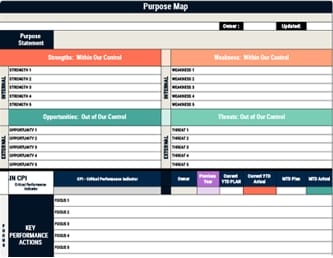
Finally, sustain results by tracking performance indicators like first-pass yield and rework trends, revalidating regularly so improvements hold as conditions change. In parallel, define a small set of Critical Performance Indicators and supporting KPIs so your mistake-proofing efforts are clearly tied to the outcomes that matter most.
Poka-Yoke Examples From the Shop Floor
- Asymmetric guide pins and unique fittings on assembly workstations ensure parts can only be installed in the correct orientation, eliminating misassembly before it occurs.
- Weight and presence sensors integrated before packaging will block the process or trigger an alarm if a component is missing or the fill weight falls outside acceptable limits.
- Light-directed picking systems project visual indicators at the exact retrieval location, reducing wrong-part errors before they reach downstream operations.
- Barcode and optical readers validate part type, orientation, and sequence in real time, voiding transactions or stopping the workflow when inputs don’t match specifications.
These controls catch problems at their source rather than after defects accumulate. By combining poka-yoke with visual management tools, operations leaders gain real-time, easily interpreted feedback that further reduces errors and accelerates problem resolution.
Digital Mistake-Proofing With Sensors, Vision, and MES
As physical poka-yoke devices like guide pins and presence sensors prove their value on the shop floor, digital mistake-proofing takes the same prevention-first logic and extends it through smart sensors, machine vision, and MES integration to cover more failure modes with greater speed and traceability. Weight sensors can reject boxes outside tolerance, while vision systems verify part type, orientation, and count at each station, blocking line progression when something’s wrong. MES integration logs every detected failure with its station, operator, shift, and timestamp, which strengthens your corrective-action workflows and reduces repeat defects. By integrating digital poka-yoke design and improvement with continuous feedback from operators and production data, you keep your strategy and execution tightly aligned as conditions change. You’ll want to validate your digital poka-yoke under real operating conditions and revalidate periodically, ensuring your detection logic stays effective as products, processes, and conditions evolve.
Prove Poka-Yoke Results With FPY and Defect Data
Once you’ve installed a poka-yoke device, you need hard evidence that it’s actually preventing the defect it targets, and First Pass Yield (FPY) paired with defect data gives you exactly that proof.
FPY and defect data are your proof that a poka-yoke device is actually doing its job.
- Track FPY daily by dividing shipped products by total produced (including rework and scrap in the denominator), so any reduction in rework directly raises your yield percentage.
- Compare defect data before and after installation, breaking down root causes to confirm the specific critical defect your poka-yoke targets is actually declining.
- Run Pareto analysis on rework and scrap reasons to verify that the top causes you identified are the ones your mistake-proofing controls now prevent or catch immediately.
- Revalidate periodically using ongoing FPY and defect trends rather than assuming the device remains effective indefinitely.
Integrate these metrics into simple visual management boards so performance is transparent, progress is easy to review, and teams can immediately see whether the poka-yoke is delivering the strategic results you expect.
Sustain Mistake-Proofing Gains Across Your Operation
Even the best poka-yoke device won’t protect your process forever if you don’t build scheduled revalidation into your operation’s routine.
Re-test each control on a fixed cadence to confirm it still catches or prevents the errors it was designed to address, because even world-class mistake-proofing degrades over time.
Integrate your poka-yoke controls into frontline standard work and 5S disciplines so the process stays repeatable.
Track First Pass Yield as your primary performance indicator—when FPY slips, run Pareto analysis on the new top causes of scrap and rework to determine where you need to add or upgrade preventive or detection devices.
Finally, lock in a no-blame, continuous-improvement culture that empowers operators to surface abnormal situations, because sustained mistake-proofing depends on people feeling safe to flag problems early.
To keep these controls effective across sites and shifts, make sure your mistake-proofing approach is tightly integrated with broader organizational alignment efforts so strategy, structure, systems, and frontline behaviors all reinforce the same error‑prevention goals.
Frequently Asked Questions
What Is an Example of Mistake-Proofing Poka-Yoke?
A common example of poka-yoke is using asymmetric guide pins on an assembly fixture so you can only install a part in the correct orientation, making the wrong placement physically impossible.
You’ll also find poka-yoke in packaging lines where a weight sensor verifies that all components are present before sealing, which blocks defective packages from moving downstream and reaching your customers.
What Are the Three Golden Rules of Poka-Yoke?
The three golden rules of poka-yoke are: first, you prevent defects from happening by designing error-proof processes; second, you don’t pass defects to the next step, ensuring mistakes are caught immediately at the source; and third, you don’t accept or allow defects to reoccur by implementing controls that block errors from reaching the customer.
You can verify these rules are working by tracking First Pass Yield toward 100%.
Conclusion
Think of poka-yoke as a guardrail on a mountain road—you don’t remove it once drivers stop going over the edge, because the guardrail is the reason they stopped. When one automotive supplier installed simple fixture pins that prevented reversed bracket loading, their first-pass yield jumped from 91% to 99.7% within a single quarter. You’ll sustain similar gains by auditing your devices regularly, tracking FPY trends, and treating every new defect as a signal to install the next guardrail.