

You should treat organizational design as your blueprint and structure as your build, aligning choices about specialization, coordination, responsibility, control, and adaptability with strategy, culture, and market realities. Design clarifies where you centralize for coherence and where you decentralize for speed, while structure turns that into roles, reporting lines, and processes. When you blend models like matrix, flatarchy, boundaryless, or holacracy with clear governance and OKRs, you reduce friction and expose trade-offs you can’t ignore.
Key Takeaways
- Design is the strategic blueprint; structure is the specific roles, reporting lines, and coordination that implement it.
- Align design to strategy, culture, and environment to enable speed, innovation, cost efficiency, or customer intimacy.
- Build the operating model first—governance, decision rights, workflows—then evolve structure to fit.
- Choose centralization versus decentralization based on risk control needs versus local responsiveness and agility.
- Select and mix structures (functional, divisional, matrix, flat) and reinforce with OKRs and feedback loops for cohesion.
Organizational Design vs. Structure: The Key Differences
How do you tell organizational design from structure when both shape how a company works every day? You start by recognizing design as the strategic blueprint that aligns your strategy, resources, processes, and culture, while structure is the concrete arrangement of roles, reporting lines, and coordination mechanisms that executes that blueprint. Design precedes structure, because you define the architecture first, then build the channels that drive information flow and decision-making. You choose a design pattern—functional, divisional, matrix, or flat—based on goals and constraints, then translate it into structures that assign tasks, connect teams, and set controls. For example, if you emphasize autonomy and innovation, you might design for flatness, yet implement a matrix or hybrid structure that enables cross-unit coordination without dulling speed. Strong alignment between design and structure enhances engagement and performance by clarifying roles, reinforcing shared values, and improving communication through frameworks like OKRs.
Aligning Organizational Design With Strategy, Culture, and Environment
Although organizational design can feel abstract, you anchor it by aligning the blueprint to your strategy, culture, and operating environment so structure becomes a practical enabler rather than a constraint. Start with strategy, since it sets the needed levels of centralization, differentiation, and coordination; a low-cost play may tolerate silos, while market-facing differentiation demands strong cross-unit links.
Anchor org design to strategy and context so structure enables, not constrains, execution.
Match the environment: stable contexts favor standardized processes and clear control, whereas complex, shifting markets require adaptable, dynamic structures.
Apply five design principles to balance trade-offs: use specialization to build expertise, coordination to connect units, responsibility to clarify ownership, control to ensure discipline, and adaptability to support change.
Leverage technology—collaboration tools, intranets, and remote work platforms—to decentralize decisions and strengthen horizontal coordination.
To sustain cohesion and execution, introduce strategic alignment mechanisms like OKRs and regular feedback loops so structure, goals, and communication reinforce each other over time.
Step-by-Step Organizational Design Process With Pitfalls and Case Lessons
Why treat organizational design as a sequence rather than a one-off chart redraw? Because design sets the blueprint and structure only implements it, you need a disciplined flow. Start by clarifying strategic intent, translating goals into choices about where to compete and how to win.
Next, map the capabilities you must excel at, identifying gaps across talent, processes, data, and technology.
Then build the operating model blueprint—governance, decision rights, workflows, and collaboration rhythms—before you evolve the structure to support it.
Watch for pitfalls: avoid overcentralization that slows decisions, prevent capability misalignment with strategy, and adapt to environmental complexity and technology-enabled collaboration.
Learn from cases: rigid hierarchies like Kodak or Blockbuster faltered, while flatter, cross-functional or Holacracy-like models (e.g., Zappos) sped decisions.
Design maturity pays: you’re 30x likelier to adapt, 5.3x likelier to be a great workplace, and 2.3x likelier to exceed financial targets.
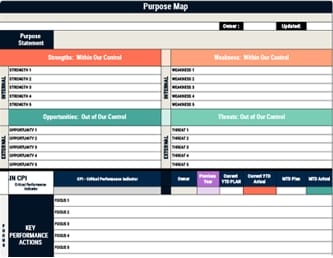
Embed a daily management system that links CPI→KPI→KPA execution loops to your operating model, making performance visible, coachable, and continuously improved at the point of work.
Criteria to Choose the Right Organizational Structure for Your Goals
When choosing a structure, start by matching it to your strategy and stakeholder needs, because the right design clarifies decision rights, accelerates execution, and scales with growth. Define the outcomes you must deliver—speed, innovation, cost efficiency, or customer intimacy—and set decision rights accordingly. Weigh centralization versus decentralization: centralize for consistency, risk control, and shared capabilities; decentralize for faster local decisions, customer proximity, and experimentation, adding oversight to avoid drift.
Assess your growth stage, since startups often evolve into hierarchies that you can streamline to stay agile. Evaluate how functional, geographic, matrix, flat, or holacracy options affect specialization, accountability, and cross-functional collaboration. Test for agility under market change, clarity of ownership for critical processes, and scalability as demand increases. Incorporating visual management principles—like the 1-3-10 rule for rapid comprehension—helps ensure structures enable fast decision-making and continuous improvement.
How to Choose Between Matrix, Flatarchy, Boundaryless, and Holacracy
Clarity comes from matching each model to the specific work you need to get done, the speed of your market, and the level of control you must retain. Choose a matrix when you need dual accountability across products and functions, since its dual reporting lines enable cross-functional collaboration without dismantling expertise. Pick a flatarchy if you want open collaboration and faster decisions yet still need some oversight, because its light hierarchy keeps coordination intact. Select boundaryless when you must partner broadly and remove silos, especially where customers and suppliers co-create value. Use holacracy if you can decentralize governance to self-organizing circles, accepting role fluidity and disciplined processes. Mix models pragmatically, as large firms often do, piloting hybrids and scaling what works. To ensure these structures translate into results, embed governance rhythms and aligned OKRs to connect top-level strategy with everyday execution.
Frequently Asked Questions
How Should Compensation and Incentives Evolve With New Organizational Structures?
Tie pay to outcomes, not hierarchy; you should reward cross-functional results, customer impact, and learning velocity. Use a mix of base, team bonuses, and skill-based pay, while granting equity or profit-sharing to align long-term behavior. Implement transparent scorecards, peer input, and OKR-linked incentives, and cap individual commissions to discourage siloed wins. Update pay bands dynamically as roles evolve, and build quarterly experiments that test incentive changes, measure effects, and iterate quickly.
What Metrics Best Measure the Success of a Redesign?
You test the theory that structure boosts outcomes by tracking concrete shifts. You measure time-to-value for initiatives, cycle time, decision latency, and defect or rework rates. You track throughput per team, cross-functional handoffs, and employee engagement retention. You watch customer NPS, churn, and expansion. You compare planned versus realized OKRs and budget adherence. You assess role clarity, accountability density, and dependency count, then verify improvements persist over two to three operating cycles.
How Do We Handle Regulatory Compliance in Boundaryless or Networked Models?
You handle compliance by mapping applicable regulations to workflows, assigning accountable owners, and embedding controls into contracts, APIs, and shared playbooks. You standardize due diligence, data handling, and audit trails across partners, then monitor them with continuous control testing and real-time dashboards. You segment data, enforce least privilege, and use DPAs and SLAs for cross-border risks. You document decisions, run training, conduct mock audits, and escalate breaches through predefined incident procedures.
What Change Management Timeline Is Realistic for Large-Scale Restructuring?
Think of it like turning a cargo ship, not a kayak. You should plan 12–18 months for large-scale restructuring, with clear phases: 2–3 months for diagnostics and design, 3–4 months for detailed planning and governance, 4–6 months for pilot execution and capability building, and 3–6 months for full rollout and stabilization. Set measurable milestones, align incentives, over-communicate changes, run parallel risk controls, and maintain a feedback loop to adjust pacing without losing momentum.
How Can We Reskill Managers Transitioning From Command-And-Control Roles?
Start with a skills baseline, then design a targeted curriculum covering coaching, facilitation, feedback, data literacy, and cross-functional collaboration. Use blended learning: short workshops, simulations, peer practice, and shadowing, reinforced by real projects with clear success metrics. Provide mentors, job aids, and microlearning for just‑in‑time support. Tie progress to performance reviews and incentives, and schedule regular retros to adjust gaps, ensuring you apply new behaviors in progressively larger, accountable assignments.
Conclusion
You translate design into structure by clarifying choices—specialization, coordination, accountability, control, and adaptability—then mapping roles, reporting lines, and rhythms that support your strategy and culture. Use OKRs and governance cadences to keep teams aligned while empowering local decisions. For example, a software firm shifting to a customer-segment matrix can keep platform standards centralized, assign segment GMs P&L accountability, and run quarterly portfolio reviews, which reduces duplication, speeds cross-functional delivery, and preserves architectural integrity.