

You’re choosing among OKRs, KPIs, and CPIs to steer performance, but each serves a different job: OKRs push strategic change with bold goals and measurable results, KPIs track ongoing health with a lean metric set, and CPIs improve process efficiency and stability. You’ll want to match the framework to your needs, timeline, and culture, then combine them wisely without measurement overload. Here’s how to decide, align cadences, and avoid pitfalls that stall progress.
Key Takeaways
- Use OKRs to drive ambitious, time-bound change with 3–5 key results per objective; ideal for strategic shifts and cross-team alignment.
- Use KPIs to monitor ongoing performance health with 5–7 stable metrics; track monthly to ensure targets and operational stability.
- Use CPIs to assess process efficiency and stability, focusing on cycle times, defect rates, and other real-time process signals.
- Combine them: set quarterly OKRs, map key results to a focused KPI set, and deploy CPIs to improve processes behind KPI gaps.
- Keep intent and cadence distinct to avoid measurement overload: OKRs strategic/time-bound, KPIs continuous health, CPIs continuous process feedback.
Defining OKRs, KPIs, and CPIs: Purposes and Core Concepts
Why do these three acronyms matter? You use them to set direction, measure progress, and improve how work gets done. OKRs combine a qualitative objective with several measurable key results, usually three objectives with three to five results each, so you align teams and drive ambitious, time-bound change. You state what you want to achieve and why it matters, then prove progress with evidence.
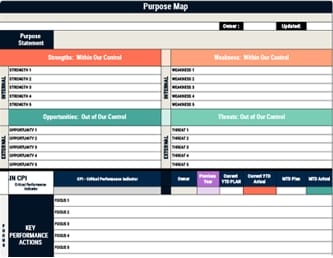
KPIs are standalone, quantitative metrics, typically a focused set of five to seven tied to targets and benchmarks, so you monitor ongoing health and validate movement toward strategic goals. CPIs, less common, track continuous process performance, emphasizing efficiency and stability in the workflows that enable outcomes. Together, OKRs define outcomes, KPIs gauge performance, and CPIs assess process health. To avoid measurement overload, define a few Critical Performance Indicators as the vital outcomes, then align supporting KPIs and daily Key Performance Actions to drive them.
Key Differences: Strategic Change vs. Performance Health vs. Process Improvement
How do you tell these frameworks apart in practice so you apply the right tool at the right time? Start by separating their intent and cadence. OKRs drive strategic change, asking you to pursue ambitious objectives with 3–5 measurable key results per objective, typically across a cycle centered on about three objectives. KPIs, by contrast, monitor performance health, giving you a small, stable set—often 5–7 per plan—of signals that indicate whether operations stay on track. CPIs target process improvement, refining how work flows so outcomes become faster, cheaper, or higher quality, and they can surface as KPIs or as initiatives within OKRs. Well-aligned use of these frameworks strengthens employee engagement and agility by clarifying goals, communication, and roles across teams.
Separate intent and cadence: OKRs shift strategy, KPIs monitor health, CPIs refine process efficiency.
1) OKRs: catalyze cross-team alignment and directional shifts.
2) KPIs: track real-time health against targets.
3) CPIs: improve efficiency and effectiveness of processes.
When to Use Each Framework: Scenarios and Decision Guide
Knowing the intent and cadence of OKRs, KPIs, and CPIs sets you up to choose the right tool in real situations, so this section turns those distinctions into practical guidance you can apply immediately. Use OKRs when you’re driving ambitious, time-bound change, such as entering a new market or lifting retention, setting about three objectives with three to five measurable key results each to align teams and sustain motivation.
Choose KPIs for steady-state performance, selecting five to seven metrics, tracking them monthly to confirm targets are met and operations remain stable.
Apply CPIs when you need real-time, continuous feedback on processes, such as cycle times or defect rates, to guide daily adjustments. When helpful, place a KPI as the outcome in an OKR, carrying it across quarters for continuity. Additionally, reinforce these choices with continuous communication and feedback loops to keep teams informed and motivated.
How to Combine Them: Aligning Objectives, Metrics, and Process Improvement
Although each framework serves a different purpose, you’ll get the best results when you connect them in a single, closed-loop system that ties ambition to execution and learning. Start by setting quarterly OKRs that express where you want to go, then translate each key result into concrete KPIs that show how well you’re progressing. Select 5–7 KPIs per plan to keep focus, and define CPIs that target processes causing KPI gaps, so improvements directly lift performance. To maintain data integrity and security while tracking KPIs and CPIs, always download tools from trusted sources and verify files with antivirus scans before use.
1) Cascade and connect: map objectives to key results, assign KPIs to each result, and link CPIs to the specific steps that influence those KPIs.
2) Measure and validate: monitor KPIs regularly, and use CPIs to confirm process changes drive measurable gains.
3) Govern the loop: review OKRs quarterly, retain enduring KPIs, and refresh CPIs as priorities evolve.
Implementation Best Practices and Common Pitfalls to Avoid
Before you roll out OKRs, KPIs, and CPIs together, set a disciplined operating rhythm that balances ambition with operational stability, because execution rigor prevents misalignment and metric churn. Define 3–5 bold Objectives per cycle, attach 3–5 measurable Key Results to each, and run quarterly reviews that check progress, unblock work, and retire obsolete items. Treat only select Key Results as KPI-like outcomes, since many KRs are mileposts, not enduring health signals. Keep KPIs lean—about 5–7 per plan—tie them to ongoing performance, and monitor them monthly or more frequently for trend clarity. Don’t rebuild KPIs every quarter; carry them forward to preserve continuity. Use a lightweight strategy reporting tool to align cross-functional OKRs with KPIs, ensuring visibility, ownership, and data-driven adjustments. Augment this rhythm with real-time visual management boards that use clear, color-coded indicators to surface deviations quickly and drive timely, team-owned action.
Frequently Asked Questions
How Do Incentives and Compensation Align With OKRS, KPIS, and CPIS?
You should tie incentives to outcomes and behaviors each framework targets. With OKRs, reward progress, learning, and achieved key results, using modest bonuses or recognition to avoid sandbagging.
With KPIs, link compensation to sustained metric attainment, using thresholds, targets, and stretch tiers.
With CPIs, align rewards to process adherence and capability gains, such as cycle-time improvements or quality maturity.
Blend team and individual components, time payouts to verified results, and audit for fairness and gaming.
What Tools or Software Best Support Mixed Okr/Kpi/Cpi Reporting?
Start with one fact: 64% of leaders say unified dashboards improve decision speed. You’ll get the best mixed OKR/KPI/CPI reporting by pairing a strategy tool with a BI layer. Use WorkBoard, Profit.co, or Gtmhub for OKRs, then centralize KPIs/CPIs in Power BI, Tableau, or Looker. Connect data via Snowflake or BigQuery, use OKR/KPI hierarchies, map CPI definitions, schedule refreshes, and standardize metadata to ensure traceability, consistency, and drill-through.
How Should Small Teams Without Data Analysts Start Measuring Reliably?
Start small with a few high-signal metrics, define clear operational definitions, and set simple collection cadences. Use spreadsheets or basic BI tools, document data sources, owners, and calculation formulas, and create a single “definitions” sheet. Track leading and lagging indicators, add sanity checks, and run weekly reviews to validate trends. Automate pulls where possible, archive raw snapshots, and visualize with lightweight dashboards. Iterate quarterly, retiring noisy metrics and enriching reliable ones.
How Do We Budget and Allocate Resources Across These Frameworks?
Strike while the iron’s hot: you budget by aligning funds to outcomes, then backing measurement. Allocate 60% to initiatives tied to top objectives, 25% to KPI instrumentation and reporting, and 15% to CPI experimentation and learning. Fund cross-functional owners, not silos, and set quarterly review gates to reallocate based on evidence. Start lean with templates and basic tools, reserve a contingency buffer, and require clear hypotheses and success criteria before spending.
How Do Regulatory or Compliance Needs Influence Framework Selection?
Regulatory or compliance needs push you toward frameworks that ensure traceability, auditability, and control. You’ll favor KPIs for monitoring mandated thresholds, CPIs for documenting processes, controls, and evidence, and OKRs for driving remediation or improvement initiatives. You should map requirements to measurable indicators, define ownership, set review cadences aligned to audits, and maintain defensible records. When regulations shift, you’ll update indicators, revise processes, retrain teams, and communicate changes through formal governance.
Conclusion
Treat OKRs, KPIs, and CPIs like a compass, dashboard, and engine, working together to steer, monitor, and refine your business. Set quarterly OKRs to chase strategic change, track 5–7 KPIs to watch performance health, and use CPIs to tune core processes. Keep cadences distinct, align metrics to objectives, and tie process fixes to measurable outcomes. Review regularly, retire stale measures, and automate reporting, so you focus on insights and action rather than noise, drift, or rework.