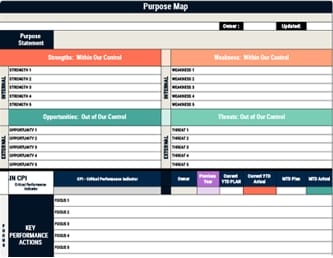


Choosing the right KPIs starts with tying every metric to a clear business goal and audience, then narrowing to a focused set of 3–5 indicators you can actually influence. You’ll balance leading metrics that forecast outcomes with lagging ones that confirm results, define data sources and owners, and set a reporting cadence. Examples include revenue growth, new customer acquisition rate, churn, and cost per acquisition—next, you’ll see how to align them to your strategy.
Key Takeaways
- Start with strategic goals; select 3–5 KPIs tightly linked to mission, near-term priorities, and long-term outcomes.
- Choose measurable, actionable metrics with clear owners, data sources, and reporting cadence to drive decisions.
- Balance leading and lagging indicators to predict performance and confirm results across time horizons.
- Use industry- and audience-specific KPI libraries; prioritize value drivers relevant to your channels and products.
- Review and evolve KPIs quarterly—retire vanity metrics, rebaseline targets, and communicate changes via dashboards.
What Is a KPI and Why It Matters
What exactly is a KPI, and why should you care? A KPI is a quantifiable indicator that shows how effectively you’re moving toward defined targets and outcomes, giving you a clear way to track performance against specific objectives. You’ll typically monitor KPIs monthly, which helps you spot trends early, allocate resources wisely, and address issues before they escalate.
KPIs come in two types: leading indicators, which predict future results, and lagging indicators, which confirm what already happened. Using both gives you foresight and proof, so you can adjust tactics confidently. A good KPI is measurable, actionable, and tightly linked to a business objective, not just a vanity metric. Most teams perform best with a focused set of 5–7 KPIs, keeping attention sharp and decision-making disciplined. To ensure KPIs drive outcomes that truly matter, align them to a few Critical Performance Indicators and reinforce them with specific Key Performance Actions.
Align KPIs With Your Strategic Goals
You’ve defined what KPIs are and why they matter; now make them serve your strategy by anchoring each metric to your mission and concrete goals across time horizons. Tie short-term KPIs to weekly or monthly execution, link mid-term KPIs to quarterly priorities, and align long-term KPIs with multi-year outcomes, so every level pulls in the same direction. Use a hub-and-spoke model: set a small set of executive KPIs as the hub, then cascade spoke metrics to functions and teams, enabling bottom-up learning and top-down focus. Favor indicators that connect objectives to product‑market fit, such as Customer Referral Rate or Expansion Revenue, over vanity counts. Assign clear owners, define decision rights, and ensure each KPI prompts specific actions at the appropriate management level. Avoid cookie-cutter measures; tailor to context and lifecycle. To drive timely decisions and quick responses to deviations, visualize these KPIs on performance dashboards with clear, color-coded indicators and real-time updates that prompt action.
Choose Industry- and Audience-Specific Metrics
How do you keep KPIs relevant across contexts? Start by matching metrics to what truly drives value in your industry and audience. Retail might focus on revenue per store and customer acquisition cost, while manufacturing leans on OEE and cost per unit. For B2B software, prioritize CAC, CLV, churn, and ARR; for B2C e-commerce, track traffic, conversion rate, and average order value. Hospitality teams monitor occupancy and guest satisfaction, whereas SaaS leaders watch MRR growth and expansion revenue. Align KPIs to channels and products so they mirror where growth occurs, such as online versus brick-and-mortar or free-to-paid app conversions. To ensure KPIs translate into execution, connect them to aligned OKRs and governance rhythms so every layer tracks progress and accountability.
- Map value drivers by industry and segment.
- Prioritize audience-relevant outcomes.
- Align KPIs to channel and product strategy.
- Use vetted KPI libraries to select metrics.
Keep Your KPI Set Simple, Measurable, and Actionable
Why chase dozens of numbers when a concise set will drive clearer action and accountability? Limit your KPI set to 3–5 metrics, and tie each one directly to a specific business goal, so you keep focus and avoid dilution. Define how you’ll measure every KPI: name the data source, set a reporting frequency—monthly works for most teams—and assign a clear owner who’s responsible for tracking and explaining changes.
Make your KPIs actionable by linking outcomes to controllable levers. If revenue is a KPI, pair it with lead generation volume and conversion rate, giving teams concrete paths to improve results. Avoid vanity metrics that look impressive but don’t guide decisions; prioritize metrics with real outcomes and predictive value that inform decisions before problems escalate.
To strengthen impact and adoption, ensure your KPIs align with shared values and are consistently communicated across teams, reinforcing organizational alignment and accountability.
Evolve Your KPIs as Priorities Change
When priorities shift—as they inevitably do—treat your KPI set as a living system that you review and refine on a clear cadence, ideally every quarter, so it stays aligned with current user, business, and product goals. You’re not locking metrics in stone; you’re adapting them to match strategy, lifecycle stage, and available resources. Add indicators that reflect new goals, remove those that no longer matter, and reset targets so they’re ambitious yet realistic. Use a structured review to confirm each KPI remains relevant, measurable, and actionable, then communicate changes clearly to maintain stakeholder alignment and momentum. Aligning KPIs with strategy-execution frameworks like OKRs ensures clear objectives, measurable targets, and routine progress checks that keep teams focused as priorities evolve.
- Define quarterly checkpoints, owners, and decision criteria for keeping or retiring KPIs.
- Map KPIs to current goals, then prune misfits.
- Rebaseline targets to reflect new realities.
- Share updates, rationale, and next steps.
Bring KPIs to Life With Dashboards, Automation, and Expert Support
Your KPIs only create value if teams can see them, act on them, and keep them current, so put them to work with dashboards, automation, and expert guidance. Build dashboards that consolidate financial, customer, operations, and employee metrics, giving everyone a real-time, holistic view of performance and a shared understanding of priorities. Automate data refreshes, scheduled reports, and alerts so leaders get timely updates, teams stay aligned, and you eliminate manual effort that delays decisions. Evaluate KPI software, such as Spider Impact, that combines dashboards, reports, and automated meetings to drive accountability, ensure follow-through, and simplify performance reviews. Sign up for a free trial or demo to confirm the tool supports your data sources and reporting needs. Finally, use expert support to align metrics with goals and implementation realities. Strengthen KPI adoption by ensuring metrics reinforce both vertical and horizontal alignment, so teams collaborate effectively and decisions reflect the company’s strategic vision.
Frequently Asked Questions
How Do We Set KPI Targets Without Historical Data?
Set KPI targets by triangulating external benchmarks, your business model, and capacity. Start with industry averages, competitor disclosures, or analyst reports, then adjust for your price point, sales cycle, and team size. Build a bottom‑up model that converts inputs—traffic, conversion, AOV, CAC—into outputs, and stress‑test best, base, and worst cases. Choose a base target, add a stretch target, and set guardrails. Review monthly, tighten assumptions, and recalibrate as data arrives.
What Common KPI Pitfalls Lead to Misinformed Decisions?
You mislead yourself by tracking vanity metrics, ignoring leading indicators, and mixing activity with outcomes. You overfit to short-term targets, neglect seasonality, and forget lag effects, which skews attribution. You accept poor data quality, inconsistent definitions, and unclear owners, so numbers drift. You set KPIs without baselines or benchmarks, then celebrate noise. You measure too many things, bury signal, and fail to link KPIs to decisions, incentives, and experimentation, inviting gaming and tunnel vision.
How Should KPIS Differ Between Startups and Enterprises?
Like a startup captain using a sundial, you prioritize speed, learning, and runway. You track activation, retention cohorts, CAC payback, burn multiple, feature adoption, and qualitative feedback, updating KPIs frequently as product–market fit evolves. In an enterprise, you emphasize scale, reliability, and governance: revenue by segment, NRR/GRR, gross margin, operating efficiency, SLA/uptime, security compliance, and talent metrics, with stable definitions, audited data, and cascading goals that align teams across complex portfolios.
How Do We Resolve Conflicting KPIS Across Departments?
Resolve conflicts by aligning every KPI to a single north-star outcome, then map each department’s metric to it, exposing trade-offs. Run a cross-functional workshop to surface conflicts, define shared definitions, and set decision rules. Convert competing KPIs into balanced, tiered targets with guardrails, like minimums for quality or margin. Establish a cadence to review impacts, use a tie-breaker hierarchy, and assign an owner to adjudicate disputes and update dashboards.
What Governance Process Maintains KPI Data Quality?
You maintain KPI data quality with a formal data governance council, clear ownership, and documented definitions. You assign data stewards per metric, set source-of-truth systems, and enforce data standards and validation rules. You run automated quality checks, audit trails, and change-control for definitions and calculations. You schedule refresh cadences, monitor lineage, and log exceptions. You publish a data dictionary, require training, and review quality metrics in monthly governance meetings.
Conclusion
Choose KPIs like a navigator selects stars: align them to your strategy, pick a focused mix of leading and lagging indicators, and tie each to an owner, source, and cadence. Start simple—3 to 5 metrics that are measurable and actionable—then refine quarterly as priorities shift. Build clear dashboards, automate collection, and seek expert input when gaps appear. With disciplined tracking and periodic reviews, you’ll steer decisions with confidence and turn goals into steady, observable progress.