

As you move beyond 50 employees, informal coordination breaks, so a Business Operating System gives you shared priorities, accountable roles, and data-driven routines that scale. You’ll standardize onboarding, define KPIs, and codify cloud-first processes so teams can decide locally without chaos, while leadership spots trends early. With EOS, Scaling Up, or GGOB, you align goals, automate handoffs, and cut friction—setting the stage for predictable growth, but the real advantage comes from how you implement each layer.
Key Takeaways
- Replace ad-hoc coordination with a Business Operating System to align priorities, decision rights, and accountability as headcount surpasses 50.
- Standardize core processes and KPIs across customer, revenue, quality, and cost to enable scalable execution and clear ownership.
- Implement cloud-first, integrated platforms (e.g., Salesforce, HubSpot, Notion) for real-time data, reliable workflows, and living documentation.
- Establish structured operating rhythms—weekly scorecards, monthly reviews, quarterly planning—to detect trends early and drive course corrections.
- Choose and roll out the right BOS (EOS, Scaling Up, GGOB) with coaching, staged adoption, integrations, and measurable outcomes.
Why a Business Operating System Becomes Essential at 50+ Employees
Although a small team can rely on informal coordination, once you pass roughly 50 employees a Business Operating System becomes essential because complexity multiplies, roles diverge, and ad hoc practices stop scaling.
You need a business operating system to align every team on priorities, cadence, and accountability, so daily work connects to company outcomes and productivity doesn’t erode.
Clear processes standardize onboarding, training, and handoffs, shrinking knowledge gaps that appear during rapid growth.
You’ll benefit from data-driven routines that surface trends early, letting you adjust plans before issues compound.
Strong change management keeps updates predictable, while people management practices clarify expectations and reduce leadership burnout.
To reinforce cohesion and measurable progress at this scale, adopt OKRs to translate strategic objectives into clear, trackable outcomes across teams.
Designing Org Structure, Roles, and KPIs for Scalable Execution
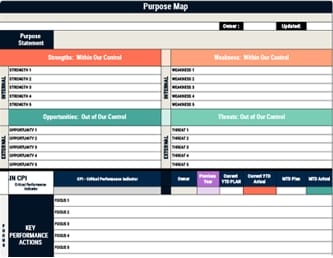
Because scale amplifies ambiguity and slows decisions, start by designing an organizational structure that mirrors your strategy, with clear reporting lines, defined spans of control, and explicit decision rights so work flows to outcomes rather than getting stuck in hierarchy. Map value streams to teams, then assign roles and responsibilities that minimize overlap and surface single-threaded owners for critical domains. Anchor your business operating system (BOS) to a tiered cadence where leaders review Key Performance Indicators (KPIs) tied to customer, revenue, quality, and cost outcomes, ensuring scalable execution under rapid growth. Translate company goals into team metrics and individual objectives, linking inputs to outputs. Establish structured communication and feedback rituals—weekly scorecards, monthly reviews, and quarterly org assessments—and adjust design as needs evolve from 50 to 500. To reinforce alignment and transparency, implement governance rhythms with regular progress tracking that connect top-level strategy to frontline execution.
Building Golden-Rule Processes: Decentralized, Cloud-First, and Reliable
You’ve defined roles and KPIs so decisions move faster; now codify how work gets done with golden‑rule processes that are decentralized, cloud‑first, and reliably fast.
In your business operating system, push authority to the edges: let teams choose tools and manage budgets within guardrails, which removes bottlenecks and increases scalability as headcount grows.
Standardize on cloud-first platforms like Salesforce and HubSpot so global and remote teammates access the same data, collaborate in real time, and avoid local file chaos.
Standardize on cloud-first tools so everyone shares real-time data and escapes local file chaos
Make reliability nonnegotiable: prioritize fast-loading, intuitive software to protect focus and cycle time.
Choose user-friendly tools that support self-onboarding, such as Payfit and Zapier, to speed adoption without heavy training.
Anchor it all with a living documentation system in Notion or Slite, ensuring continuity and clarity.
Reinforce the system with regular reviews and performance metrics to track progress, align teams with goals, and drive continuous improvement.
Self-Onboarding, Integrations, and Knowledge Hubs to Reduce Friction
When teams grow fast and work across tools, reduce friction by designing for self-onboarding, tight integrations, and a single source of truth from day one.
Build a business operating system that lets team members set themselves up quickly: choose user-friendly software with intuitive dashboards, publish step-by-step guides, and automate account provisioning. Pair that with integrations to core platforms like Salesforce and HubSpot, so data flows without manual entry and workflows stay consistent across departments.
Create knowledge hubs in Notion or Slite that centralize policies, playbooks, and system maps, giving everyone fast access to information.
Maintain clear ownership, update cadences, and version histories to keep guidance current. This structure promotes a culture of independence, reduces repetitive questions, accelerates onboarding, and sustains momentum during rapid growth. Integrate operational realities early and tie guidance to measurable outcomes to ensure strategy and execution stay aligned during scaling.
Selecting and Rolling Out EOS, Scaling Up, or GGOB for Sustainable Growth
With friction reduced through self-onboarding, integrations, and a clear knowledge hub, the next step is choosing a structured business operating system that sustains disciplined growth and accountability.
Start by matching fit: the Entrepreneurial Operating System suits first-time SMEs, aligning Vision, People, Data, Issues, Processes, and Traction so leadership teams create a good culture and cadence. Aligned organizations can grow revenue faster and be more profitable, underscoring the importance of strengthening both vertical and horizontal alignment as you scale.
Match fit first: EOS suits first-time SMEs, aligning Vision, People, Data, Issues, Processes, and Traction.
If you’re $10–500M, Scaling Up provides deeper tools across People, Strategy, Execution, and Cash Flow, with documented ROI and complex practices that support a successful business.
Use GGOB when you want open-book management to boost shared responsibility and engagement.
Plan implementation deliberately: select a coach or self-implementation, define a 90-day rollout, set KPIs, and run weekly and quarterly reviews.
Budget realistically—coaching ranges from $40,000 to $200,000+ annually.
Frequently Asked Questions
What Percentage of Businesses Have More Than 500 Employees?
About 0.4% of U.S. businesses have more than 500 employees, while roughly 0.2% do in the European Union.
You should interpret this as evidence that large enterprises are rare, so most firms operate as small businesses.
If you’re benchmarking growth, compare your headcount trajectory to these baselines, assess operational readiness, and plan systems that support hiring, onboarding, and coordination, because scaling beyond 500 employees typically demands robust processes and disciplined management.
How to Scale Business Operations?
Scale operations by documenting core processes, so teams execute consistently and knowledge survives growth; implement structured onboarding, clarifying roles, tools, and performance standards; decentralize decisions with clear budgets and guardrails, letting managers handle purchases and tool choices;
adopt cloud-based systems to improve access, collaboration, and security for dispersed teams; and review org design quarterly, aligning reporting lines and accountability with outcomes, while tracking KPIs to expose bottlenecks, inform hiring, and prioritize automation.
What Is the Scale of Operation of a Business Organization?
The scale of operation is the size and scope at which you produce and manage activities, including resources, processes, and markets served.
Think of it as your engine’s capacity, determining costs, speed, and flexibility. You assess it by employee count, output volume, geographic reach, and system maturity, then align structure, roles, and tools accordingly.
As you grow, you standardize workflows, decentralize decisions, and measure performance rigorously to sustain quality, responsiveness, and profitability.
How Many Businesses in the US Have Less Than 50 Employees?
About 29.8 million U.S. businesses have fewer than 50 employees, since roughly 97% of all employer firms fall under this threshold.
You can estimate this from the SBA’s share applied to the total employer base, and it aligns with Census data showing many firms operate with 20–99 employees, plus millions under 20.
You should view this group as highly diverse across retail, healthcare, and professional services, and as major job creators.
Conclusion
You won’t just add a BOS—you’ll bolt a rocket to your organization, channeling chaos into repeatable execution. Define roles, KPIs, and cloud-first processes so teams decide fast without you, then anchor everything in a knowledge hub that onboards people before their coffee cools. Pick EOS, Scaling Up, or GGOB, roll it out with fierce consistency, and review data weekly; you’ll spot trends before they whisper, scale decisions without bottlenecks, and turn growth into a disciplined habit.