
Choose your strategy, choose your cadence, choose your level of engagement—because Hoshin Kanri and traditional planning push you in different directions. You’ll weigh collaborative catchball and PDCA cycles against top-down directives and annual targets, consider whether X-matrices and bowling charts beat classic scorecards, and decide how much adaptability your culture can handle. If you need alignment that sticks without slowing execution, you’ll want to compare their decision-making mechanics and review rhythms next.
Key Takeaways
- Hoshin Kanri focuses on a few breakthrough objectives; traditional planning spreads effort across many goals, diluting impact.
- Hoshin uses catchball for two-way alignment; traditional planning relies on top-down directives with limited feedback.
- PDCA cycles drive iterative learning and course correction in Hoshin; traditional plans are static and less adaptable.
- X-Matrix, bowling charts, and scorecards create transparent accountability in Hoshin; traditional methods often lack visibility and ownership.
- Hoshin boosts engagement and innovation but requires cultural change and training; traditional planning is easier to start but risks disengagement and missed targets.
Defining Hoshin Kanri and Traditional Planning
Definition sets the stage: Hoshin Kanri is a strategy deployment method that aligns a few breakthrough objectives with daily work through a collaborative “catchball” process, where leaders and teams iterate goals, measures, and actions until they’re clear, feasible, and owned at every level; traditional planning, by contrast, is a top‑down approach that codifies many goals in lengthy documents, assigns broad initiatives without precise ownership, and then executes with limited feedback loops. When you define Hoshin Kanri, you emphasize focus, shared ownership, and ongoing review using PDCA cycles, so strategy stays connected to operations. When you define traditional planning, you describe a static model that sets many targets, communicates directives downward, and often leaves accountability vague. You adopt Hoshin Kanri to concentrate effort, clarify responsibilities, and adjust quickly. For example, companies like Tesla and Spotify demonstrate how aligning strategy with execution through clear objectives and feedback loops—akin to Hoshin Kanri—can drive leadership in their industries by improving cross-functional alignment and user-focused KPIs.
Core Principles and Decision-Making Approaches
Although both approaches aim to translate strategy into action, their core principles and decision-making differ in ways that shape how work gets done. You’ll see Hoshin Kanri favor disciplined focus, iterative learning, and shared ownership, while traditional planning often leans on one-way directives and broad goal sets that dilute effort and slow adaptation. Aligned organizations improve adaptability and customer outcomes by reinforcing organizational alignment, which harmonizes strategy, structure, and communication for faster, more effective execution. 1. Prioritization: You select a few breakthrough objectives in Hoshin Kanri, concentrating resources where impact is highest, whereas traditional planning often spreads attention across many goals, weakening execution. 2. Decision cadence: You use PDCA cycles to test, check, and adjust, enabling timely course corrections; traditional plans typically review less often, delaying response. 3. Ownership: You assign clear goal owners, creating transparent accountability beyond hierarchy. 4. Communication: You employ visual tools, like the X-Matrix, to connect objectives, measures, and initiatives, ensuring shared understanding.
Alignment Mechanisms: Catchball vs. Top-Down Directives
When you compare alignment mechanisms, Hoshin Kanri’s Catchball creates a two-way dialogue that refines goals before they’re locked in, while traditional top-down directives push decisions downward with little room for adjustment.
You involve managers and frontline employees in structured exchanges, test assumptions about feasibility, and adjust objectives before committing, which builds shared ownership and clearer alignment with operational realities.
In contrast, you issue directives from the executive level, expect compliance, and often discover gaps later, which can drive disengagement and missed targets.
With Catchball, you run iterative feedback loops, revisit objectives and tactics regularly, and adapt quickly as conditions change, maintaining relevance and momentum.
Research shows higher alignment and engagement with Catchball, because people feel heard, understand trade-offs, and commit to achievable goals.
Aligned organizations can grow revenue faster and be more profitable by strengthening both vertical and horizontal alignment, making Catchball’s two-way dialogue especially valuable for sustained performance.
Tools and Artifacts: X-Matrix, Bowling Charts, and Scorecards
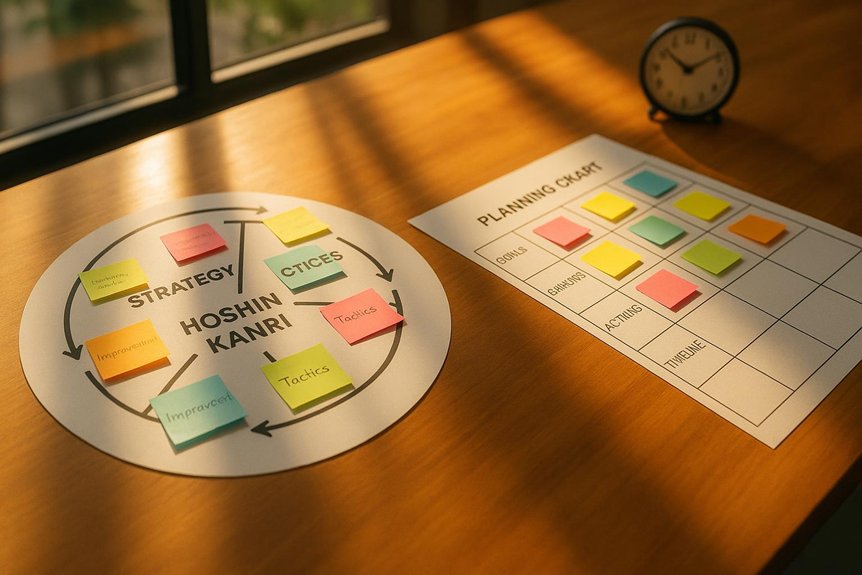
With alignment built through Catchball, you need tangible artifacts that hold strategy, actions, and results together day to day, and the X-Matrix, Bowling Charts, and scorecards serve that role.
These tools translate intent into visible commitments, clarify ownership, and keep attention on what matters, helping you move from high-level aims to operational focus without drift.
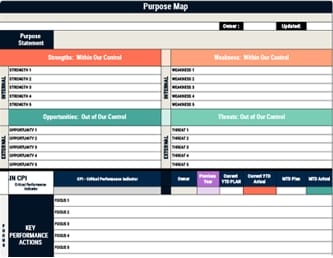
1) Use the X-Matrix to connect long-term objectives, annual objectives, improvement priorities, and key metrics, so everyone sees how work links to strategy and where tradeoffs exist.
2) Track Breakthrough Priorities with Bowling Charts, visually comparing planned versus actual KPI results, then flagging gaps early for targeted support.
3) Maintain scorecards to report performance against goals, reinforcing focus and individual accountability.
4) Integrate all three to create a single, transparent picture that aligns planning with daily execution.
Establish governance rhythms and regular progress tracking with performance dashboards to maintain momentum and visibility, reinforcing alignment and accountability throughout execution.
Execution and Review Cycles: PDCA, Monthly Checks, and Annual Retrospectives
Because strategy only matters if it changes what people do this week, Hoshin Kanri anchors execution in a tight PDCA cadence that turns plans into tested actions, measured results, and timely adjustments.
You translate breakthrough objectives into clear experiments, run them, check outcomes against targets, and act on the gap, which keeps learning continuous and grounded in data rather than opinion.
You reinforce this loop with disciplined monthly checks that compare actuals to plan, surface deviations early, and assign specific countermeasures with owners and deadlines, so priorities and resources stay aligned with strategic goals.
You then run an annual retrospective that looks beyond scorecards to evaluate the Hoshin process itself, capturing lessons, removing systemic barriers, and refining objectives and methods, which promotes accountability, transparency, and ongoing strategic coherence.
This cadence works best when leaders and teams maintain aligned leadership and engage operational experts early, ensuring strategies remain actionable, measurable, and grounded in operational realities.
Selecting the Right Model for Your Organization’s Context
How do you decide whether Hoshin Kanri or a traditional planning model fits your context? Start by evaluating how much focus, collaboration, and adaptability you need, then match those needs to each model’s core strengths.
Hoshin Kanri centers on a few breakthrough goals, uses catchball for alignment, reviews progress frequently, and embeds PDCA for continuous improvement, while traditional planning favors extensive goal lists, top-down decisions, annual cycles, and fixed plans. To strengthen alignment and execution, you can complement either approach with OKRs, which provide measurable objectives and regular reviews that reinforce cohesion.
- If you need sharper focus, choose Hoshin’s limited breakthrough goals over sprawling objective lists that dilute execution.
- If cross-level engagement is critical, adopt catchball; avoid rigid top-down planning that dampens ownership.
- If your market shifts quickly, prioritize Hoshin’s frequent reviews rather than infrequent, rigid updates.
- If clarity matters, leverage visual X-Matrices for alignment instead of fragmented documents.
Frequently Asked Questions
How Do We Train Leaders and Teams to Practice Catchball Effectively?
Start with a drill: like passing a soccer ball, you practice short, accurate exchanges before shooting.
You train leaders and teams by teaching purpose clarity, defining roles, and scripting structured prompts that elicit constraints, assumptions, and measurable outcomes.
Use time-boxed rounds, visual A3s, and decision logs, then rotate facilitators to build accountability.
Coach respectful challenge, quantify alignment with simple surveys, and close loops with documented decisions, next steps, and cadence reviews to reinforce discipline.
What Cultural Barriers Commonly Derail Hoshin Kanri Adoption?
You face barriers like top-down control that stifles catchball, fear of transparency that hides problems, and siloed mindsets that block cross-functional alignment.
You also battle short-termism that undermines annual breakthroughs, vague metrics that blur priorities, and leaders who won’t model PDCA discipline.
To overcome them, set psychological safety, reward candor, standardize A3 thinking, link incentives to process and outcomes, train middle managers as translators, and run visible, monthly strategy-review cadences.
How Are Incentives and Performance Reviews Aligned With Hoshin Objectives?
Like aligning stars, you tie incentives and reviews to breakthrough and annual hoshin targets, not just functional output.
You set cascading KPIs, define leading and lagging measures, and weight objectives and key results in scorecards.
You reward cross-functional collaboration, A3 problem-solving, and PDCA cycles, while penalizing local optimization.
You hold monthly and quarterly reviews, adjust goals based on catchball learning, and link variable pay, promotions, and recognition directly to hoshin impact.
What Early Warning Signals Indicate Strategy Deployment Is Off-Track?
You’re off-track when leading indicators stall, trend the wrong way, or lack owners, and countermeasures slip without root-cause analysis.
You see misaligned projects proliferate, OKRs cascade late, and review cadences become irregular.
Cross-functional handoffs jam, dependencies miss dates, and budgets drift from strategic bets.
Teams can’t articulate priorities, dashboards show lagging-only metrics, and variance closes through heroics.
Customer feedback degrades, while talent churn rises in critical roles, signaling deeper alignment and execution gaps.
How Do Small Startups Tailor Hoshin Without Excessive Overhead?
Start with a “steam-powered” Hoshin: pick one breakthrough goal, define 3–5 measurable outcomes, and link weekly experiments to them.
Use a one-page A3, a simple KPI dashboard, and a 15-minute weekly check to review gaps, blockers, and next tests.
Cascade via OKRs-lite, assigning one owner per metric, and timebox initiatives.
Keep catchball lightweight with async comments, run monthly retrospectives, and sunset anything not moving the needles within two cycles.
Conclusion
Picture your strategy as a map you’ll navigate daily: choose Hoshin Kanri if you need adaptive alignment, shared ownership, and PDCA-driven reviews; choose traditional planning if your environment is stable, compliance-heavy, or benefits from clear, top-down control. Use catchball, X-Matrix, and bowling charts to link goals to execution, or rely on scorecards and annual retrospectives for steadier cadence. Assess culture, decision speed, and risk tolerance, then commit, measure monthly, and adjust deliberately to stay on course.