

You probably assume better visibility will fix your execution problems, but dashboards only show you what’s already gone wrong. When your teams are misaligned on priorities, unclear on ownership, and reacting instead of anticipating, no amount of reporting closes that gap. What you’re actually missing isn’t more data—it’s an operating system that connects decisions, accountability, and action into one continuous loop. The difference between the two changes everything.
Key Takeaways
- Dashboards reveal what already happened but cannot tell teams what to do next or prevent escalation.
- Conflicting metrics across departments signal an alignment problem no additional dashboard can resolve.
- An execution operating system converts decisions into completed work through defined ownership, handoffs, and review rhythms.
- Real-time feedback loops surface problems early, replacing reactive firefighting with proactive, coordinated execution.
- Mapping the entire system on one page exposes accountability gaps and connects leadership targets to team-level assignments.
Why Dashboards Can’t Fix What They Show You
Although dashboards promise visibility into every corner of your business, they can’t actually repair the operational breakdowns they reveal—because showing you a number and enabling you to act on it are two fundamentally different capabilities.
Most dashboards function as static reports that surface metrics after the fact, which means they can’t create the early feedback loops you need to change outcomes in time.
They’ll tell you what happened but won’t tell you what to do next.
Without automated execution workflows and escalation prevention built into your systems of record, dashboards simply turn small issues into firefighting.
When teams lack clear ownership, handoffs, and decision rhythms, adding more dashboards only accelerates fragmentation by multiplying conflicting versions of the truth across departments.
By contrast, effective visual management systems embed real-time data displays and action-oriented cues directly into the work, so problems are seen, understood, and addressed within seconds instead of after the fact.
What an Execution Operating System Actually Replaces
Every dashboard you’ve added to your tech stack was supposed to solve a visibility problem, but an execution operating system replaces something far more fundamental than visibility—it replaces the way your organization converts decisions into completed work.
Instead of progress-by-updating loops, it defines how work moves from start to finish, including ownership, handoffs, and review rhythms.
Instead of static leadership-only reports, it surfaces truth early enough to change outcomes through real-time decision mechanisms.
Instead of manual report building, it delivers 1-click reporting with automated reminders that keep teams aligned.
Instead of PDF-style work about work, it standardizes process steps—SOPs, delegation frameworks, onboarding systems—so teams execute rather than interpret.
Instead of fragmented tools, it connects strategic objectives directly to measurable execution through integrated core systems.
It also embeds governance rhythms and regular progress tracking so strategy execution remains visible, adaptable, and tightly connected to day-to-day work.
Signs Your Bottleneck Is Alignment, Not Data
How do you know whether your real problem is a lack of data or a failure to align on what the data means and who acts on it?
Look for these patterns: you’re drowning in dashboards yet can’t instantly answer where costs spiked or which region fell behind target.
Departments cite conflicting numbers because they lack a shared language for metrics and definitions.
Priority shifts don’t propagate cleanly, forcing teams to interpret rather than execute.
You surface problems too late because early feedback loops don’t exist, so issues escalate into crises.
Updates stall in dependency loops because no one owns the decision about what gets changed.
In these situations, the root issue is often weak organizational alignment, where strategy, roles, and feedback loops are not clearly connected across teams.
If these symptoms sound familiar, you don’t need more reporting—you need an execution operating system.
Three Layers of an Execution Operating System
Because an execution operating system needs to do more than display information—it needs to connect strategy to daily work—it runs through three interconnected layers: Foundation, Strategic, and Execution.
The Foundation layer defines your data architecture and information flows between teams, making cross-functional work measurable and coordinated from the start.
The Strategic layer connects your business objectives to measurable outcomes by decomposing goals into projects, workflows, and milestones you can update when priorities shift.
The Execution layer manages day-to-day coordination through automated workflows and real-time reporting, so you’re tracking progress without constant manual updates.
Together, these layers create the operational link between high-level targets and concrete assignments, enabling your teams to revise work early enough to change outcomes rather than only surface problems after it’s too late.
To keep this system effective over time, you also need disciplined continuous improvement cycles that periodically review performance metrics and refine processes as your organization and market evolve.
Build Your Execution Operating System on One Page
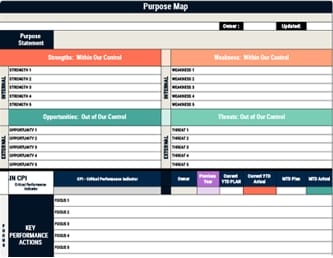
Once you understand the three layers, the next step is mapping your entire execution operating system onto a single page—a visual model that shows how work moves from start to finish, who owns each decision, and how your organization surfaces truth early enough to change outcomes. This one-page map connects leadership targets like revenue goals to departmental objectives, project milestones, and team-level assignments that people can update when priorities shift. When you don’t make ownership and handoffs explicit on this single page, tool migrations create dependency loops and teams spend their energy negotiating across platforms instead of executing. The one-page constraint forces clarity—you can’t hide ambiguity in a sprawling document, so every gap in accountability becomes immediately visible. Treat this single page as a visual management board that uses clear standards, color-coded indicators, and team-driven updates so performance gaps and needed decisions are instantly visible and actionable.
Frequently Asked Questions
What Controls the Execution of Processes?
Your organization’s execution operating system—its structures and routines—controls how processes move from start to finish.
This includes standardized handoffs, clear decision ownership, and consistent meeting rhythms like weekly check-ins that surface priorities, blockers, and accountability.
You’ll also need feedback loops that catch problems early enough to change outcomes, not just track them.
Without these controls, you’ll default to dashboards that fragment data instead of aligning your team.
Conclusion
Think of your organization as a ship crossing open water: dashboards are the instruments on the bridge, but an execution operating system is the crew, the compass heading, and the watch schedule that actually keep you on course. You don’t need another gauge telling you you’ve drifted—you need the disciplined structure that prevents the drift in the first place. Start building that system today, one page at a time.