

Over 70% of transformation efforts fail due to siloed processes and unclear ownership, which you can counter by building a connected business process framework that ties daily work to strategy, standardizes how teams operate, and clarifies who decides what. You’ll map cross-functional workflows, define metrics, and use visual management to expose bottlenecks, then layer governance and continuous improvement on top. With the right roles, tools, and training, you’ll uncover value hiding in plain sight—next comes how.
Key Takeaways
- Establish a connected process framework linking daily work to strategic goals, aligning all departments around shared outcomes and performance visibility.
- Categorize core, support, and management processes; assign owners and managers with RACI to ensure accountability and smoother cross-functional handoffs.
- Map end-to-end workflows using BPMN and swimlanes to clarify roles, inputs/outputs, and expose bottlenecks across departments.
- Anchor processes to measurable KPIs; review them regularly with DMAIC, Lean, Six Sigma, and Kaizen to drive continuous improvement.
- Integrate process mapping, mining, and automation within a Business Operating System, supported by change management, training, and cadence reviews.
Why Every Organization Needs a Connected Process Framework
Every organization benefits from a connected process framework because it links day-to-day activities to strategic goals, aligns departments around shared outcomes, and makes performance visible and manageable.
You use it to standardize business processes, clarify who does what, and reveal how work flows across teams, which reduces miscommunication and speeds handoffs. By mapping workflows with BPMN and swimlane diagrams, you document interdepartmental interactions in a format everyone can understand, so collaboration improves and errors decline.
Implement process governance to set ownership, controls, and review cycles, ensuring compliance and eliminating blind spots.
Track key performance indicators (KPIs) like lead time, error rates, and throughput in one dashboard, then base decisions on trends instead of guesses. With unified metrics, you spot bottlenecks, remove redundancies, and drive continuous improvement efficiently.
Integrate aligned OKRs to connect top-level strategies with everyday operations, reinforcing accountability and making progress visible through regular governance rhythms.
From Vision to Value: Aligning Processes With Strategy
Although strategy sets your destination and processes are the roads to get there, alignment doesn’t happen by accident—you translate strategic themes into concrete process objectives, categorize core, support, and management processes, and map how work creates customer and business value.
You start by linking each objective in your organizational strategy to measurable process performance indicators, then use standardized metrics to compare outcomes across departments and guide process improvement.
Assign clear process governance roles—owners and managers—so accountability persists as priorities shift. Use BPMN or APQC to document flows, reveal dependencies, and verify that resources back the most strategic activities.
Review regularly, adjust quickly, and keep customers central, ensuring every change advances value and agility.
- Confidence in direction
- Relief from ambiguity
- Pride in contribution
- Momentum toward results
- Trust in leadership
To sustain cohesion and clarity, adopt OKRs and regular feedback loops to connect strategic objectives with measurable results across teams.
Process Categorization: Building a Unified Process Architecture
With strategy-to-process alignment in place, you need a systematic way to organize the work itself, and that starts with clear process categorization that builds a unified architecture.
Begin by grouping processes by strategic importance, then assign ownership and define roles and responsibilities to guarantee accountability.
Use Process Levels to standardize your process architecture, from high-level value streams to detailed procedures, so every function and related process is defined consistently.
This structure makes bottlenecks, redundancies, and inefficiencies visible, guiding targeted improvement and smarter resource allocation.
Establish a common naming convention to strengthen communication across departments, enabling a shared language for priorities and handoffs.
Finally, link categorized processes to organizational goals and performance metrics, reinforcing continuous improvement and delivering better outcomes for customers and the business.
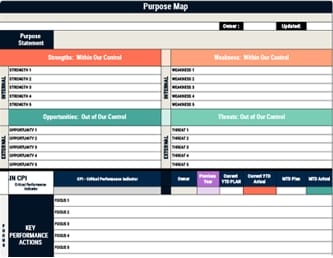
To ensure execution, connect these processes to Key Performance Actions that translate strategy into daily, observable behaviors and create accountability across teams.
Mapping Cross-Functional Workflows for Clarity and Speed
Because cross-functional work spans handoffs and decisions across departments, you should map workflows to make responsibilities, inputs, and outputs visible end to end, so teams can act with clarity and speed.
Use BPMN and swimlane diagrams to capture steps, decision points, and owners, then analyze the flow to expose bottlenecks, redundancies, and risky rework.
Tie each workflow to organizational goals, so process management improves performance and aligns incentives across collaboration boundaries.
Validate the mapping with stakeholders, confirm data sources and required approvals, and specify measurable cycle times and quality thresholds.
Review the maps regularly, updating them when policies, systems, or staffing change, so your workflows stay relevant and resilient.
Integrate your maps into a documented Business Operating System to unify roles, processes, and metrics, and to drive continuous improvement across teams.
- See the bottleneck, fix the delay.
- Replace confusion with clarity.
- Unite teams around outcomes.
- Turn rework into flow.
- Build confidence through transparency.
Documentation Standards That Empower Every Team
Two essentials make documentation standards truly empowering: clear structure and consistent practice. You need a thorough process library that defines purpose, scope, roles, inputs, outputs, and supporting systems, so teams can understand processes within and act without guesswork.
Establish documentation standards that mandate process documentation elements, including descriptions, governance policies, controls, and handoffs, which improve transparency and support compliance.
Mandate process elements—descriptions, governance, controls, handoffs—to boost transparency and strengthen compliance.
Use standardized formats—process maps, swimlane diagrams, and flowcharts—to make information accessible to both technical and non-technical stakeholders, reducing misinterpretation and speeding onboarding.
Require version control, ownership, and review cycles, so updates reflect changing regulations, tools, and organizational goals. Provide templates and naming conventions to promote consistency across departments, then centralize access in a searchable repository.
Finally, enforce change logs and approval checkpoints to maintain accuracy and accountability.
Incorporate regular assessments to ensure documentation aligns with strategic goals, reinforcing both vertical and horizontal alignment across teams for improved collaboration and performance.
Metrics That Matter: KPIs for Enterprise Process Health
Although every organization measures performance differently, you should anchor enterprise process health to a focused set of KPIs that capture speed, quality, volume, and customer impact.
Use key performance indicators (KPIs) like lead time, cycle time, throughput, error rates, and customer satisfaction to assess how well your business processes deliver outcomes, then monitor them consistently to reveal trends and bottlenecks.
Align each KPI to strategic goals so improvements translate into measurable value, and standardize definitions and calculations to compare results across departments.
Establish targets using APQC’s Process Classification Framework to benchmark against industry peers, guiding continuous improvement and competitive analysis.
Review dashboards regularly, investigate root causes, and run controlled changes, ensuring KPIs improve together rather than shifting problems elsewhere.
- Clarity builds confidence
- Shared metrics reduce friction
- Visible progress motivates teams
- Fair comparisons foster trust
- Momentum sustains improvement
Taking cues from companies like Tesla and Spotify, tie KPIs to strategic alignment frameworks such as OKRs to maintain cross-functional focus and ensure execution translates into measurable business impact.
Governance, Roles, and Accountability Across Departments
Set up process governance as the backbone that keeps every department aligned to strategy, compliant with standards, and accountable for results, then make the roles explicit so work flows without ambiguity.
Define governance guidelines that translate enterprise goals into actionable rules, escalation paths, and decision rights, so processes run consistently across boundaries.
Assign process owners to each end‑to‑end value stream; they track cross‑functional KPIs, surface bottlenecks, and drive fixes that require coordination beyond a single team.
Appoint process managers to run day‑to‑day operations, monitor compliance, and coach teams on standard work.
Use a RACI matrix to clarify who’s responsible, accountable, consulted, and informed at the task level, reducing handoff friction.
Finally, involve every department in continuous improvement to prevent silos and blind spots, maintaining shared accountability.
Add regular two-way check-ins and feedback loops to governance routines to sustain alignment and accountability, improving agility and reducing the execution gap highlighted by Kaplan and Norton research.
Continuous Improvement With Lean, Six Sigma, and Kaizen
When you weave Lean, Six Sigma, and Kaizen into your business process framework, you create a disciplined engine for ongoing performance gains that cuts waste, reduces variation, and lifts quality where it matters most to customers. You apply continuous improvement by aligning every department to measurable outcomes, then standardize the processes used to deliver value. Lean streamlines handoffs and removes non‑value work, lowering cost while speeding flow. Six Sigma brings data discipline, using defect metrics and root-cause analysis to push variation toward 3.4 DPMO in critical steps. Kaizen builds daily habits, inviting everyone to suggest small changes that compound into sizable gains, such as 20%–50% cycle time reductions and higher satisfaction. To sustain these gains, embed DMAIC reviews and clear performance indicators that align teams with organizational objectives, reinforcing accountability and continuous learning.
- Confidence that waste will shrink
- Relief from recurring defects
- Pride in measurable wins
- Trust in shared standards
- Momentum from daily progress
Choosing the Right Tools: Mapping, Mining, and Automation
Sustaining Lean, Six Sigma, and Kaizen gains takes the right instrumentation, so you should choose tools that make processes visible, measurable, and executable.
Start with Process Mapping using BPMN and swimlane diagrams, because a standardized visual syntax clarifies activities, handoffs, and responsibilities, helping you spot bottlenecks and inefficiencies across departments.
Then apply Process Mining to historical system logs to verify how work truly flows, quantify delays and rework, and prioritize high‑impact improvements with evidence rather than assumptions.
Next, deploy Automation Tools to remove repetitive, error‑prone steps, integrate systems, and enforce business rules, which raises productivity and consistency.
Finally, connect these capabilities within your Business Process Framework so mapping informs mining, mining guides automation, and feedback loops sustain Continuous Improvement, improving governance and adapting quickly to changing needs.
Integrate visual management practices—such as Kanban boards and Andon signals—to provide real-time transparency, accelerate issue resolution, and reinforce continuous improvement across teams.
Scaling BPM Enterprise-Wide: Change Management and Training
Although tools can reveal and automate workflows, scaling BPM across the enterprise depends on deliberate change management and targeted training that prepare people to work differently, not just better.
You need a clear roadmap that names sponsors, sets expectations, and addresses employee resistance early, using town halls, FAQs, and feedback loops.
Build training frameworks that blend role-based modules, hands-on labs, and microlearning, so multi-generational teams grasp BPM principles and their responsibilities.
Pair coaching with dashboards that expose process performance, then use those insights to refine curricula and close skill gaps.
Maintain momentum through governance, cadence reviews, and success metrics, treating continuous improvement as a habit.
Finally, adapt as business needs shift, updating playbooks, retraining teams, and adjusting incentives to reinforce desired behaviors.
- Clarity that reduces anxiety
- Support that respects experience
- Recognition that validates effort
- Progress that feels measurable
- Purpose that connects work
Embed visual management practices by equipping teams with shared boards and real-time data displays, enabling 1-3-10 second comprehension of status, problems, and actions to accelerate decision-making and accountability.
Frequently Asked Questions
What Is a Business Process Framework?
A business process framework is a structured method you use to design, document, govern, and improve how work flows across your organization.
You categorize processes, map steps, define roles, and set standards so teams collaborate consistently. You can adopt models like APQC, BPMN, ITIL, or COBIT to clarify activities and measure performance.
You track KPIs such as cycle time, lead time, and customer satisfaction, then refine processes through ongoing review and controlled change.
What Are L1, L2, L3, and L4 Processes?
L1 processes define your highest-level functions and strategic goals.
L2 processes break those into related activity groups that show how you operate.
L3 processes decompose each group into specific subprocesses and workflows, clarifying sequences and handoffs.
L4 processes detail the most granular tasks, roles, rules, and variations needed for execution.
You use all four levels to build a clear hierarchy that improves management, alignment, measurement, and continuous improvement across teams and systems.
What Are the 7 Steps of the Business Process?
You follow seven steps: identify the problem, map the current process using tools like BPMN or swimlanes, analyze for bottlenecks and waste, design the improved process with clear roles and controls, implement changes with training and communication, monitor results through defined KPIs, and continuously optimize using data.
You engage process owners and managers throughout, guarantee alignment with organizational goals, and iterate as evidence emerges, so efficiency, accountability, and customer satisfaction steadily improve.
What Is the PPT Framework?
Like gears in a clock, the PPT framework synchronizes People, Process, and Technology so you execute strategy smoothly.
You prioritize skilled, empowered employees, define clear, streamlined workflows, and select tools that support and automate those workflows.
You align roles, responsibilities, and metrics, then train and iterate based on feedback and performance data.
Conclusion
You might worry a connected process framework adds bureaucracy, but it actually reduces friction by clarifying ownership, standardizing handoffs, and surfacing bottlenecks early. Start small: map one cross-functional workflow, define roles and metrics, and publish simple visual cues. Use lightweight tools first, then layer in automation and mining as you learn. With clear governance and ongoing improvement, you’ll align daily work to strategy, improve speed and quality, and scale consistent practices across departments without slowing innovation.