

To build a complete performance measurement ecosystem, you’ll move beyond KPIs and design a holistic architecture that links OKRs, SMART goals, CSFs, and CPIs to strategy, risk, and culture. You’ll balance lagging and leading indicators, blend quantitative data with qualitative insight, and connect frontline signals to executive decisions. You’ll create safe feedback loops, leverage real-time analytics, and establish governance that prevents metric gaming, setting up the next step: deciding what truly matters.
Key Takeaways
- Blend traditional KPIs with purpose-driven indicators to capture outcomes, customer experience, and employee engagement in a holistic scorecard.
- Integrate OKRs, SMART goals, and CSFs to align ambition, measurement, and ownership across teams.
- Build continuous feedback loops linking qualitative insights to quantitative results, validating causality and guiding iterative improvements.
- Deploy integrated dashboards that combine real-time metrics and qualitative inputs, ensuring data integrity, transparency, and faster decisions.
- Use frontline, talent, and market signals as leading indicators to boost agility, customer retention, and profitability.
Defining a Holistic Measurement Architecture
Although many teams default to traditional KPIs, defining a holistic measurement architecture means you intentionally blend quantitative results with qualitative insights to capture how performance truly creates value.
You start by mapping a holistic view of outcomes, then select performance metrics that combine qualitative and quantitative data, ensuring each metric ties to strategic alignment and real stakeholder needs.
Prioritize alternative metrics that reflect employee engagement, organizational health, and customer satisfaction, since these indicators often predict retention and long-term results.
Build strong feedback systems that gather input from employees and customers, translate signals into action, and validate changes over time.
Establish measurement cadences that keep you agile in a rapidly changing environment, review indicators regularly, and retire those that don’t inform decisions or drive improvement.
To reinforce strategic connection and financial outcomes, incorporate indicators tied to organizational alignment, which has been shown to drive faster revenue growth and higher profitability.
Blending KPIS With OKRS, SMART Goals, CSFS, and CPIS
With a holistic architecture in place, you can turn measurement into execution by blending KPIs with OKRs, SMART goals, CSFs, and CPIs so each layer clarifies intent, aligns teams, and proves impact.
Start by blending KPIs with OKRs to pair ambitious Objectives with measurable Key Results, which drives innovation in e-commerce and SaaS while keeping outcomes verifiable.
Translate Objectives into SMART Goals so targets are specific, time-bound, and actionable, sustaining alignment in digital marketing.
Name your Critical Success Factors (CSFs) to identify the few activities that guarantee progress, then assign owners and cadences.
Add Customer Performance Indicators (CPIs), like NPS, to emphasize customer satisfaction, loyalty, and engagement.
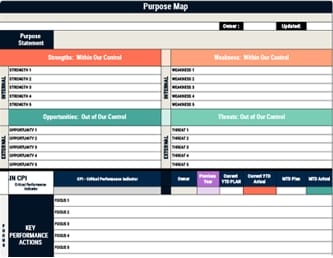
Balance qualitative and quantitative measures, include employee engagement levels, and track growth metrics to connect campaigns to organizational success within your performance measurement ecosystem. To ensure execution, embed daily Key Performance Actions that make performance visible and coachable, creating a feedback loop that links CPIs to KPIs and drives continuous improvement.
Measuring What Matters: From Performance to Purpose
Because growth increasingly depends on more than revenue and throughput, you should measure what matters by pairing traditional KPIs with purpose-driven indicators that capture customer and employee realities.
Expand performance tracking with metrics that reflect customer satisfaction, employee engagement, and organizational health, since 87% of executives already view these signals as essential for growth.
Tie purpose to outcomes by linking qualitative feedback to quantitative results, then review trends for causality, not just correlation.
Prioritizing non-traditional metrics can lift customer retention by 20%, while high engagement aligns with 21% greater profitability, so integrate these measures into regular reviews.
Build a holistic scorecard that blends outcome, experience, and learning indicators, and set thresholds that trigger action.
This approach strengthens culture, adaptability, and sustainable success.
As proof that alignment accelerates results, companies like Tesla, Airbnb, and PayPal turned strategy into execution through strategic alignment, reinforcing why purpose-linked metrics belong in every scorecard.
Integrating Soft Skills and Culture Into Performance Systems
As you evolve your performance system, treat soft skills and culture as measurable drivers of outcomes, not side notes, by defining clear behavioral standards, capturing them through structured assessments, and tying them to promotion, pay, and development decisions.
Build performance metrics that weight emotional intelligence, team collaboration, and leadership development alongside delivery goals, because organizations that embed soft skills in performance management report up to 40% collaboration gains and 20% lifts in employee engagement.
Weight EQ, collaboration, and leadership with delivery to drive 40% better teamwork and 20% higher engagement.
Use 360-degree feedback to surface behaviors that enable continuous improvement and resilient organizational culture.
- Define role-specific soft skills rubrics, mapping behaviors to ratings and outcomes, then calibrate using Project Oxygen-style managerial behaviors.
- Instrument regular 360-degree feedback cycles, feeding insights into coaching and development plans.
- Link hiring and advancement to emotional intelligence evidence, mirroring Zappos-level retention results.
Integrate Six Sigma principles to reinforce continuous improvement by defining, measuring, and refining behavioral and process metrics that drive operational excellence.
Frontline, Talent, and External Awareness as Leading Indicators
You’ve embedded soft skills into performance decisions; now extend your system by treating frontline, talent, and external awareness as leading indicators that surface risks and opportunities before lagging KPIs do.
Build frontline awareness by engaging directly with teams and operations, since they see delays, defects, and unmet needs first, giving your performance measurement a sharper, holistic approach.
Elevate talent awareness by inviting emerging leaders to challenge assumptions, align input with organizational vision, and surface practical fixes that improve employee engagement and retention.
Develop external awareness by scanning weak signals, tracking market shifts, and learning from observation units, as Samsung did, to secure a competitive edge.
Research shows organizations using these leading indicators boost engagement and achieve higher profitability through faster, better decisions.
As you expand these leading indicators, reinforce them with continuous communication and feedback loops to keep teams informed, motivated, and aligned to strategic objectives.
Data to Dialogue: Building Insight Loops and Safe Voice
While dashboards summarize what happened, insight loops turn that data into ongoing conversations that shape what happens next, and they work only when people feel safe to speak candidly.
Insight loops turn past data into candid, ongoing conversations that shape what happens next.
You need structured feedback loops that translate numbers into decisions, combining performance metrics with qualitative insights gathered through regular check-ins, retrospectives, and anonymous channels.
When you normalize a safe voice, organizational communication improves, employee engagement rises about 20%, and collaboration strengthens as teams see their input drive action.
- Define the loop: collect signals weekly, synthesize themes, decide actions, and close the loop by reporting back.
- Embed voice safeguards: anonymity options, no-retaliation policy, and leader training that models curiosity.
- Tie insights to outcomes: integrate feedback into metrics, track collaboration and innovation gains near 30%, and monitor employee retention, often 16% higher, to move Beyond KPIs.
Align these feedback loops with operational realities so insights translate into actionable decisions and measurable execution, reinforcing the interdependence of strategy and execution.
Technology, Dashboards, and Governance for Sustainable Impact
Insight loops need infrastructure, so put technology, dashboards, and governance to work as the backbone that turns candid feedback and metrics into sustainable impact.
Use technology to integrate diverse data sources, so you can track traditional KPIs and non‑traditional signals together, producing holistic insights that strengthen performance measurement.
Build dashboards that surface real‑time metrics beside qualitative inputs, improving decisions, transparency, and accountability across teams.
Establish governance that protects data integrity and compliance; with executives reporting higher reliability, you’ll trust the numbers you act on.
Apply advanced analytics to automate collection and analysis, releasing productivity and freeing capacity for strategic focus on improvement.
When these elements operate as a unified framework, you’ll boost organizational agility, respond faster to market shifts, and sustain measurable progress.
Add governance rhythms that tie dashboards to aligned OKRs, creating a clear line of sight from strategic objectives to day‑to‑day performance decisions.
Frequently Asked Questions
What Are the 4 P’s of KPI?
The 4 P’s of KPI are People, Process, Product, and Performance.
You track People to measure satisfaction, retention, and capability, ensuring a motivated workforce.
You monitor Process to evaluate efficiency, identify bottlenecks, and improve throughput.
You assess Product to gauge quality, customer satisfaction, and market fit, aligning offerings with demand.
You measure Performance to compare outcomes to strategic goals, enabling informed decisions, resource prioritization, and continuous improvement across the organization’s core activities.
What Are Your Strategies for Achieving Beyond Set KPIS?
You surpass set KPIs by setting OKRs that stretch performance, integrating qualitative signals like employee feedback and customer sentiment, and using real-time analytics to pivot quickly.
You align metrics to strategy, cascade goals across teams, and review weekly to remove blockers.
You run experiments, A/B test improvements, and automate alerts for leading indicators.
You embed continuous learning, tie incentives to outcomes, and track organizational health to sustain gains beyond short-term targets.
What Are KPIS for Measuring Performance?
KPIs for measuring performance include revenue growth, profit margin, customer acquisition cost, and churn.
Since 87% of executives value non-traditional indicators, you should include customer satisfaction, NPS, and employee engagement.
You’ll track operational KPIs like cycle time, defect rate, and on-time delivery, while monitoring leading indicators such as pipeline velocity and website conversion.
Align each KPI to strategic goals, set clear targets and thresholds, and review trends regularly to drive corrective action.
How Can One Develop KPIS to Measure Actual Performance?
Define KPIs by mapping them to strategic goals, then translate goals into specific, time-bound outcomes with clear owners and data sources.
Combine quantitative metrics with qualitative inputs, like customer sentiment and peer feedback, to capture soft skills.
Use baselines and targets, validate feasibility with frontline teams, and pilot before scaling.
Instrument systems for real-time tracking, review results monthly, and refine measures as priorities shift, ensuring transparency, consistency, and actionability.
Conclusion
You’re now ready to design a performance ecosystem that ties KPIs to OKRs, SMART goals, CSFs, and CPIs, links purpose to outcomes, and embeds culture, soft skills, and frontline signals as leading indicators. Build continuous insight loops, protect safe voice, and translate data into action through clear governance and practical dashboards. Will you pilot a minimal viable scorecard to prove value quickly, then scale? If you iterate transparently, you’ll align strategy, improve decisions, and sustain impact.