

You’ve probably watched a well-crafted strategy dissolve somewhere between the executive conference room and the production line, and you’re not alone—most organizations lose strategic clarity long before it reaches the people who do the actual work. The gap isn’t usually about intent; it’s about translation, structure, and rhythm. What follows is a practical, level-by-level approach to making sure your strategy survives every handoff intact.
Key Takeaways
- Define strategic initiatives in plain, jargon-free language so every organizational level can consistently describe them.
- Build a cascading map linking board initiatives to department goals, team priorities, and individual daily responsibilities.
- Translate team priorities into concrete weekly metrics like defect reduction targets or throughput KPIs.
- Embed initiative language into daily huddles, visual management boards, training sessions, and standard work documents.
- Pressure-test alignment by regularly asking frontline workers which strategic initiative their daily work directly impacts.
Why Most Cascading Strategies Fail Before the Front Line
Although executives at the top of an organization can often rattle off their strategic initiatives—call them X, Y, and Z—the people actually running the machines, serving customers, and executing daily operations typically can’t name a single initiative they directly impact, and that disconnect is exactly where cascading strategies break down.
When you measure alignment by whether the CEO or board can articulate the plan rather than whether frontline employees understand it, you’re tracking the wrong signal.
Without a strong culture that actively transfers knowledge through every organizational layer, initiative awareness stalls at middle management and never reaches execution.
You need to make work-to-initiative connections explicit enough that shop-floor staff can tell you exactly which strategic priority their daily tasks support.
This requires intentionally designing clear communication channels and feedback loops so that strategic goals, roles, and expectations are consistently understood at every level of the organization.
What a Cascading Strategy Looks Like Level by Level
When you break a cascading strategy into its distinct layers, you can see how each level of the organization carries a specific responsibility for translating broad priorities into actionable work.
At the board and CEO level, you’ll identify a small set of strategic initiatives—call them X, Y, and Z—that define what the business will fund and measure.
Strategic clarity starts at the top—name the few initiatives the business will actually fund and measure.
Your executive layer then translates those initiatives into departmental objectives, so each function can explain its direct contribution to X, Y, and Z.
Mid-management converts those objectives into concrete programs, processes, and KPIs that teams execute daily.
At the front line, including operators on manufacturing machines, individuals can answer “Which strategic initiative do I impact?” with specific examples rather than generic goals, confirming that alignment runs from leadership through execution.
This clarity at every level is reinforced by governance rhythms that regularly track progress, surface risks, and keep strategic priorities connected to day‑to‑day operations.
Define Strategic Initiatives in Plain Language
Because a strategy only works when every person in the organization can describe it without stumbling over jargon, you need to define each strategic initiative as a clear “what we’ll do” statement written in everyday language.
For example, replace abstract language with something like “Reduce machine downtime by improving maintenance schedules,” so shop-floor teams can repeat it accurately.
You’ll then tie every initiative to a measurable outcome that includes a number and a timeframe, such as “cut downtime 20% within 12 months.”
Translate each initiative into cause-and-effect behaviors using consistent wording across all levels.
Validate your definitions by asking frontline workers, “Which strategic initiative do you impact?”
If their answers map directly back to your initiatives without executive clarification, you’ve cascaded successfully.
You can reinforce this clarity by linking each plain-language initiative to visible visual management boards that track its KPIs, so teams can see progress and adjust daily actions.
Turn Your Cascading Strategy Into Team-Level Priorities
Clear initiative definitions give you a shared vocabulary, but vocabulary alone doesn’t drive work forward—you need to break each board-approved strategic initiative into measurable team-level deliverables that tell every group exactly what to produce and by when.
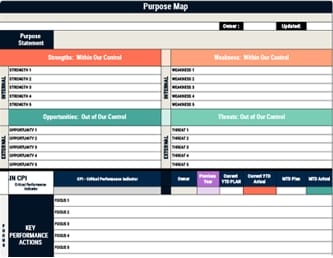
Build a cascading map that draws a direct line from each initiative to a department goal, then to team priorities, and finally to individual responsibilities.
This structure ensures every role can answer one critical question: “Which strategic initiative do I impact?”
Translate those priorities into weekly OKRs, machine KPIs, or defect and throughput targets so progress stays concrete rather than abstract.
When you assign specific metrics to specific teams, you eliminate ambiguity and create accountability that connects daily output to boardroom strategy.
This kind of clear linkage between strategy, roles, and metrics is what drives organizational alignment, enabling faster revenue growth, higher profitability, and stronger employee engagement.
Connect Daily Work to Your Cascading Strategy
Although team-level priorities give every group a clear target, the real test of a cascading strategy happens when a front-line machine operator or warehouse associate can tell you exactly which strategic initiative—X, Y, or Z—their daily work supports.
You’ll want to translate each initiative into the specific tasks and metrics people actually run so their effort connects directly to outcomes, not just activity.
Embed initiative language in training sessions, daily huddles, visual management boards, and standard work documents so everybody knows their part without guessing.
When you connect strategy to daily work using visual management tools, you increase transparency, enable real-time feedback, and make it easier for employees to see how their roles contribute to larger organizational goals.
Then pressure-test alignment by asking front-line team members which initiative they impact.
If you hear consistent answers across roles—from leadership through the shop floor—your cascading strategy is working because alignment shows up in execution, not only in executive briefings.
Test Your Cascading Strategy With One Shop-Floor Question
The simplest way to pressure-test your cascading strategy is to walk onto the shop floor, pick one person—say, a machine operator mid-shift—and ask a single question: “Which strategic initiative do you affect?” If that operator can name Initiative X, Y, or Z and explain how their daily tasks contribute to it, you’ve got real evidence that your strategy doesn’t just live in boardrooms but actually reaches the people doing the work. If you want this alignment to be visible and repeatable, translate those initiatives into visual management boards on the shop floor so operators can literally see how their KPIs and daily tasks connect to strategic goals.
If they can’t link their tasks to any initiative, you’ve found a breakdown in your cascade. Don’t stop at one person—ask the same question across multiple frontline roles to check whether alignment is uniform. A strong culture ensures reliable knowledge transfer, so initiative awareness comes into play at the shop floor, making strategic impact unmistakably clear.
Measure Cascading Strategy From Boardroom to Shop Floor
Because a single shop-floor question reveals whether your strategy reaches the people doing the work, you now need a repeatable measurement system that tracks cascading effectiveness from the boardroom all the way down to the production line.
Start by running cross-level surveys that compare executive awareness of initiatives against front-line understanding rates, because gaps between these levels expose where deployment breaks down.
Conduct structured walk-throughs on manufacturing lines to record the percentage of roles whose daily activities map to at least one strategic initiative.
Then quantify effectiveness by measuring how many teams articulate their contribution through specific outputs—like defect reduction or throughput improvement—rather than slogans.
Finally, confirm that understanding persists by re-testing quarterly and checking consistency across shifts, so you’re measuring durable knowledge transfer, not one-time briefing recall.
To deepen insight, correlate these measures with a simple index of high-performance team traits—such as trust, clear roles, and continuous learning—to see whether stronger team dynamics improve how well strategic intent reaches the shop floor.
Frequently Asked Questions
What Is the Cascading Strategy Process?
You start the cascading strategy process by having your board and CEO define a small set of strategic initiatives, then translate them into measurable objectives at each management level so every unit knows precisely what outcomes to deliver, by when, and how they’ll be monitored.
Through strong knowledge transfer and culture, you ensure front-line teams can clearly articulate which initiative their daily work affects, confirming true alignment from leadership to execution.
Conclusion
The theory that strategy fails at the front line due to complexity holds true when you test it—simplification at every level is what drives real alignment. You’ve now seen that cascading strategy isn’t about distributing documents but about translating intent into daily decisions. If a frontline worker can’t name the initiative their task supports, your cascade hasn’t landed, and it’s time to revisit each translation layer.