
If you’ve ever wondered why a process that should take hours stretches into days, you’re already asking the right question—and Value Stream Mapping gives you a structured way to find the answer. By tracing every step, delay, and handoff from start to finish, you’ll uncover hidden waste that’s silently draining time and resources. What you do with that visibility, though, is where the real transformation begins.
Key Takeaways
- Value stream mapping diagrams the entire material and information flow, separating value-adding steps from non-value-adding waste across the process.
- A current-state map captures reality as-is, revealing hidden bottlenecks, inventory accumulation, and delays through standardized metrics and timelines.
- Key metrics like cycle time, downtime, changeover time, and percent complete and accurate pinpoint where specific wastes occur.
- The seven wastes—overproduction, waiting, transportation, overprocessing, and defects—are identified by analyzing data boxes, timelines, and flow arrows.
- Comparing the current-state map against a future-state design reveals gaps that become an actionable roadmap for eliminating waste.
What Is Value Stream Mapping?
Before you can eliminate waste from any process, you need a way to actually see it, and that’s exactly what value stream mapping provides.
Value stream mapping is a Lean tool that diagrams the entire flow of materials and information required to deliver a product or service to your customer.
You’ll use standardized icons and boxes to represent each process step, information handoff, and key metric—including cycle time, changeover time, and percent complete and accurate.
The real power of VSM lies in its ability to separate value-adding actions from non-value-adding ones.
When paired with performance dashboards, it also supports continuous monitoring and alignment by making process inefficiencies visible across teams.
From Toyota’s Factory Floor to Your Industry
The roots of value stream mapping reach back to Toyota’s factory floors in post-war Japan, where engineers developed the Toyota Production System around a simple but powerful idea: trace a product family’s path from the customer backward—door to door—and expose every material and information handoff that doesn’t add value.
Toyota’s teams captured the current state exactly as it happened, not as they wished it worked, then designed a future state that eliminated muda through continuous flow and quality at the source.
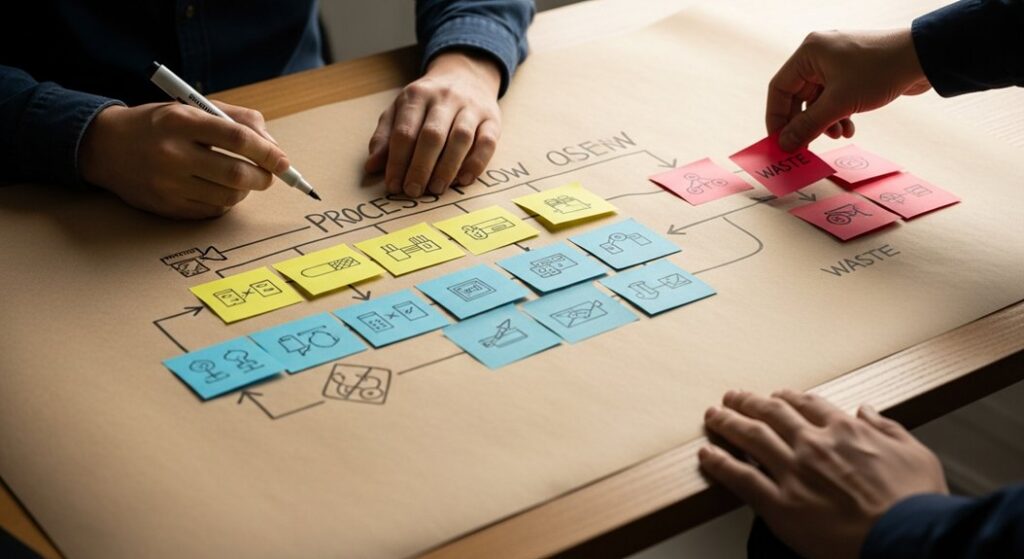
You can apply this same logic beyond manufacturing by mapping end-to-end service or administrative workflows, including information flow and delays, to surface bottlenecks and excess work-in-progress that slow your process and consume resources without delivering value to your customer. Integrating visual management tools like Kanban boards can further enhance this process by making workflow, delays, and work-in-progress visible in real time.
Current-State Map: Capture How Work Actually Flows
Once you’ve traced the product family’s journey from customer back to starting point, your next step is to build a current-state value stream map that captures the actual dock-to-dock material and information flow as it runs today—not an idealized or “should-be” version of the process.
Place information flow across the top row, then list each process step below with data boxes showing cycle time, downtime, changeover time, uptime, and percent complete and accurate.
Add a timeline at the bottom summarizing lead time so delays and inventory accumulation become visible.
Where material flow disconnects, stop and redraw those handoffs—they typically reveal non–value-adding steps.
This map becomes your shared baseline for pinpointing where work waits, rework occurs, or information arrives late.
Incorporating real-time data visualization from visual management practices can make these gaps and delays even more immediately actionable for the team.
Spot These Seven Wastes on Your Current-State Map
With your current-state map now laying bare how work actually moves, you can begin reading it for the seven classic wastes that inflate lead time and erode value.
Start by checking for overproduction—downstream process boxes receiving work before their timeline targets indicate need, which creates excess inventory triangles between steps.
Next, trace the timeline for waiting: long Lead Time gaps between process boxes, high Downtime, or extended changeover values confirm flow has stalled.
Unnecessary transportation shows up as extra material-flow arrows linking disconnected steps that force additional handoffs.
Overprocessing appears when Processing Time looks inflated or %Complete and Accurate drops, signaling work the customer doesn’t require.
Finally, identify defects through rework loops, reduced Uptime, rising Downtime, and worsening %C/A that compound overall lead time.
Integrating insights from strategic alignment ensures that waste reduction efforts stay connected to broader organizational goals and deliver meaningful impact.
Future-State Map: Design the Leaner Process You Want
For each process step, define what triggers the next action and when it should occur.
Ensure both material and information flow without disruption.
Once complete, treat your future-state map as an implementation blueprint—converting each planned improvement into an actionable roadmap for continuous improvement.
Incorporate clear performance metrics to track how effectively the future-state process achieves its intended improvements over time.
Build Your First Value Stream Map Step by Step
Before you can eliminate waste, you need to see it clearly, and that’s exactly what building your first value stream map allows you to do. Start by selecting a specific product family and documenting the entire dock-to-dock process as your current-state map, capturing both material and information flow. Draw information flow across the top row, place process steps in the middle, and list key metrics like cycle time, downtime, changeover time, and percent complete and accurate directly beneath each step. Add a timeline at the bottom summarizing total lead time, wait times, and bottlenecks. Then mark each action as value-adding or non-value-adding by asking whether the customer would pay for it. Use this current-state map to design your future-state target, which becomes your blueprint for lean implementation. Incorporating insights from operational realities during mapping ensures your future-state design is both practical and executable.
Who Should Own the Value Stream Map?
Once you’ve built your current-state map, the next critical question is who takes responsibility for keeping it accurate and acting on what it reveals.
Ideally, a dedicated value stream manager owns this work, focusing on the entire product family from the customer backwards rather than optimizing individual departments in isolation.
This person coordinates both material and information flow, which prevents the miscommunication that siloed thinking creates.
Executives leading Lean initiatives should also know how to read and draw these maps, even when day-to-day ownership sits elsewhere.
The owner must explicitly support both current-state capture and future-state design so your team continuously drives waste elimination.
Don’t worry that removing wasteful steps threatens quality—defects and inefficiency actually disrupt flow and harm the customer experience.
Strong ownership also reinforces continuous improvement by ensuring regular reviews, feedback loops, and alignment with overall operational goals.
Why Most First Maps Fail and How to Fix Yours
Having a dedicated owner for your value stream map matters, but even the best ownership structure can’t save a map that was built incorrectly from the start—and most first maps are. This is where a documented Business Operating System helps anchor teams in real processes rather than assumptions.
Teams typically fail because they document an idealized flow rather than walking the actual door-to-door path their product family follows. To fix yours, avoid these common mistakes:
- Mapping the “ideal” instead of the real current state, which hides where delays and downtime actually occur
- Over-detailing individual operations like a task-level process map instead of connecting linked processes end-to-end
- Omitting information flow, even though it’s a core structural element showing who requests or sends what and when
- Skipping key metric boxes beneath each process step—capture cycle time, changeover time, downtime, uptime, and percent complete/accurate
- Building a future state that isn’t validated against the pain points your current state revealed
Keep Improving After Your First Value Stream Map
Although your completed current-state map represents a significant milestone, it’s really just a baseline—a snapshot of how material and information actually flow through your process right now.
Compare this current state against a future-state target, and use the gap between them to drive specific improvement experiments rather than guessing where to focus.
After you’ve implemented changes, re-collect key data points—cycle time, downtime, changeover time, and percent complete and accurate—to verify you’ve actually reduced waste.
Don’t rely on opinions when numbers tell the real story.
Then redraw your map as the “new current state,” because each iteration reveals previously hidden bottlenecks.
Assign owners to value-stream KPIs, define next actions, and refresh your plan after every improvement cycle to prevent your process from drifting backward.
Consistent iteration and accountability mirror the principles of strategic alignment, ensuring your improvements actually translate into sustained operational performance.
Frequently Asked Questions
How to Identify Waste in a Value Stream Map?
You’ll identify waste by mapping your current-state material and information flow dock-to-dock, then classifying each step as value-adding or non-value-adding.
Review the process data boxes—cycle time, changeover time, downtime, and %C/A—to pinpoint variability and defects.
Look for inventory buildup between disconnected processes and compare lead time against actual processing time, since the gap reveals waiting, overprocessing, and unnecessary transport you’ll need to eliminate.
What Are the 7 Wastes of Value Stream Mapping?
Think of waste as rust eating through a pipeline—it silently degrades flow. The seven wastes you’ll spot in a value stream map are defects, overproduction, waiting, non-utilized talent, transportation, inventory, and motion. You can remember them with the acronym DOWNTIME. Each one adds cost and lead time without delivering value, and you’ll find them hiding in WIP triangles, idle gaps between steps, and unnecessary material movement across your map.
How Can a Value Stream Map Help Identify Opportunities to Reduce Environmental Waste?
You can use a value stream map to trace both material and information flows end to end, which makes delays, excess inventory, and rework visible across every step.
What Are the 7 Wastes in Kaizen?
The seven wastes in Kaizen, known as *muda*, are defects, overproduction, waiting, non-utilized talent, transportation, inventory, and motion.
You can remember them using the acronym DOWNTIME.
Each waste drains resources without adding value—defects trigger rework, overproduction builds excess inventory, waiting stalls flow, and unnecessary transportation or motion increases costs.
When you map these wastes through value stream analysis, you’ll pinpoint exactly where improvements will have the greatest impact.
Conclusion
You’ve learned how to map the current state, how to spot the seven wastes hiding in plain sight, and how to design a future state that eliminates them. Now it’s your turn to gather your cross-functional team, walk the actual process from end to end, and draw what you see—not what you assume. Each map you create sharpens your vision, shortens your lead time, and moves your operation closer to true flow.