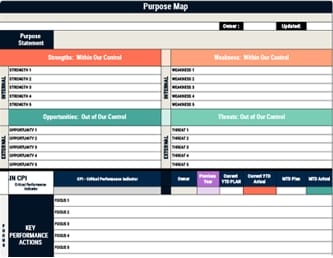


You turn plans into results by translating vision into 3–5 prioritized initiatives, assigning clear owners and milestones, and tying each to measurable KPIs on a live dashboard. You align roles, resources, and decision rights, then enforce a cadence—bi‑weekly updates and quarterly reviews—that surfaces risks, redirects investment, and rewards delivery. You coach for ownership, standardize decision criteria, and course‑correct fast, ensuring progress stays visible and actionable, which sets up the five moves you’re about to use next.
Key Takeaways
- Translate vision into 3–5 owned initiatives with clear milestones, timing, and decision rights to focus execution.
- Align roles to strategy using JDOT: clarify control, define accountability, expand influence, and secure support.
- Establish a quarterly cadence: Reflect/Align, Define Strategy, Build Tactical Plans, Communicate/Execute, with bi-weekly leadership reviews.
- Set strategy-linked KPIs and daily Key Performance Actions; use dashboards for real-time visibility and accountability.
- Communicate the plan plainly and frequently so everyone sees how their work ladders to strategic outcomes.
Start Here: The 5 Moves for Strategy Execution
How do leaders turn a strategic plan into results their teams can actually deliver? Start with five moves. First, commit to a concise, shared plan, ideally three pages, so everyone sees how their work ladders to strategy. Second, align jobs to strategy using JDOT’s four factors—clarify control, define accountability, expand influence, and secure support—so roles match outcomes. Third, communicate clearly and often, because when 95% don’t grasp the strategy, execution stalls. Fourth, set KPIs that translate goals into measurable behaviors, then break work into a quarterly cadence: Reflect/Align, Define Strategy, Build Tactical Plans, and Communicate/Execute. Fifth, monitor and adjust with bi-weekly leadership reviews and quarterly business reviews, using data to course-correct quickly, reinforce priorities, and sustain alignment over time. Additionally, implement governance rhythms with regular progress tracking to create alignment and accountability from C-suite to frontline operations.
Why Strategy Execution Fails (and How to Fix It)
You’ve seen the five moves that turn plans into action, but execution still breaks when leaders underestimate the gap between intent and daily work. The data is blunt: 48% of organizations miss at least half their strategic targets, and only 7% of leaders think their companies implement strategy well. Failure often starts with poor communication; when 95% of employees don’t understand the strategy, they can’t align decisions, resources, or trade-offs. Doubt follows, and in weak execution cultures 71% of employees question strategic choices, draining momentum and accountability. Aligned organizations can adapt faster and boost performance when they embed clear communication and shared values into daily work. Fix it by translating strategy into roles, not slogans: align jobs to strategy using JDOT, clarifying each role’s control, accountability, influence, and support, then measure outcomes, adjust resourcing, and reinforce ownership through cadence and coaching.
Turn Vision Into Owned, Prioritized Initiatives
Why let a clear strategy stall at the concept stage when you can convert it into a short list of owned, prioritized initiatives that move the organization week by week? Start by translating broad goals into concrete initiatives, then assign a single owner, explicit participants, measurable milestones, and timing. Use a simple Action Plan template that links each initiative to your top priorities, making ownership and checkpoints visible.
Turn clear strategy into owned, prioritized initiatives with visible ownership, milestones, and cadence-driven execution.
To reinforce cohesion and adaptability, integrate regular OKR reviews so initiatives stay tied to strategic alignment and adjust with feedback loops.
Limit the portfolio to three to five initiatives for the period to force focus and preserve alignment. Engage the organization with clear roles, aligned incentives, and steady communication so people commit and deliver. Establish a governance cadence: bi-weekly leadership updates and quarterly reviews to track progress, solve issues, and adjust.
1) Cut noise, keep focus.
2) Name owners, demand outcomes.
3) Measure, learn, adapt.
Align Roles, Resources, and Decision Rights to Strategy
Rarely does strategy fail for lack of ideas; it fails when roles, resources, and decision rights don’t line up with what the strategy actually requires. Start by redesigning jobs using JDOT’s four factors—control, accountability, influence, and support—so each role can actually deliver the strategic outcomes you expect. Clarify how each person’s responsibilities connect to strategic goals, because most employees don’t grasp the strategy without explicit links and reinforcement.
Use a strategy map or planning template to break goals into initiatives with owners, milestones, and decision rights that match priorities. Resource those owners with time, budget, and tools. Measure progress with targeted KPIs, review bi-weekly with RYG status, and run quarterly business reviews. Finally, align incentives so rewards drive the behaviors that sustain execution. Add daily Key Performance Actions that make performance management observable and coachable, creating accountability that drives KPIs and the vital few CPIs.
Communicate Goals, Milestones, and Accountability
How do leaders turn abstract strategy into daily clarity that everyone can act on? You translate goals into plain milestones, show who owns what, and explain why it matters. Since most employees don’t grasp the strategy, you restate priorities in simple terms, define deliverables and dates, and link each team’s work to the larger objectives so people see their impact. Use a clear cadence: set quarterly plans, run monthly reviews, and hold bi‑weekly leadership discussions with red/yellow/green status to maintain focus and resolve risks early. Establish numeric targets during planning, then publish progress so accountability is transparent, and align incentives with milestone achievement to reinforce behaviors. Incorporate visual management boards with color‑coded indicators to display real‑time KPIs and ownership so teams can quickly spot deviations and take action. 1) See your role in the mission. 2) Feel progress through milestones. 3) Own outcomes with clear accountability.
Measure What Matters: KPIs, Reviews, and Course Corrections
Consistently measuring what matters turns strategy from intent into results, so you start by defining a small set of numeric KPIs during planning, tie each to a strategic goal, and set clear targets and owners. Track them continuously, not quarterly, so deviations surface early and you can act before results slip. Use a simple red/yellow/green status in bi-weekly leadership updates to spotlight risk, and review monthly financials to confirm that operational movement translates into economic outcomes. Hold quarterly business reviews to assess trends, compare performance against benchmarks, and decide on corrective actions with clear timelines. Monitor outcome metrics like customer retention and voluntary attrition as proof that initiatives are working. Let data trends guide adjustments, justify tradeoffs, and focus effort where acceleration is feasible. To sustain performance, incorporate Six Sigma practices such as DMAIC and control charts to reduce process defects and strengthen accountability across teams.
Run a Strategy Review Loop: Adapt Fast, Balance Innovation With Guardrails
While markets shift faster than annual plans, you can stay ahead by running a tight strategy review loop that blends rapid learning with firm guardrails.
Set a formal cadence: bi-weekly leadership updates with red/yellow/green statuses, monthly financials to check runway, and quarterly business reviews to recalibrate against long-term goals.
Set a cadence: bi-weekly RYG updates, monthly runway checks, quarterly reviews to realign long-term goals.
Translate strategy into concrete initiatives with clear owners, milestones, and timing, then monitor KPIs tied to your strategy map through dashboards for real-time visibility.
Define 3–5 top priorities and decision rights so teams can innovate without drifting.
Use the loop to judge trade-offs, rebalance resources, and retire low-yield bets quickly.
1) Feel confident: you know what matters now.
2) Stay focused: your guardrails prevent chaos.
3) Move faster: your data removes doubt.
Add regular outcome reporting to foster transparency and accountability, using Balanced Scorecards or dashboards so teams can see progress and adjust quickly.
Frequently Asked Questions
How Do Incentives and Compensation Reinforce Strategy Execution Behaviors?
They reinforce strategy execution by making desired behaviors the most rewarding path. You translate goals into measurable outcomes, tie pay and recognition to those metrics, and set thresholds and accelerators that motivate consistent, high-quality performance.
You align short-term bonuses with milestones, use long-term equity for sustained results, and add noncash rewards for collaboration and learning. You also publish clear rules, track progress transparently, and adjust incentives when behaviors drift from strategic priorities.
What Governance Structures Prevent Strategy Drift Over Multi-Year Horizons?
You prevent strategy drift by installing multi-year governance that locks intent while adapting execution. You use a strategy-aligned board calendar, annual strategy reaffirmations, and rolling three-year roadmaps tied to capital allocation. You create an enterprise PMO with stage gates, define decision rights via a RACI, and run quarterly business reviews with KPIs and leading indicators. You embed risk management, portfolio reviews, and talent succession, then audit strategy adherence and publish corrective actions.
How Should M&A or Partnerships Be Integrated Into Execution Planning?
Like fitting gears in a clock, you integrate M&A or partnerships by translating deal theses into roadmaps, then embedding them into OKRs, budgets, and timelines. You define synergies, owners, milestones, and KPIs, align operating models and tech stacks, and set integration stages with clear decision rights.
You build a joint risk register, communication cadence, and change plan, while tying incentives and governance reviews to synergy realization, product milestones, and customer retention targets.
Which Collaboration Tools Best Support Cross-Functional Strategy Workflows?
Use tools that tie goals, tasks, documents, and data together. You’ll cover strategy with Workboard or Quantive, execution with Asana, Jira, or Monday, and collaboration with Slack or Microsoft Teams.
For documents and wikis, choose Confluence or Notion, while Miro or FigJam handle whiteboarding. Connect roadmaps with Aha! or Productboard, and dashboards with Power BI or Looker.
Ensure single sign-on, standardized templates, and automated integrations to keep cross-functional workflows synchronized.
How Do You Budget and Reallocate Capital Dynamically During Execution?
Like a steam-powered dashboard, you budget and reallocate by setting rolling forecasts, updating monthly as assumptions shift, then linking spend to measurable outcomes. You define guardrails, fund core priorities first, and place small options on uncertain bets. You monitor leading indicators, unit economics, and capacity constraints, then shift capital through preapproved tranches. You use stage gates, scenario analyses, and variance thresholds to trigger reallocations, while enforcing post‑investment reviews to recycle underperforming funds.
Conclusion
You turn plans into results by choosing 3–5 priorities, assigning clear owners, and tying milestones to measurable KPIs, then you run a steady review loop that drives timely decisions. Use bi-weekly updates and quarterly reviews to surface risks, rebalance resources, and coach performance, like a disciplined “steam-powered” dashboard keeping pace. Document decision rights, track progress in real time, and adjust fast; with this cadence, you align teams, prevent drift, and convert strategic intent into visible, compounding outcomes.